

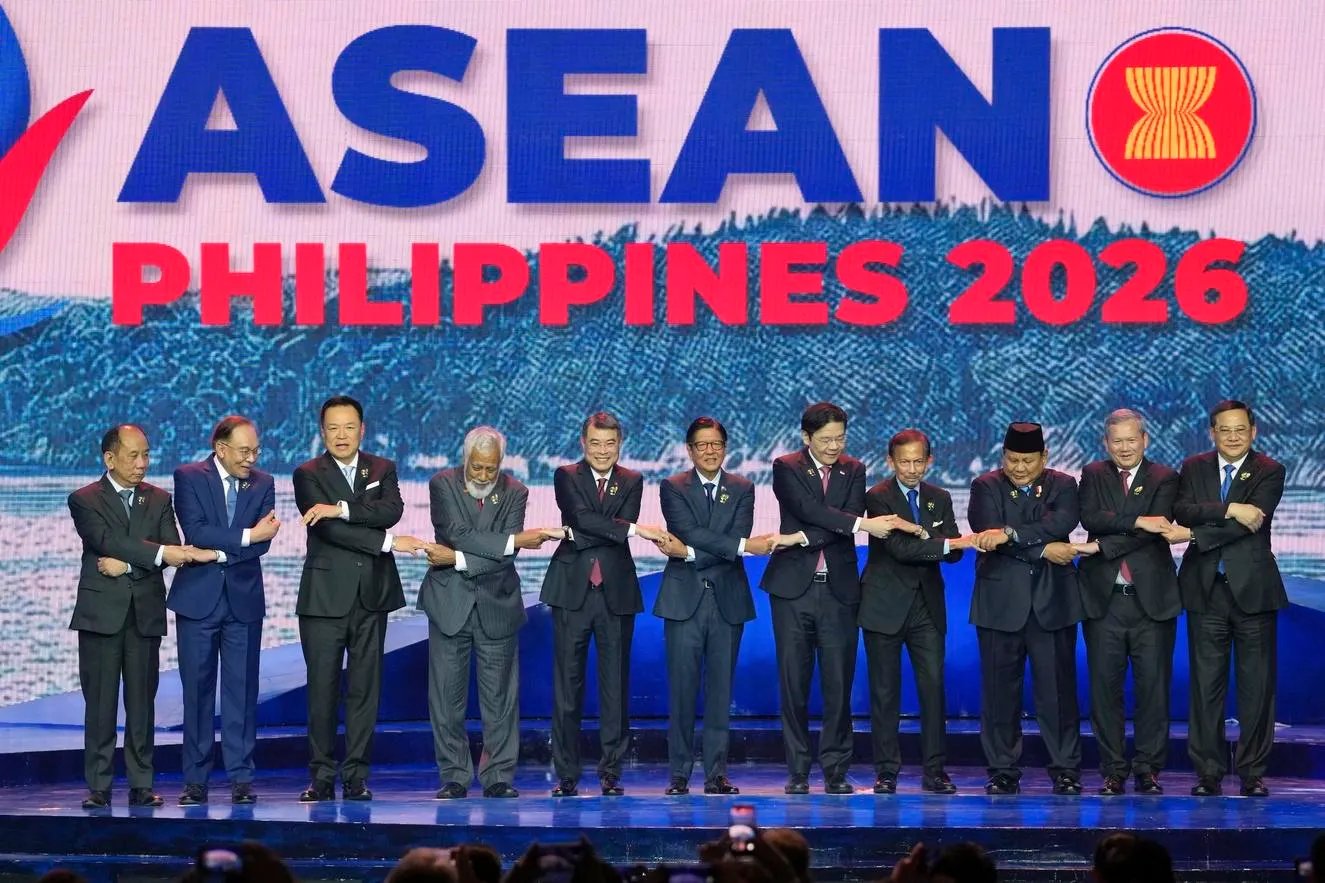
CEBU, PHILIPPINES – MAY 08: (L-R) Myanmar Permanent Secretary of the Ministry of Foreign Affairs U Hau Khan Sum, Malaysian Prime Minister Anwar Ibrahim, Thailand Prime Minister Anutin Charnvirakul, Timor-Leste Prime Minister Xanana Gusmao, Vietnam Prime Minister Le Minh Hung, Philippine President Ferdinand Marcos Jr., Singapore Prime Minister Lawrence Wong, Brunei Sultan Hassanal Bolkiah, Indonesian President Prabowo Subianto, Cambodian Prime Minister Hun Manet, and Laos Prime Minister Sonexay Siphandone pose for a group photo during the opening ceremony of the ASEAN Summit at Mactan Expo on May 08, 2026 in Cebu, Philippines. T(Photo by Aaron Favila – Pool/Getty Images)
Getty Images
The blockade of the Strait of Hormuz has done more than spike LNG prices—it has shattered Southeast Asia’s illusion of energy security. Before the current Gulf conflict, LNG in the region traded at $10–$12 per MMBtu. Today, at $20.80, those costs have effectively doubled, turning a “transition fuel” into a fiscal anchor.
Southeast Asia doesn’t have the luxury to bet its economic future on a 6,000-mile supply chain that passes through a single, 21-mile-wide chokepoint, the Strait of Hormuz. The Iran-related disruptions have turned what was once a sustainability goal into an urgent mechanical priority: if you can’t get the gas or pay the price, the lights go out. To keep electricity humming, governments are “panic buying” green energy—not because they’ve suddenly become climate-conscious, but because a solar panel doesn’t require a naval escort to generate power.
The economic fallout is already quantifiable. The Asian Development Bank recently slashed its regional growth forecast from 5.1% to 4.7%. As energy prices bleed into every sector, the shift toward renewables is maturing into hard-nosed geopolitical hedging—a permanent insurance policy against a world where fossil fuel prices are controlled by missiles and blockades.
“Our fossil fuel model is centralized and very geopolitical; it depends on imports, long supply chains, and a lot of exposure to global shocks. But renewables change that dynamic,” says Brenda Valerio, Philippine Country Director at New Energy Nexus, at this month’s 48th ASEAN Summit held in Cebu, an island in the Philippines.
To understand why Southeast Asia is pivoting, look 3,000 miles north. This shift mirrors what is unfolding across Central Asia, where nations once tethered to Russian-controlled pipelines are now building the infrastructure to say “no” to geopolitical coercion. Using new transit routes like the Middle Corridor—a strategic bypass of Russian territory—these nations are moving from being “price takers” to “policy makers.”
The lesson is directly relevant to ASEAN. In both regions, the goal is the same: replace vulnerable imports with sovereign infrastructure. A national grid is like a massive machine that must spin at a precise frequency. Historically, if a local plant failed or solar output dipped, a country relied on a foreign shock absorber to keep it running. In Central Asia, that meant the Russian grid; in Southeast Asia, it means a constant 6,000-mile umbilical cord of imported LNG.
From Sustainability To Survival
A worker cleans solar panels installed on the roof of the traditional Gedhe market in Klaten, Central Java, June 20, 2024. (Photo by DEVI RAHMAN / AFP) (Photo by DEVI RAHMAN/AFP via Getty Images)
AFP via Getty Images
This creates a dangerous dependency. If you don’t control the forces that stabilize your grid, you aren’t self-reliant—you are renting your national stability. When conflict in the Strait of Hormuz blocks tankers, or a neighbor uses the “off switch” as a diplomatic weapon, your economy is in the hands of outside influences.
Building sovereign infrastructure means replacing that foreign dependency with homegrown intelligence—batteries and software that keep the grid stable without outside help. By pairing battery banks with digital twins—virtual maps that let a country manage its power grid in real time—a nation can anticipate changes in load and inject power from domestic sources in milliseconds.
In the Philippines, the market is already moving faster than the bureaucracy. Weekly inquiries for rooftop solar have surged by more than 500% since the crisis began. This isn’t a climate movement; it’s a cold-eyed cost management strategy. According to the International Renewable Energy Agency, firm solar-plus-storage systems now range from $54 to $82 per megawatt-hour. New coal sits between $70 and $85, while new gas-fired generation can cost more than $100. The economic case is closed.
Yet the transition faces a significant friction point. Putra Adhiguna, Managing Director of the Energy Shift Institute, points to a paradox in Japan’s regional involvement. In Central Asia, Japan has been a forward-leaning partner, pledging over $19 billion to help nations bypass Russian influence through the Middle Corridor. There, Tokyo champions decoupling and sovereign infrastructure.
In Southeast Asia, the strategy runs in reverse. Through its Asia Zero Emission Community initiative, Japan continues to push for LNG agreements to secure its industrial survival. Japanese utilities like JERA and Tokyo Gas are locked into decades-old “take-or-pay” LNG contracts from the U.S. and Australia that they no longer need at home, thanks to Japan’s shrinking population and domestic shift to renewables. To avoid billions in losses, Japan is effectively using Southeast Asia as a captive market for excess supply.
The “choice” for nations like Vietnam and the Philippines is often foisted on them. Japan doesn’t just offer gas; it offers the low-interest infrastructure loans from the Japan Bank for International Cooperation required to build the terminals and power plants in the first place.
A Grid Of Grids
SINGAPORE, SINGAPORE – APRIL 06: A liquefied natural gas (LNG) tanker sails near the Sebarok Island oil storage terminal along the Singapore Strait on April 06, 2026 in Singapore. Singapore is strengthening its long-term energy resilience as the Iran conflict disrupts global supply routes, exposing vulnerabilities in import-dependent economies. (Photo by Ezra Acayan/Getty Images)
Getty Images
But that capital comes with a hidden cost: a decades-long commitment to buy the very LNG Japanese utilities are offloading. If Japan needs all of the LNG, it won’t save its partners—they’ll be tossed into the global spot market, where they lack the financial muscle to compete. In a region where Malaysia’s fuel subsidies have exploded to $819 million a month, Japan’s game plan has become a burden—not an insurance policy or a strategic shield.
The endgame of this crisis will likely be an integrated ASEAN, which is a survival strategy, not a technical goal. Historically, these nations have operated in silos, competing for limited LNG shipments. A unified ASEAN Power Grid flips that script. It allows for resource smoothing: a cloudy day in the Philippines is offset by a windy afternoon in Vietnam, or surplus hydropower from Laos.
By linking their grids, member states can share domestic surpluses in real time. That “ends” the era when every country had to maintain its own massive, fossil-fuel-dependent backup supply.
The first concrete signals are already visible. The Philippines’ 10-year auction plan to procure 25 gigawatts of renewable capacity isn’t just about domestic power—it signals to the region that Manila is ready to act as a major node in a high-tech, integrated market. ASEAN is moving away from being 11 isolated energy islands and toward a single interconnected region. The water between them is no longer a wall; it’s the floor for the infrastructure that lets them share their insurance policy.
“The role of policymakers now is to catch up with these market developments by investing in grid infrastructure, streamlining approvals, enabling storage and flexibility, creating clear long-term investments and signals, which is very commendable for the Philippines for announcing a 10-year auction plan,” says Rex Amancio, with the Global Renewables Alliance, during the summit.
The Hormuz blockade is a stress test, but it is also a catalyst. With power demand from AI infrastructure and electric vehicles rising sharply, the debate is no longer about the validity of renewables. Instead, the focus turns to grid intelligence—the ability to transform a localized crisis into a strategic shield.
