

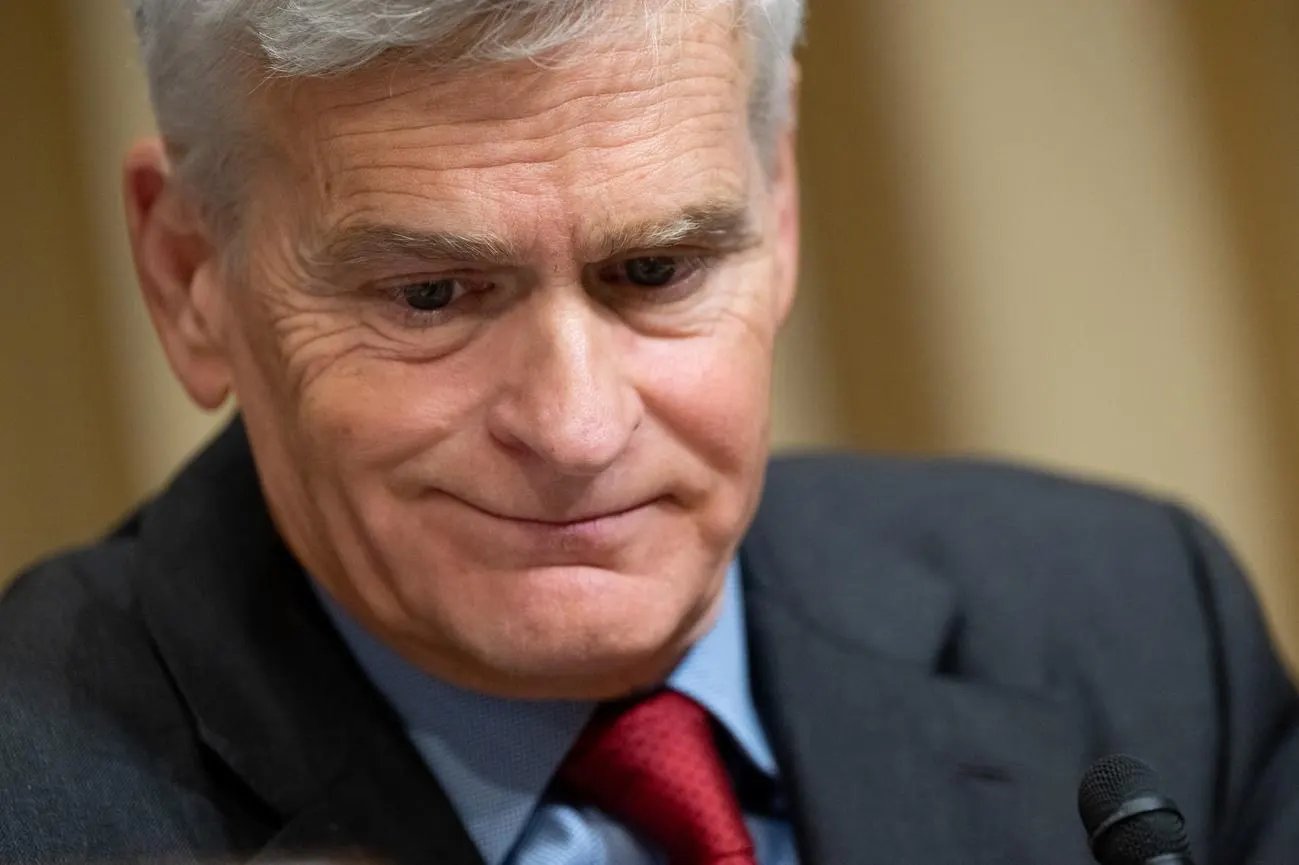
US Senator Bill Cassidy, Republican of Louisiana, attends a US Senate Finance Committee business meeting to consider the nomination of Robert F. Kennedy, Jr. to be Secretary of Health and Human Services, on Capitol Hill in Washington, DC, February 4, 2025. US President Donald Trump’s embattled health secretary pick, vaccine conspiracy theorist Robert F. Kennedy Jr, passed a crucial test in his confirmation bid on Tuesday as senators voted to advance his nomination to the floor. (Photo by SAUL LOEB / AFP) (Photo by SAUL LOEB/AFP via Getty Images)
AFP via Getty Images
Last week, Senator Bill Cassidy (R-Louisiana) lost his Republican primary in his bid to serve a third term in the U.S. Senate.
The defeat carries political consequences for Cassidy. But it also carries a broader lesson about leadership, public health and political risk.
In early 2025, Cassidy, a physician as well as a senator, publicly wrestled with whether to support Robert F. Kennedy Jr.’s nomination to lead the Department of Health and Human Services. He knew that his vote might be enough to reject Kennedy’s nomination. He expressed concerns about Kennedy’s long history of stoking vaccine skepticism and spreading misleading interpretations of medical data.
As a doctor, he understood the stakes better than most members of Congress. But in the end, Cassidy voted to confirm him.
The decision appeared rooted in political survival — an effort to avoid backlash from a Republican base increasingly aligned with Trump and the emerging Make America Healthy Again movement surrounding Kennedy.
It did not work.
Cassidy will now end his final term in the Senate as a lame duck while Kennedy will continue to lead the nation’s most important health agency.
How He Could Have Changed the Story
Most defining moments do not feel historic in the moment. They unfold quietly — in hearing rooms, private conversations, prepared remarks and votes cast under fluorescent lights.
Cassidy could have had such a moment during the confirmation hearings. And he missed it.
He wasn’t simply another senator evaluating a controversial nominee — he was uniquely positioned to understand the stakes. Before entering politics, he had worked as a physician in a public hospital for the uninsured for 30 years. He understood science, vaccines, infectious disease and the fragile relationship between public trust and public health.
In his statement announcing he would support Kennedy’s confirmation, he emphasized the proven safety of vaccines, saying “the science is good, the science is credible. Vaccines save lives. They are safe. They do not cause autism. There are multiple studies that show this. They are a crucial part of our nation’s public health response.”
I had an opportunity to work briefly with Senator Cassidy when he participated in a de Beaumont Foundation-funded focus group designed to develop messaging to encourage more Americans to get vaccinated against COVID-19. It was obvious to everyone that he approached the conversation first as a physician and second as a politician. He spoke with the clarity and seriousness of someone who understood both the science and the responsibility that comes with public trust.
Had he voted no — and explained why as a physician — the country would have witnessed something increasingly rare in American public life: a leader accepting political risk in defense of science, medicine and the public’s health.
A Vote That Legitimized False Narratives
Cassidy could have stood before the nation and declared that his responsibility as a doctor was greater than his responsibility as a senator and that some positions are too important to politicize.
But instead, he gave dangerous public health positions something far more valuable than a Senate vote: institutional legitimacy.
At the time of the confirmation hearings, public trust in science and medicine was already strained after the COVID-19 pandemic. The elevation of figures and movements built around skepticism of vaccines, institutions and public health expertise further normalized distrust at precisely the moment the country needed serious leadership and credible public health communication.
Weaker Public Health Threatens National Security
The United States is again confronting infectious disease threats that should command national attention. Measles cases are resurging. Avian influenza continues to raise concern among global health officials. Recent hantavirus outbreaks and plague cases serve as reminders that ancient pathogens never fully disappear. Ebola outbreaks abroad continue to threaten global stability in an interconnected world.
Americans understandably focus on wars, borders and geopolitical conflict. But history repeatedly reminds us that microbes can destabilize societies just as effectively as missiles.
Public health is national security, public safety and economic prosperity. When we weaken public health, we weaken the nation itself.
A weakened public health system is a threat to workforce productivity, educational continuity, military readiness, economic stability and civic trust. And yet, as the nation moves deeper into another election cycle, health preparedness and public health leadership remain secondary topics in far too many political conversations.
That must change.
We are already seeing signs that voters understand this reality even if political institutions lag behind. Public health issues have moved to the center of civic life. In the Los Angeles mayoral race, homelessness, addiction, mental health and public safety have dominated the conversation. These are public health issues with profound implications for communities and economies.
Putting Public Health In The Forefront
Public health no longer operates quietly in the background of American life. It sits at the center of whether communities feel safe, stable and functional.
Increasingly, candidates who can speak credibly about health, addiction, homelessness, mental illness, preparedness and community well-being are speaking directly to voters’ lived experiences. Candidates who fail to articulate serious public health strategies increasingly risk appearing disconnected from voters’ daily realities.
The candidates who can offer serious, evidence-based plans to address these and other issues may ultimately hold a political advantage over those still trapped in yesterday’s talking points.
And yet debate moderators spend comparatively little time on public health preparedness. Every candidate for major office should be asked basic questions about health, science, and preparedness:
- What is your plan to rebuild trust in public health institutions?
- How will your administration prepare for future infectious disease threats?
- How will you strengthen the public health workforce?
- What metrics will you use to determine whether Americans are becoming healthier?
- What role should science play in policymaking?
Cassidy’s ouster should serve as a cautionary tale for candidates and elected officials. The country needs leaders who are willing to defend science, expertise and public health openly — especially when doing so carries political risk.
