

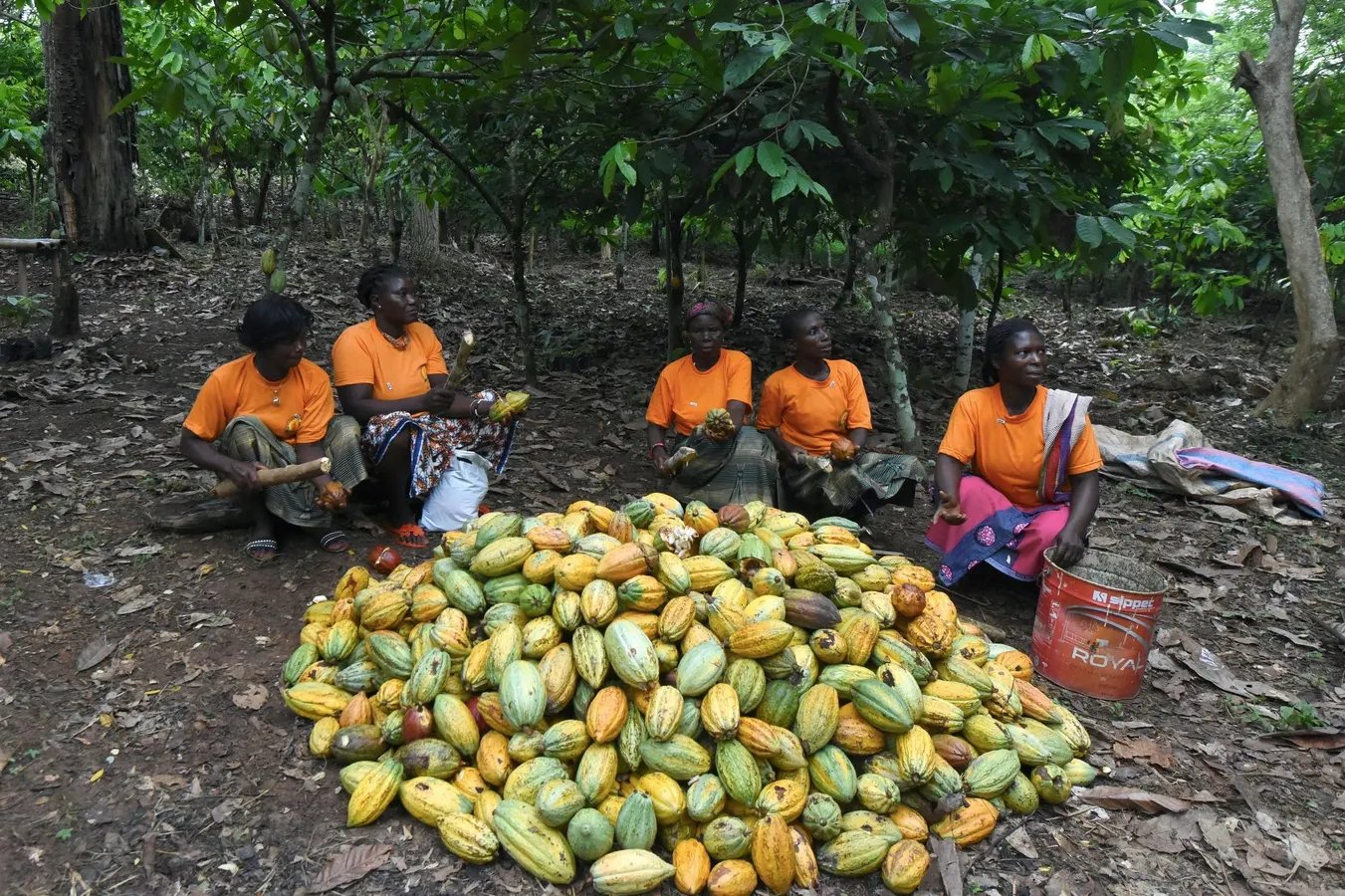
Women members of an agricultural cooperative break cocoa pods on April 17, 2019 in a farm near Adzope, southern Ivory Coast. (Photo by ISSOUF SANOGO / AFP) (Photo credit should read ISSOUF SANOGO/AFP via Getty Images)
AFP via Getty Images
Cocoa production is becoming increasingly volatile, even as the chocolate industry attempts to be more sustainable.
Droughts, unseasonal rains and harsh winds have affected yields across key cocoa growing regions globally in the last few years. While the crop’s prices have eased somewhat from the significant shortages seen in 2024, chocolate prices remain high, reflecting a fundamental strain on the market.
At the same time, chocolate brands are trying to improve transparency by focusing more on sustainability, ethical sourcing and traceability. This is especially as more consumers now care about fairer labour practices and accountability across industries.
This has led to a key mismatch in the global chocolate market, as while sustainability optics improve, core supply chains remain volatile due to climate factors.
Western and central African countries such as Ivory Coast, Ghana, Nigeria and Cameroon could lose up to 50% of land suitable for cocoa farming by 2050 due to climate change, according to a March 2025 study by the Agricultural and Forest Meteorology journal.
As cocoa becomes more vulnerable to weather changes, sustainable chocolate is no longer enough to stabilise and address the root climate problem- resilience must be prioritised instead.
How Climate Pressure Affects Cocoa
Cocoa is one of the world’s most climate-sensitive crops. It can be heavily impacted by irregular rainfall patterns, extreme heat or changing wind conditions.
The crop is mainly grown at commercial scale in developing nations near the equator, known as the “cocoa belt”, like Ivory Coast, Ghana and Ecuador. It requires a very narrow, precise range of conditions, such as steady temperatures between 18-30 degrees celsius, rich soil and evenly-distributed rainfall.
However, several of these regions have experienced more frequent extreme weather episodes in the last few years.
In 2023, Western African cocoa-producing giants like Ivory Coast, Ghana, Nigeria and Cameroon saw very high levels of rainfall and flooding. This led to rotten cocoa pods and widespread outbreaks of diseases like Cocoa Swollen Stem Virus and black pod, because of waterlogging.
On the other hand, in early 2024, extreme droughts worsened by El Niño and unprecedented heatwaves took over in these regions. This caused wilting, stunted crop growth, tree die-back and lower yields, while increasing global cocoa prices even more.
Extreme rain, wildfires and high heat was also seen in Indonesia, Peru and Mexico in late 2024 and 2025, severely impacting major smallholder plantations especially.
Changing weather patterns, especially rising heat, can also impact the small midge pollinators that cocoa trees rely on, which can cause declining pollination and yields.
“For producers, climate change is no longer a future risk; it is directly affecting farmer productivity and livelihoods. Lower harvests and post-harvest challenges make sustainable sourcing more difficult and urgent,” Julia Ocampo, vice president of Cacao Sourcing and Sustainability at Luker Chocolate, said.
This is especially as resilience and the impact of climate change varies across major cocoa regions in Africa and Latin America.
“Where farming systems are better equipped to adapt, production is holding or growing. Where they are not, farmers are more exposed to volatility and loss,” Ocampo added.
How Chocolate Is Becoming More Sustainable
Despite climate woes, several chocolate brands are trying to be more sustainable. One of the biggest ways this is being done is by mapping supply chains from farm to bar to support transparency.
Brands like Barry Callebaut and Cargill employ GPS polygon mapping, which uses satellites to track cocoa bags from individual farms all the way to processing warehouses.
This greatly reduces the chances of “chocolatewashing” or greenwashing within the chocolate industry, by letting brands electronically verify where cocoa was grown and distribute sustainability premiums accordingly.
It also helps ensure that brands only source from suppliers who do not take part in deforestation, by mapping out farm perimeters.
Tony’s Chocolonely is aiming to pay farmers a livable income by attempting to bridge the gap between market prices and the actual Living Income Reference Price.
Similarly, Nestlé has a dedicated Income Accelerator Programme to financially incentivise farmers employing sustainable practices, while encouraging them to keep children in school.
Global chocolate brands are also undertaking independent certification and in-house sustainability schemes. These depend heavily on verified third-party oversight, such as the Rainforest Alliance, to audit supply chains and ensure they meet both environmental and social standards, such as banning child labour and stopping deforestation.
Companies like Mondelēz International, which owns major brands like Cadbury and Toblerone, are improving sustainable packaging initiatives too. This is mainly by phasing out single-use plastics and unnecessary packaging layers, while also including high percentages of recycled plastics and fully recyclable cardboard.
While the above initiatives have gone a long way to improve transparency, pricing fairness and customer satisfaction, they have not been as successful in absorbing the fundamental climate volatility faced by most cocoa farmers.
Where The Current Cocoa Model Cracks Under Climate Stress
While the evolution of sustainable chocolate is a step in the right direction, cocoa farmers, especially smallholders, are still under considerable climate stress, which is not adequately addressed by the current industry model.
This is mainly due to systemic climate degradation consistently being treated as a short-term “bad harvest” problem, rather than a structural economic crisis.
Many sustainability initiatives only address visible issues like deforestation, without recognising them as symptoms of much larger, more deeply embedded systemic issues, such as long-term farmer poverty, climate vulnerability and fundamentally inadequate incentive structures.
Many West African smallholder farmers cannot afford basic inputs and food due to extreme poverty, let alone major sustainability or regenerative agricultural investments like shade trees, irrigation or changing farm locations.
In several cases, certification premiums are often too small to materially combat poverty. As such, farmers may be pushed to clear out significant forest areas for fertile land, simply to survive.
“There is a growing generational challenge. The average age of a cocoa farmer is above 55 years old, so in many cocoa-growing regions, younger generations are reluctant to stay in farming; they view it as physically demanding, low-paying and unattractive,” Ocampo noted.
With younger generations increasingly moving away, skills, knowledge and production all risk declining over time.
For those who can invest in sustainability and benefit from financial incentives, premiums still do not guarantee yield stability or reduce climate shocks and exposure in cases of floods, droughts or crop diseases.
It can also take several years to see results when switching from traditional cocoa farming to sustainable farming, which means that farmers assume a major risk in trying to sustain themselves in the meantime.
“When cocoa prices rise and fall sharply, it becomes harder to plan, manage costs and guarantee consistent products on shelves,” Ocampo said.
As these pressures travel down the supply chain into farming communities, producers can struggle with income uncertainty.
Similarly, while traceability and certifications can help confirm where cocoa beans come from, they often operate on a “mass balance” system. This essentially means that certified cocoa beans are mixed with uncertified ones in the supply chain, especially during shipping and manufacturing.
Usually, companies have to guarantee that the exact volume of sustainably sourced cocoa purchased matches the volume sold in final products. However, this cannot be tracked down to individual bars, which can threaten trust and transparency with customers who believe they are supporting ethical practices with their purchases.
How Global Cocoa Needs To Adapt Now
Around 99.9% of all cocoa comes from countries with low climate readiness, according to data from the UN Food and Agriculture Organisation.
As extreme weather events in key cocoa producing countries become more frequent, the need for climate-resilient farming systems is all the more crucial.
This includes incorporating more agroforestry, by phasing out unshaded monoculture farming. Cacao trees should be planted under the canopy of larger, fruit-bearing native trees. Through this, farmers can encourage more local biodiversity and pollinators, while rebuilding soils and enabling farms to better withstand heat.
Similarly, diversifying crops by intercropping cocoa with other crops like plantains and bananas could go a long way in establishing a second income for farmers and increasing food security in case of harvest failures.
Boosting natural pollination, which in turn can increase yields, is another key factor. This can mainly be done by preserving pollinator habitats. Leaving leaf litter and pod husks on the ground can help the main cocoa pollinators, biting midges, breed. Reducing the use of synthetic insecticides helps prevent beneficial insects from being killed too.
Chocolate companies also need to support cocoa farmers in climate-exposed regions to switch to breeding and planting hybrid cocoa varieties which are more drought-resistant.
Most importantly, true adaptation and resilience in this case means addressing the root cause of farmer poverty by establishing fair and long-term contracts.
These should move beyond unpredictable and short-term premiums and prioritise true collaboration by blending local insight with strategic direction, instead of a largely top-down model.
In the next few decades, cocoa production may also move more towards countries like Cameroon and Nigeria, which are expected to fare a little better than West African countries like Ivory Coast and Ghana in terms of climate change.
As such, a key way chocolate companies can future-proof supply chains is by helping more vulnerable producers move farms now, rather than later. This will also help ensure sustained livelihoods and retain younger farmers.
From Sustainability To Resilience
Accelerating climate change has revealed that chocolate can be ethically sourced, but still deeply structurally vulnerable.
Chocolate companies must move beyond sustainability initiatives which mainly prioritise transparency and ethics to resilience investments which focus on climate survival and agricultural stability.
“In a climate-pressured market, sustainable sourcing is not simply about compliance. It is about building the economic, environmental and social foundations that allow cocoa to thrive for generations,” Ocampo highlighted.
As such, cocoa supply chains must continue to expand, diversify and consistently adapt to climate risk. At the same time, on-ground agricultural reality needs to be central to corporate climate strategy, in order to drive systemic solutions, rather than only better branding.
