

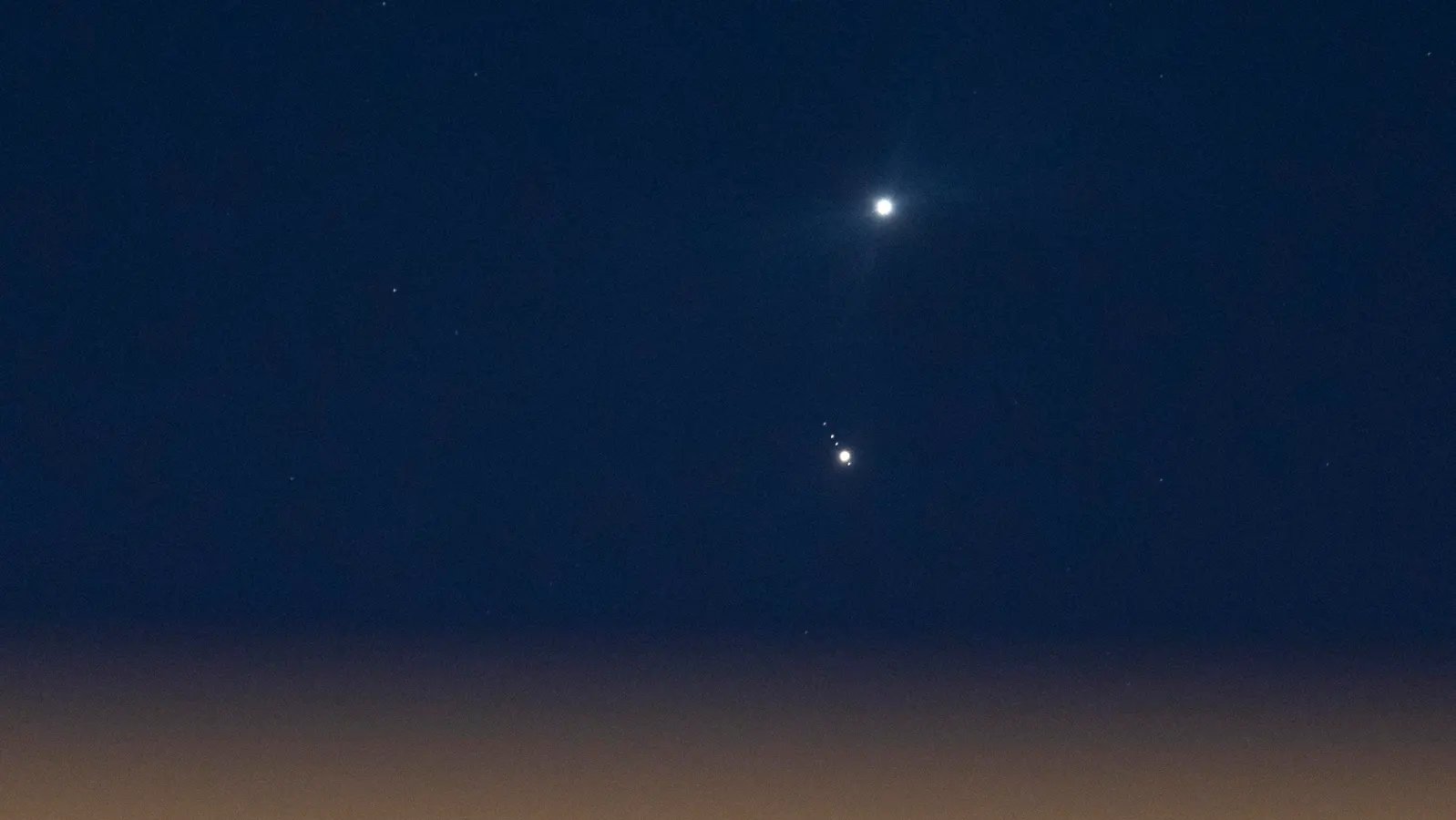
Jupiter and Venus create spectacle view as they appeard extremely close on March 2, 2023 (Photo by Nicolas Economou/NurPhoto via Getty Images)
NurPhoto via Getty Images
What’s that bright star tonight? Anyone glancing toward the western horizon after sunset in late May and early June may notice two unusually bright “stars” shining close together in the twilight. They are not stars at all, but Venus and Jupiter — the two brightest planets in Earth’s night sky — slowly coming together in one of 2026’s most eye-catching celestial events.
The planetary pairing (called a conjunction by astronomers) will peak on the evening of Tuesday, June 9, when the two worlds will appear exceptionally close above the western horizon. Visible without any special equipment, the conjunction is expected to become one of the year’s most photographed skywatching moments — and it’s already begun.
Venus Will Steal The Show
Look west after sunset tonight, and you’ll see one really bright “star” lower down and another, slightly less bright, to its upper left. The latter is Jupiter, the largest planet in the solar system, but it’s the lower Venus that already dominates the view.
During the conjunction on June 9, Venus will be roughly seven times brighter than Jupiter. Why is Venus so bright? Firstly, it’s far closer to Earth than Jupiter (about six times closer, in fact — and currently getting closer each night). Secondly, its dense cloud cover reflects a lot of sunlight.
Throughout the summer, Venus will continue to shine prominently as the “Evening Star,” climbing higher into the twilight sky and reaching its greatest separation from the sunset in mid-August.
Venus and Jupiter in late-May, 45 minutes after sunset.
Stellarium
When To See The Venus-Jupiter Conjunction
You can start watching it right now, roughly 45 minutes to two hours after sunset. Skywatchers should look low in the western sky and choose a location with an unobstructed horizon.
The two planets will gradually get closer each night until June 9, when they will appear only 1.6 degrees apart — about three times the width of a full moon.
The event is entirely a matter of perspective. As Earth moves away from Jupiter — a slow-moving outer planet — the gas giant appears lower in the west each evening and will eventually disappear into the sun’s glare by late July. Meanwhile, the faster-moving inner planet Venus is approaching Earth, making it increasingly prominent after sunset. So the apparent meeting is the result of Venus rising higher in the evening sky while Jupiter gradually slips toward the horizon.
The Sun sets in alignment with Manhattan streets running east-west, also known as Manhattanhenge, in New York City on May 30, 2023. Manhattanhenge occurs about the same two days in May and then again on two days in July every year. (Photo by Ed JONES / AFP) (Photo by ED JONES/AFP via Getty Images)
AFP via Getty Images
What’s Next In The Night Sky
Before the Venus-Jupiter conjunction, there’s a rare Blue Moon, which will be best seen rising at dusk on May 30 — also the night of “Manhattanhenge” at sunset in New York City. After Venus and Jupiter’s tryst, there’s a brief dark-sky window around a New Supermoon — the biggest of the year — on June 15, before the summer solstice on June 21 brings the shortest nights of the year. Another notable planetary conjunction will follow later this year on Nov. 15, when Jupiter and Mars appear close together before sunrise.
Wishing you clear skies and wide eyes.
