

Published May 25, 2026 07:17AM
You use your pelvic floor all day, every day. But you probably don’t spend much time thinking about it, or even know what it is, until something’s not working right, says Sara Reardon, a pelvic floor physical therapist.
The number one misconception about pelvic floor health is that it’s solely a woman’s issue, says Alex Hill, a board-certified pelvic health and oncology physical therapist and spokesperson for the American Physical Therapy Association. But everyone, regardless of sex or gender, has the same pelvic floor muscles. That means women and men can experience pelvic floor dysfunction, she explains. In fact, pelvic floor issues are more common than people realize—especially among men, says Hill, who shares that about half of her patients are men.
A common cause of pelvic floor issues is weakness in this muscle group. Incontinence, erectile ejaculation, and pelvic organ prolapse are some of the signs that your pelvic floor isn’t as strong as it needs to be. While no one wants to deal with these problems, pelvic floor dysfunction is “not something you have to suffer with in silence,” Hill says.
That’s because there are lots of things you can do to bolster your pelvic floor–including simple, at-home exercises. Below, we dig into everything you need to know about this often-overlooked muscle group and the five best beginner-friendly moves to strengthen it.
What Is the Pelvic Floor?
The pelvic floor is a group of muscles that sit at the bottom of your pelvis and support your pelvic organs, Reardon says. For women, this includes the bladder, rectum, ovaries, and uterus. In men, it encompasses the bladder, rectum, and prostate, she says.
In female bodies, the pelvic floor muscles have three openings: one for urine to exit the body; one for bowel movements; and one for vaginal intercourse, vaginal birth, and menstruation, Reardon says. Male bodies have just the first two openings.
As a muscle group, the pelvic floor really does a lot, helping with everything from bladder and bowel function to spinal and core support to sexual function, and reproductive health in women, Reardon says.
How Common Is Pelvic Floor Dysfunction?
We’ll start with a sobering statistic: more than 50 percent of women will experience pelvic floor issues at some point, Reardon says, adding that she believes this number to be “very under-reported.” And research suggests pelvic floor dysfunction impacts 16% of men.
Important callout: a common, long-held narrative with pelvic floor issues is that they’re caused only by weakness in these muscles and that the solution is to do a bunch of kegels, Reardon says. But a lot of people—including women and men—have too much tension in their pelvic floor muscles, she says. That tension can prevent these muscles from functioning optimally across a host of scenarios, including contracting when we cough, sneeze, laugh, run, or jump, and relaxing during intercourse, bowel movements, and childbirth, Reardon says.
That said, in women, it’s more common to have pelvic floor weakness than tightness (though it’s possible to have both issues at once), Reardon says. In men, it tends to be more of a tension issue rather than weakness, Reardon says, though men can absolutely experience weakness, too.
What Causes Pelvic Floor Weakness?
A bunch of factors can contribute to pelvic floor weakness. Here are some of the major culprits.
Working Out and High-Intensity Exercise
High-impact activities like running, jumping, tennis, basketball, and volleyball, Reardon says. Think of your pelvic floor muscles “like a trampoline,” Reardon explains. Every time you run or jump, the muscles sink down to accommodate the pressure. If you apply repetitive pressure to the muscles without training them to withstand it, they can weaken over time, she says.
Resistance Training and Lifting Heavy
The same goes for heavy weightlifting, Reardon adds. Lifting heavy weights without proper posture or breathing patterns can impair the function of your pelvic floor muscles, leading to weakness, she adds.
Health Issues and Aging
Chronic coughing and constipation can play a role, too, she adds, since the straining associated with these activities can gradually weaken the pelvic floor muscles.
Simply getting older can affect the pelvic floor as well. “Pelvic floor muscles are still muscles, so just like any other muscle in the body, they can weaken as we age,” Hill says. Nerve damage and neurologic conditions—such as Parkinson’s, multiple sclerosis, and strokes—can impact pelvic floor strength as well, Hill adds.
Pregnancy and Childbirth
For women specifically, pregnancy and childbirth are two big contributing factors. “Pregnancy itself weakens the pelvic floor,” Reardon says. Certain elements of a vaginal birth, such as pushing for a prolonged period of time, can lead to weakness. “Another one is menopause,” Reardon adds. That’s because estrogen helps keep the pelvic floor muscles in the vagina strong, so when estrogen levels drop due to menopause, women become more at risk of pelvic floor weakness, Reardon says.
Prostate Conditions
For men, pelvic floor weakness can happen after, or become more apparent after, a prostatectomy, which is when the prostate is removed to treat prostate cancer, or with other procedures, such as a transurethral resection of the prostate (aka a TURP, which is used to treat an enlarged prostate), Hill says. These procedures can affect the pelvic floor muscles as well as their nerve supply (meaning how nerves connect to the muscles and help them work), she explains.
What Happens When Your Pelvic Floor Is Weak?
A host of not-so-great things can happen when your pelvic floor muscles are weak. A really common one? Urinary leakage. This could be as small as a little dribble of pee coming out as you cough, or it could be as severe as fully peeing yourself when you’re walking to the bathroom with a full bladder, Reardon says. It could also show up as a little dribble of pee coming out after you already finished urinating, Hill adds. You could also experience fecal leakage or incontinence, Reardon says, which can range from leaking a little bit of poo onto your underwear to totally pooping your pants.
For women, there’s also pelvic organ prolapse, which is when the hammock of muscles can’t quite support the pelvic organs and they start to push into the vaginal walls, Reardon explains. “It feels like something’s heavy or falling out of your vagina,” she says.
For men, pelvic floor weakness can lead to sexual dysfunction, including difficulty maintaining an erection and reduced ejaculatory force, Hill adds.
Do Kegel Exercises Strengthen Your Pelvic Floor?
Yes, and the Kegel is probably the most well-known pelvic floor exercise. To do it, pretend like you’re trying to stop your urine flow. Doing this helps you figure out which muscles you’re targeting. Once you do that, you can contract those muscles and squeeze them briefly, then release them.
While Kegel can boost pelvic floor strength, “a Kegel is not a holy grail of pelvic floor strengthening by any means,” Reardon says. Instead, she recommends the following beginner-friendly exercises.
5 Exercises to Strengthen Your Pelvic Floor
If you have a weak pelvic floor or just want to keep yours strong, incorporating certain exercises into your routine can help strengthen it and possibly alleviate your symptoms.
How to Do This Pelvic Floor Workout
When you’re new to these moves, do them as a standalone routine or as part of a warm-up to your main workout, Reardon advises. Once you feel more confident with the engagement, breathwork, and posture, fold them into your regular strength-training routine, she adds.
Start with a single set of ten reps, then gradually work your way up to three sets of ten reps, Reardon advises. Once that feels easy, add weights or a resistance band to the movements to increase the intensity, she says. The ultimate goal is to add enough load that you finish a set of ten feeling like you’re close to failure (meaning, you couldn’t manage more than another rep or two)
A few other tips to keep in mind as you do the moves below:
- Keep your spine in a neutral position. Basically, don’t arch or round your back as you do the exercises. A neutral spine is “optimal for pelvic floor engagement,” Reardon says.
- Breathe steadily, making sure you exhale through the exercises. This one’s key, since holding your breath can prevent your pelvic floor muscles from contracting properly and can also place unnecessary pressure on the muscles, Reardon says.
- After you’re done, spend a few minutes relaxing your pelvic floor. This will help release muscle tension so the area doesn’t become overly tight. A few minutes of deep breathing and a couple of yoga stretches (like child’s pose or happy baby, for example) can do the trick, Reardon says.
What Does “Contract Your Pelvic Floor” Mean?
You’ll see the term “contract your pelvic floor” in this workout routine. If you’re not sure how to do that, Reardon suggests imagining you’re holding in urine and a fart, or sucking up a smoothie with your vagina. This will help engage both the front and back of the muscle group, so they work together. (If you don’t have a vagina, focus on the first two cues.)
Once you build up endurance in your pelvic floor, hold the contractions for several reps of the exercise, rather than relaxing it between each rep, as directed below. Just make sure you don’t hold the contraction all the time—it’s important to regularly release tension in your pelvic floor so that the muscles don’t tense up and cause a host of other issues.
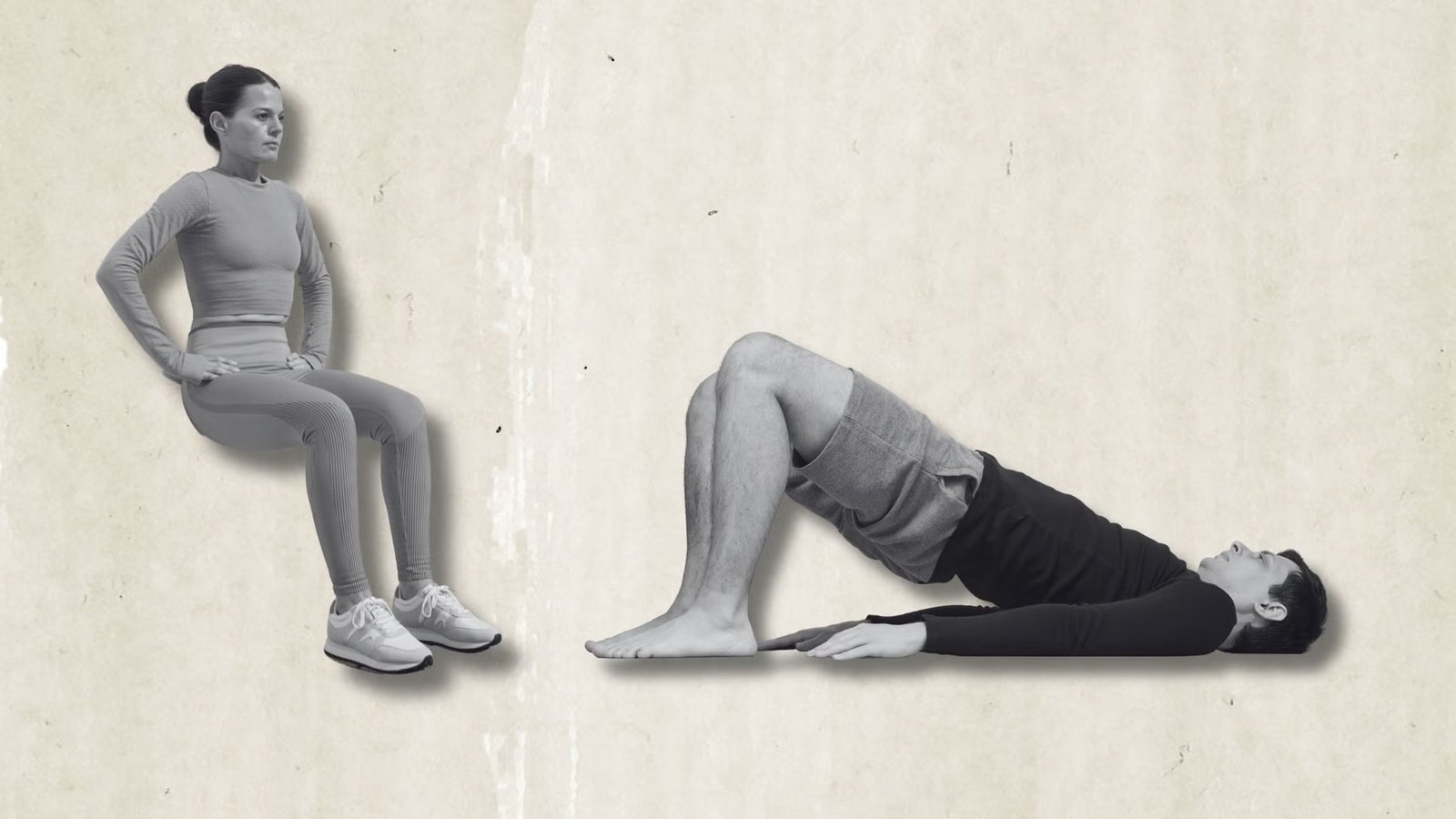
1. Glute Bridge
- Lie on your back with knees bent and feet pressed firmly into the floor, about hip-distance apart. Rest your arms by your sides with your spine in a neutral position. This is the starting position.
- Contract your pelvic floor as you drive your feet into the ground, squeeze your glutes, and lift your hips straight up. Pause at the top for a moment.
- Slowly lower back down to the starting position. Release the pelvic floor contraction. This is one rep.
- Do ten reps.
2. Inner Thigh Ball Squeeze
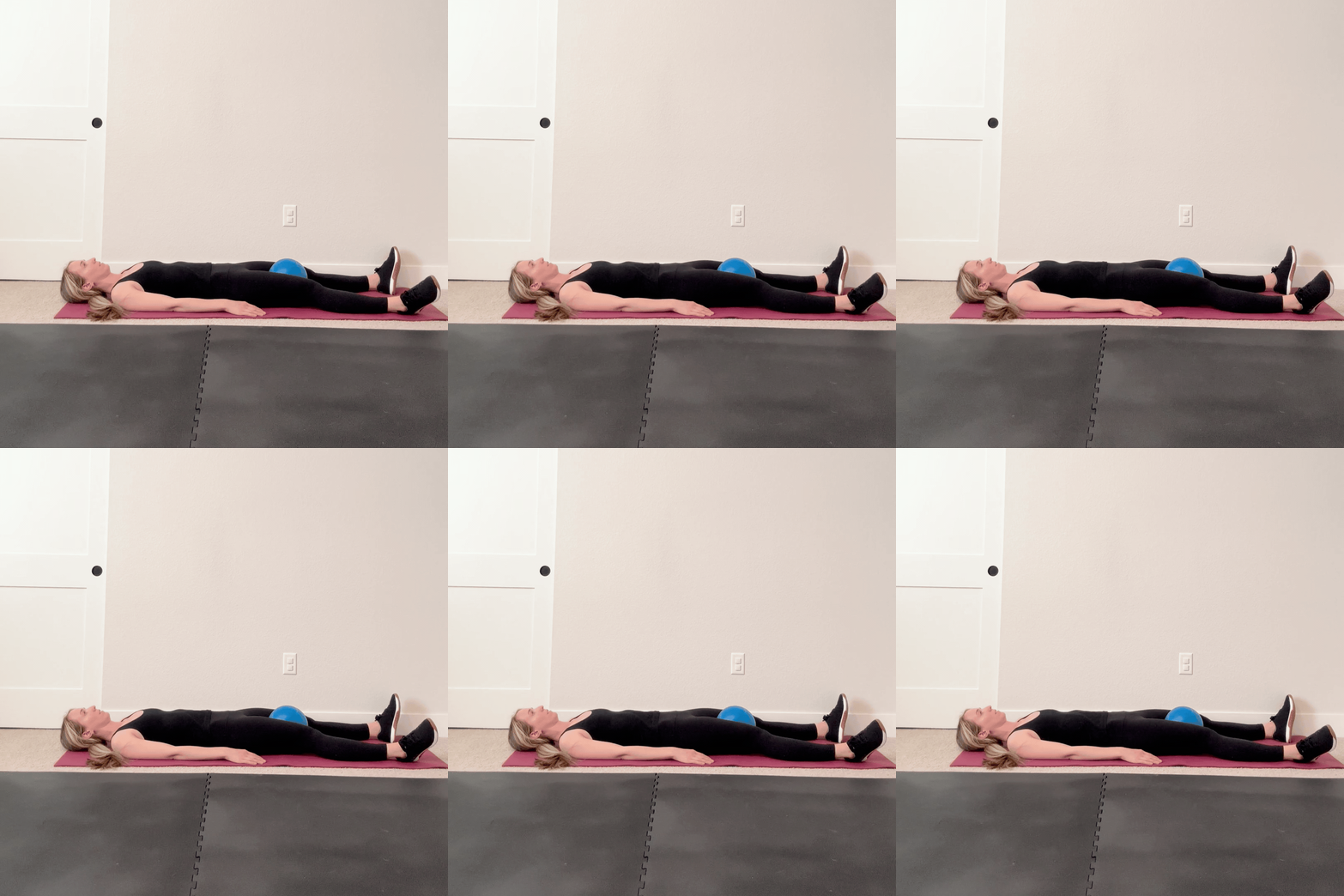
- Lie on your back and place a small stability ball between your thighs.
- Gently squeeze the ball as you contract your pelvic floor. Hold for a few seconds, then release. This is one rep.
- Do ten reps.
3. Wall Sit
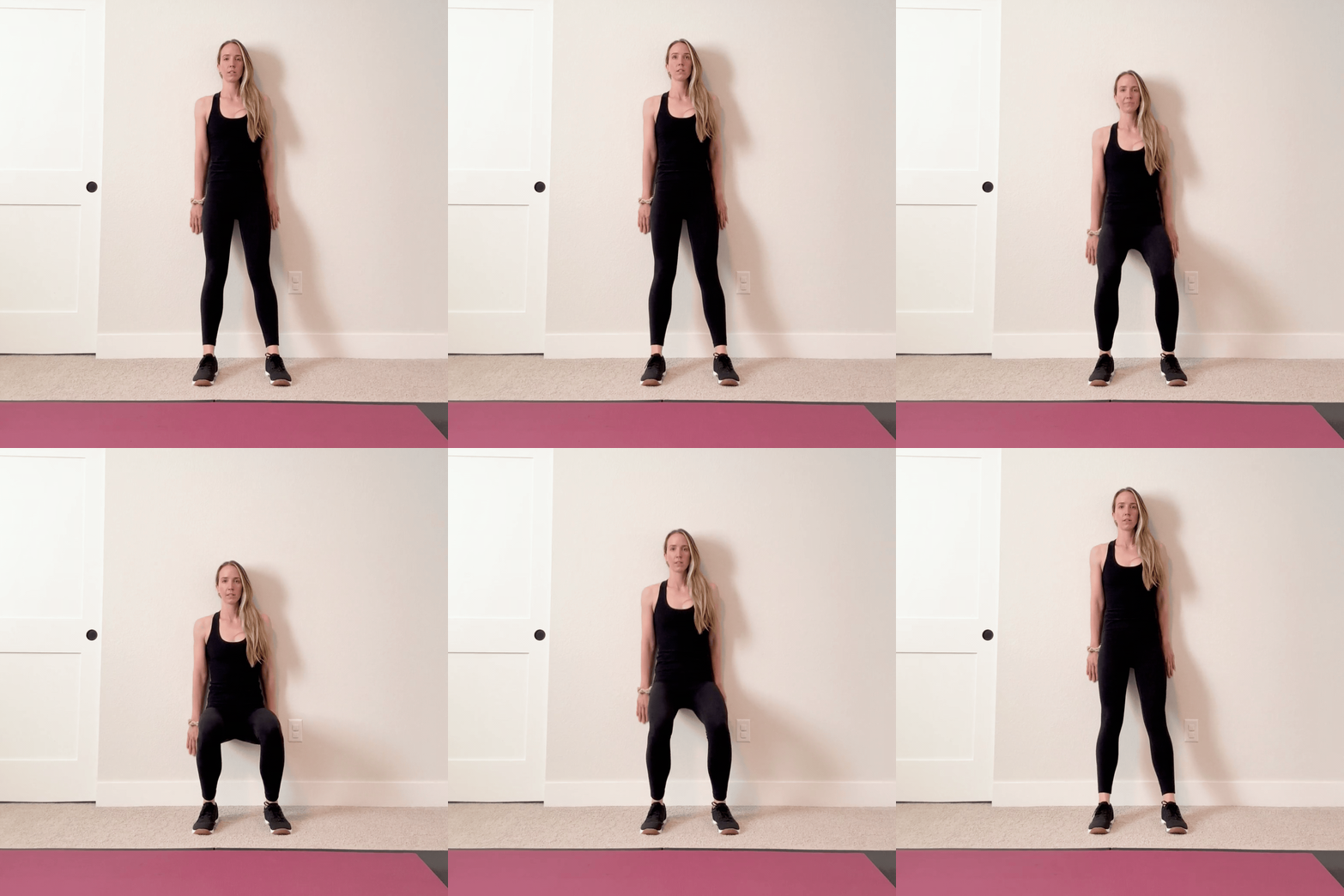
- Stand with your back against a wall, arms resting by your sides, and feet hip-distance apart, toes facing forward.
- Keeping a neutral spine, contract your pelvic floor and slide down the wall by bending your knees to 90 degrees as if you’re sitting in a chair. Hold for a few seconds, then slide back up to standing against the wall and release the contraction. This is one rep.
- Do ten reps.
4. Quadruped Hover with Ball Squeeze
- Start on all fours with wrists under shoulders and knees under hips. Place a small stability ball between your knees. This is the starting position.
- Gently squeeze the ball and contract your pelvic floor as you lift your knees a few inches off the ground. Hold for a few seconds, and then release the pelvic floor contraction and ball squeeze as you return to the starting position. This is one rep.
- Do ten reps.
5. Modified Side Plank Clamshell
- Lie on your side with your forearm on the ground, elbow directly underneath your shoulder. Stack your hips, knees, and feet, and bend your knees so that your feet are pointing behind you. This is the starting position.
- Press your bottom knee into the ground and keep your feet stacked as you lift your hips up.
- Contract your pelvic floor as you raise your top knee straight up.
- Pause for a moment, then reverse the movement to return to the starting position.
- Release the pelvic floor contraction and return to the ground. This is one rep.
- Do ten reps.
- Switch sides and repeat.
When Should You Get Your Pelvic Floor Checked Out By a Doctor?
If you’re experiencing any of the pelvic floor issues described above, your best bet is to see a pelvic floor physical therapist or other healthcare provider, Hill says. “Everybody’s case is so unique, and there are so many different layers as to what could be going on,” she explains, so getting a full in-person assessment and treatment plan tailored to you is really the ideal.
You can search for qualified PTs near you by entering your zip code and the specialty (for example: men’s pelvic health) on the website ChoosePT.com, Hill says. You can also reach out to your primary care doctor for recommendations.
Want more Outside health stories? Sign up for the Bodywork newsletter.
