

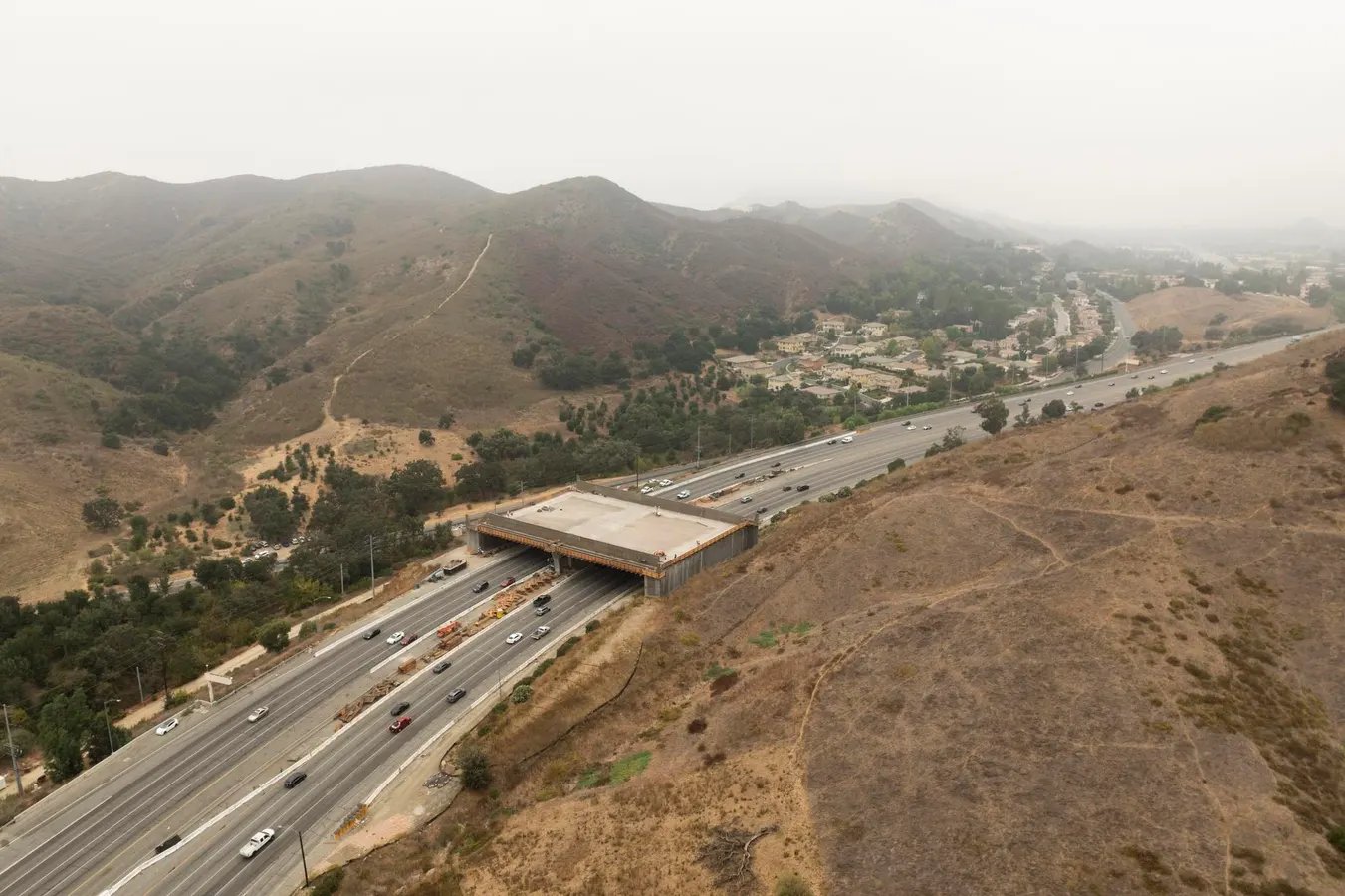
In California, construction is nearing completion on the Wallis Annenberg Wildlife Crossing over the 101 Freeway in Agoura Hills.
Copyright 2024 The Associated Press. All rights reserved
Drivers in Colorado, Oregon, Utah and Virginia will be safer due to new laws enacted to create more wildlife road crossings that will reduce animal collisions with vehicles.
State Farm’s currently estimates that 1.7 million auto insurance claims were filed in the U.S. from July 1, 2024 to June 30, 2025 due to vehicle collisions with from animals. Crashes with deer are linked to more than 1.1 million of those claims.
The company noted the states with the most motorists colliding with wildlife were:
- West Virginia (1 in 40),
- Montana (1 in 53)
- Wisconsin (1 in 58),
- Michigan (1 in 61), and
- Pennsylvania (1 in 62).
To protect both drivers and wildlife, many states will have new laws on the books that will provide key revenue to pay for wildlife corridors. These crossings are important when species as small as tiny salamanders to large elk and moose migrate.
States are getting creative in devising how the money will be collected either through taxation or voluntary donations by state residents.
Oregon Rolling Out “1.25% for Wildlife” Hotel Tax
Bighorn ram near Imnaha, Oregon.
getty
Starting June 5, Oregon will have a dedicated revenue stream for wildlife using a 1.25% increase in the state transient lodging tax dedicated for wildlife.
Gov. Tina Kotek enacted House Bill 4134 on April 9 during the 2026 regular session of the state legislature. The new tax will rise from 1.5% to 2.75%.
Shortly after the legislation was signed, National Wildlife Federation heralded the bill as a model for other states. Karla Raettig, chief advocacy officer, noted in a press statement, “This is a decisive victory for wildlife and a landmark moment for conservation. Oregon Gov. Tina Kotek has demonstrated extraordinary leadership to preserve and protect the wildlife and habitat that define Oregon.” The bill had strong bipartisan support.
Connecting habitats both on the ground and in water is important for the survival of a variety of wildlife species.
“Connectivity is species-specific,” noted the Oregon State Wildlife Action Plan for 2026. “Species with low mobility are at extreme risk of impacts from habitat fragmentation, as they may lack the ability to move away from disturbance. More mobile species may be better able to adapt to habitat fragmentation by dispersing into suitable habitat elsewhere. However, as a result of this greater mobility, these species may also be more likely to come into conflict with humans and human-caused barriers like development and roadways.”
Virginia to Provide Wildlife Corridor Grant
A white tail deer waits to cross a road.
getty
Virginia Gov. Abigail Spanberger on April 13 enacted House Bill 597 establishing a Wildlife Corridor Grant Fund. Starting July 1, the state Treasury will have a fund earmarked for projects, such as new infrastructure, that improve wildlife corridors.
The grant will be administered by the state Department of Wildlife Resources and added to the state’s list for voluntary contributions from tax refunds. In addition, the Department of Motor Vehicles will work to ensure residents know they can contribute to the fund when they make electronic transactions like vehicle registrations.
Funds from the grant will support the state’s Wildlife Corridor Action Plan, developed to protect habitat corridors where animals travel and lower collisions between wildlife and vehicles.
“More than 60,000 known deer-vehicle collisions have occurred annually in Virginia since 2015, costing the Commonwealth and its citizens approximately $533 million each year,” according to the Wildlife Corridor Action Plan.
Environment Virginia issued a public statement of thanks to Spanberger, legislative sponsor Delegate Shelly Simonds and members of the Virginia General Assembly who supported passage of the bill.
“Wildlife crossings are a common sense way to improve habitat connectivity and protect people on the road,” the group stated. “We are thrilled that Virginia is advancing wildlife connectivity and the protection of animals and people on our roads.”
Utah Establishing Special Account for Wildlife Connectivity
Also effective July 1 is a new law in Utah to create a Wildlife Crossing Account in the Transportation Investment Fund. Money will be provided from there for wildlife connectivity and livestock protection projects. The fund will receive $2 million annually.
Gov. Spencer J. Cox on March 18 signed a wildlife crossing amendment in H.B. 431. The new law will also establish “an earmark for sales and use tax revenue to be deposited into the account.” Another feature of the law is to enable residents to make voluntary donations when they register a vehicle and also when taking out hunting and other licenses.
Funds will pay for wildlife crossing and connectivity projects such as:
- Wildlife overpasses and underpasses,
- Directional fencing and escape ramps,
- Associated habitat-connectivity mitigation structures and technology (wildlife-friendly fencing, cattle guards, and fence modifications to facilitate wildlife movements and reduce wildlife-vehicle collisions),
- Fencing, cattle guards and other infrastructure to promote traffic and safety,
- Culvert replacements and modifications that improve aquatic species and fish passages as well as connect streams,
- Wildlife-movement and habitat-connectivity planning (i.e., mapping, research, monitoring, and statewide connectivity analyses).
The Pew Charitable Trusts lauded this successful legislation. It noted that Utah’s traffic has doubled during the last two decades. More traffic has resulted in some 7,000 deer-vehicle collisions each year.
“This dedicated investment ensures that crossings are built strategically and efficiently, protecting drivers, conserving mule deer and other wildlife, and strengthening the resilience of the state’s iconic migration corridors,” noted Nic Callero announced. He is an expert on government wildlife habitat and biodiversity policies at Pew.
“Just as important, a reliable funding source allows Utah to accelerate life‑saving projects, reduce long‑term costs, and build a strong foundation to attract additional federal funding and partnerships that will expand these benefits for communities and wildlife across the state,” Callero said.
Colorado to Offer Residents Voluntary Collision Prevention Fee
A Colorado Department of Transportation employee reviews remote camera video taken inside a wildlife crossing along U.S. 285 near Buena Vista.
The Washington Post via Getty Images
Next Jan. 1, Colorado will enable its residents to make donations to wildlife projects during motor vehicle registrations with an optional collision prevention fee.
Gov. Jared Polis enacted Senate Bill 26-141 on May 27 to set an initial $5 that can be adjusted higher due to inflation at the start of fiscal year 2030.
Revenue from 75% of the fee will go toward the collision prevention fund including:
- Paying for one or more wildlife safe passage projects that reduce wildlife-vehicle collisions through better habitat connectivity in wildlife road crossings,
- Matching money required in federal grants for wildlife passage safety projects.
Environment Colorado issued a statement approving Colorado’s new law for protecting migrating herds and improving roadway safety. It noted that the use of wildlife overpasses, underpasses and fencing allow animals like elk, deer and moose to “safely cross busy highways to reach critical seasonal habitats. When combined with fencing, wildlife crossings reduce wildlife-vehicle collisions by up to 90%. The legislation protects critical migration corridors and surrounding lands, ensuring animals can roam freely for years to come.”
New wildlife corridors will especially help struggling herd populations like the Western Slope mule deer, the organization added.
Support Increasing for Wildlife Crossings
Wildlife warning sign to motorists traveling through a U.S. forest highway.
getty
These examples of successful legislation to provide money for wildlife crossings indicate growing support throughout the nation for such safety measures.
According to Pew, “Each prevented wildlife–vehicle collision can save thousands of dollars—more than $19,000 per deer crash, $73,000 per elk, and $110,000 per moose—in vehicle, injury, and wildlife costs, making well-placed crossings a strong investment.”
The benefits of funding wildlife crossings are numerous. More good news is that the U.S. House of Representatives’ Committee on Transportation and Infrastructure recently included federal funds for wildlife crossings in the BUILD America 250 Act. The past federal funding for wildlife crossings was set to expire in a pilot project. If the legislation succeeds in its current state, the federal government would allocate the proposed $80 million annually during fiscal years 2027 through 2031 for wildlife crossings.
