


Published June 3, 2026 06:54AM
In 1992, two physiologists published a paper in the prestigious journal Nature predicting that the gap between men’s and women’s running performances would continue to narrow and eventually disappear entirely. Women would make the rapidest progress in longer events, they predicted: based on previous trends, the best male and female marathoners would be equal in… 1998.
It didn’t happen. There’s now considerable evidence that sex differences in physiology give male athletes all but insurmountable advantages in strength, speed, and endurance over their female counterparts in the most common athletic events. But the idea that women might have a relative edge over really long distances has persisted. And it resurfaces every time a phenomenal female athlete bests her male rivals, as ultrarunner Rachel Entrekin recently did at the Cocodona 250-mile race in Arizona—a phenomenon that seems to be happening more and more frequently.
Why Women Might Have an Edge
There have been numerous theories advanced for why women might be better—or at least narrow the gap—over long distances. It might be physiological: for example, they tend to burn more fat and less carbohydrate than men, which makes them less likely to run out of fuel prematurely. They also have a greater proportion of slow-twitch rather than fast-twitch muscle fibers, which are more resistant to fatigue. Or it might be psychological: the longer the race, the less raw physiology matters and the more mental toughness comes into play—which at the very least levels the playing field, or perhaps even gives women an edge.
Now, a new paper in the Scandinavian Journal of Medicine & Science in Sports offers another possibility: perhaps women have better fatigue resistance than men.
Fatigue resistance is a relatively new idea that has emerged as one of the hottest topics in endurance science over the past five years or so. The traditional view is that you can predict a runner’s endurance performance by heading to the lab and measuring their VO2 max, running economy, and lactate threshold. But these tests are done when the runner is fresh. If you were to test them again after an hour or two of running, all three measures would have worsened. And the change is significantly bigger in some runners than others. A mounting body of evidence suggests that one of the keys to elite endurance performance is having good fatigue resistance—that is, not just having a high VO2 max and so on in the lab, but keeping them high as you fatigue.
There are two subcomponents of fatigue resistance. “Physiological resilience” refers to how much your underlying physiology—things like VO2 max—changes with fatigue. “Durability” refers to how much your actual performance capacity changes: how fast you can sprint a mile when you’re fresh versus after a few hours of running, say. Scientists are still trying to figure out exactly how two traits are related.
What the New Study Shows
Researchers at the University of Innsbruck in Austria recruited 11 female and 11 male trail runners, all experienced and highly trained. The groups were carefully selected to have similar performance levels relative to their sex—that is, the men were faster on average than the women, but tended to place at a similar level in their respective race divisions. That’s a somewhat tricky point that we’ll come back to.
The main performance test consisted of three sets of a 60-minute run at a predetermined moderate intensity, followed by a 12-minute all-out uphill time trial at a 12 percent grade, for a total running time of 3 hours and 36 minutes. Throughout the run, a series of measurements were taken: oxygen consumption, lactate levels, biomechanical analysis, and more. The goal was to figure out how these various parameters changed over time, and whether there were any differences between men and women.
There are a whole bunch of outcomes to look at, but the most significant is also the simplest: how fast were the runners able to go in the three 12-minute uphill time trials, compared to when they did the same test in an unfatigued state? Here’s the data, showing percent slowdown after one, two, and three hours of moderate running, with females in red and males in blue:
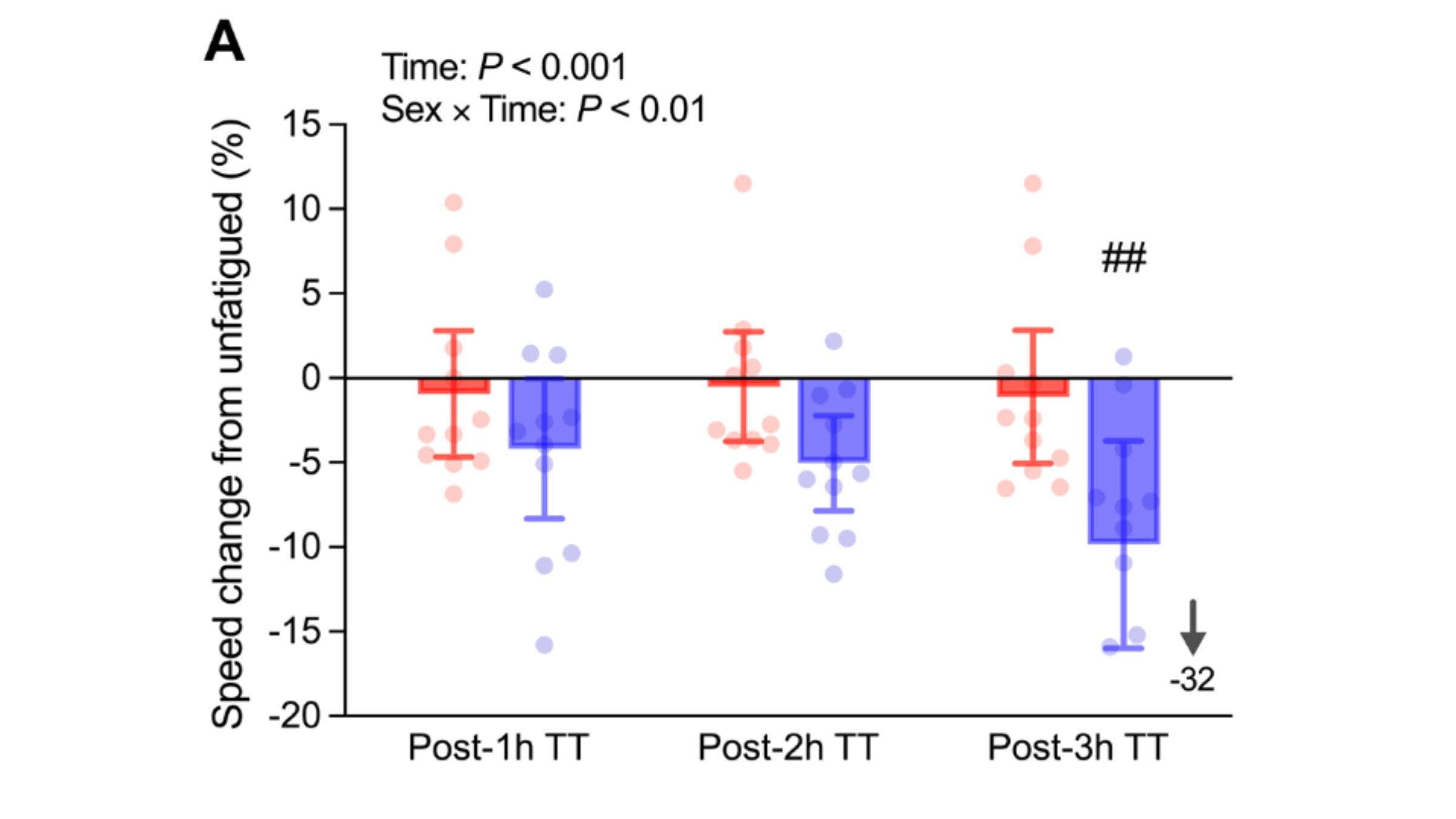
The differences here are pretty stark. Women demonstrate far better durability: they hardly slow down at all in the uphill time trials, while men get progressively slower. In the final time trial, men are ten percent slower on average, while women are only one percent slower.
It’s less clear why the women do so much better—or, to put it in the scientific jargon, what aspects of physiological resilience enable the superior durability. Tests of maximum leg strength declined by 18 percent in the men but didn’t change in the women, which fits with previous research showing less muscular fatigue in women. Carb-burning declined steeply in men compared to a much more gentle decline in women. There were also differences in heart rate and perceived effort.
The Apples-to-Apples Problem
The simplest interpretation of all this data would be that women are “better” at fat-burning than men, perhaps in part because of their greater reliance on slow-twitch muscles. This means they have less reliance on carbohydrates, which means their muscles don’t get as depleted, which means they’re able to maintain their unfatigued performance levels for longer.
In support of this view, here’s the data showing carb-burning (“CHO oxidation”) over the course of three hours of moderate running, with men in blue and women in red:
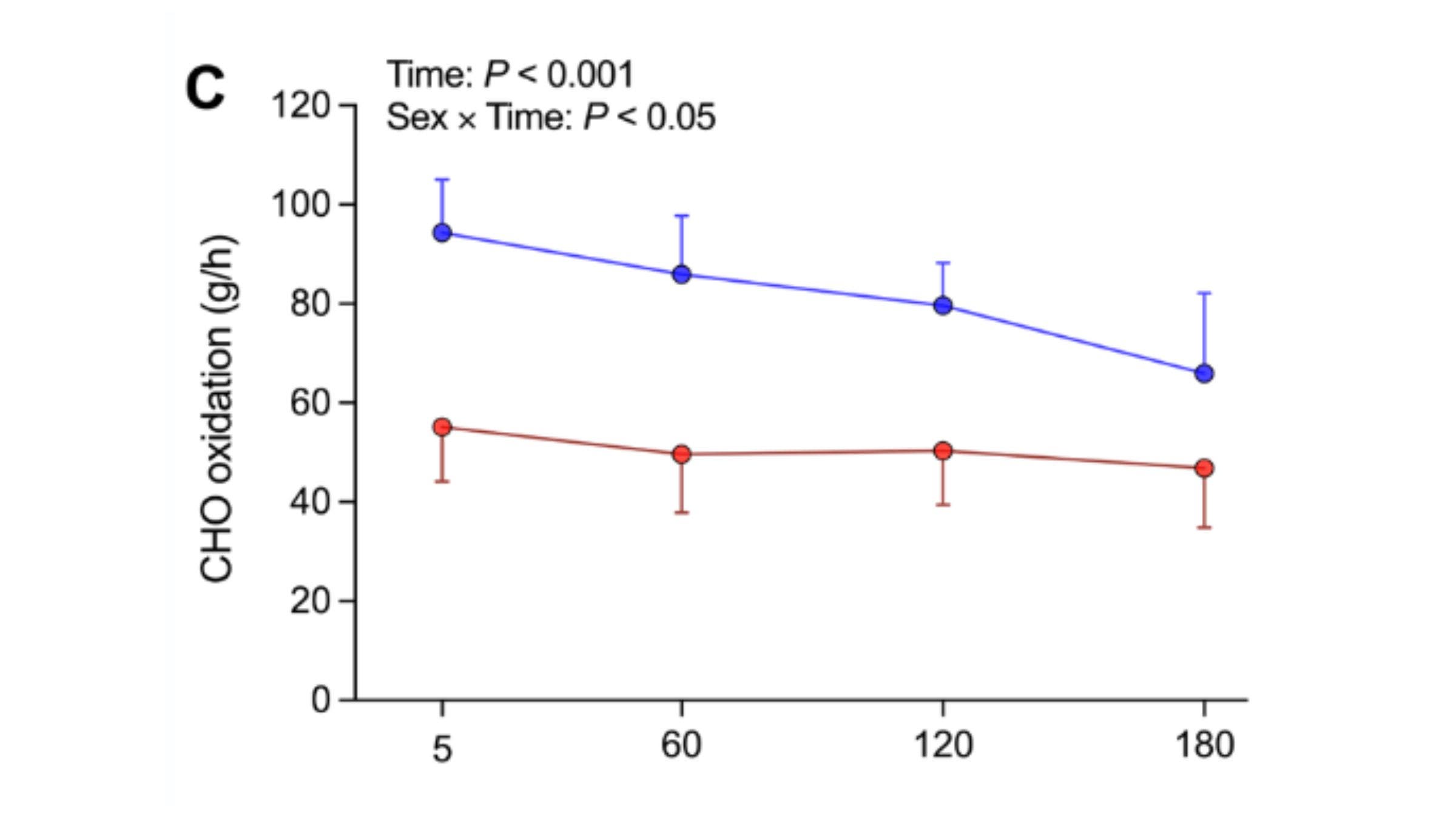
Men indeed start with much higher levels of carbohydrate burning, but it declines steadily, while women are able to maintain nearly the same levels throughout.
But there’s an unanswered question here because of the way the two groups are being compared. The pace of the moderate run was pegged a bit below lactate threshold. But if men and women are different, perhaps an arbitrary percentage of lactate threshold elicits different responses. For example, here are the ratings of perceived exertion (RPE) for the two groups:
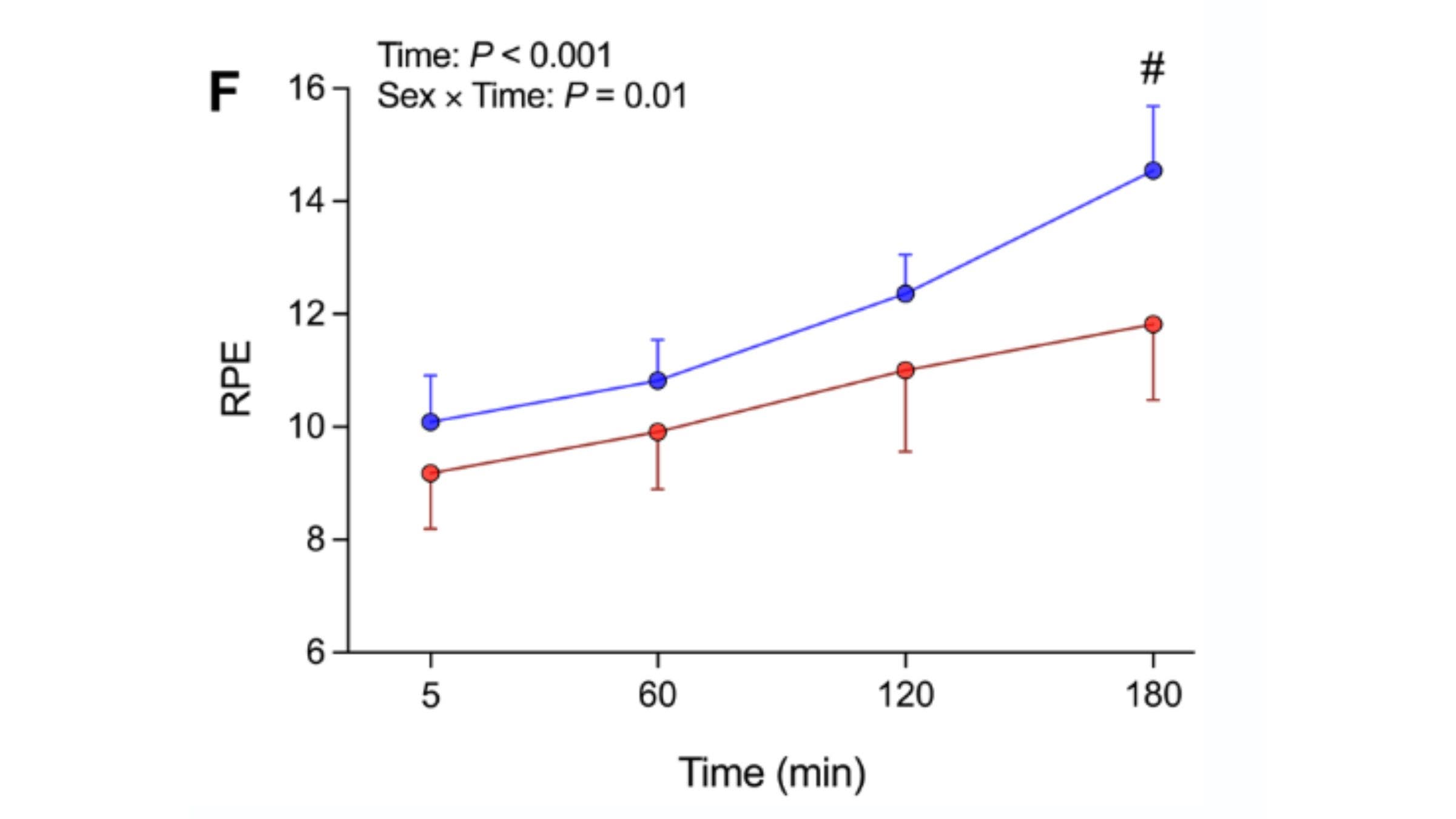
Right from the start, the men perceived the running pace as harder, and the gap then widens as the run progresses. But what would have happened if they had started at an identical perceived effort? Or at a pace that elicited identical levels of carb and fat burning?
In practice, it’s impossible to set up a genuine apples-to-apples comparison when you’re comparing apples and oranges. Perhaps most significantly, because the amount of time spent running was equalized, the men ran farther, covering a total of 26.5 miles compared to 22.1 for the women. If the cumulative impact of feet slamming into the ground is part of what creates muscular fatigue, it’s perhaps not surprising that men exhibited a greater decline. But if you set up the experiment with equal distances, the women would end up running longer. There’s no perfect solution.
Despite these caveats, the observed sex differences in fatigue resistance are interesting, and fit with the idea that female physiology is well-suited to long distances. But personally, if I had to guess why runners like Entrekin, Courtney Dauwalter, and Jasmin Paris have put up such amazing performances in recent years, I wouldn’t attribute it to this quirk of physiology. In general, studies have found that it’s very hard to predict ultrarunning success based on lab tests. Every race at every distance tests both body and mind, but the balance shifts toward the latter as the distance gets longer. If traits like mental toughness are amorphous and hard to measure in the lab, making it dangerous to jump to premature conclusions about who “should” win an ultra—well, I’d call that a feature of the sport, not a bug.
For more Sweat Science, sign up for the email newsletter and check out my new book The Explorer’s Gene: Why We Seek Big Challenges, New Flavors, and the Blank Spots on the Map.
