

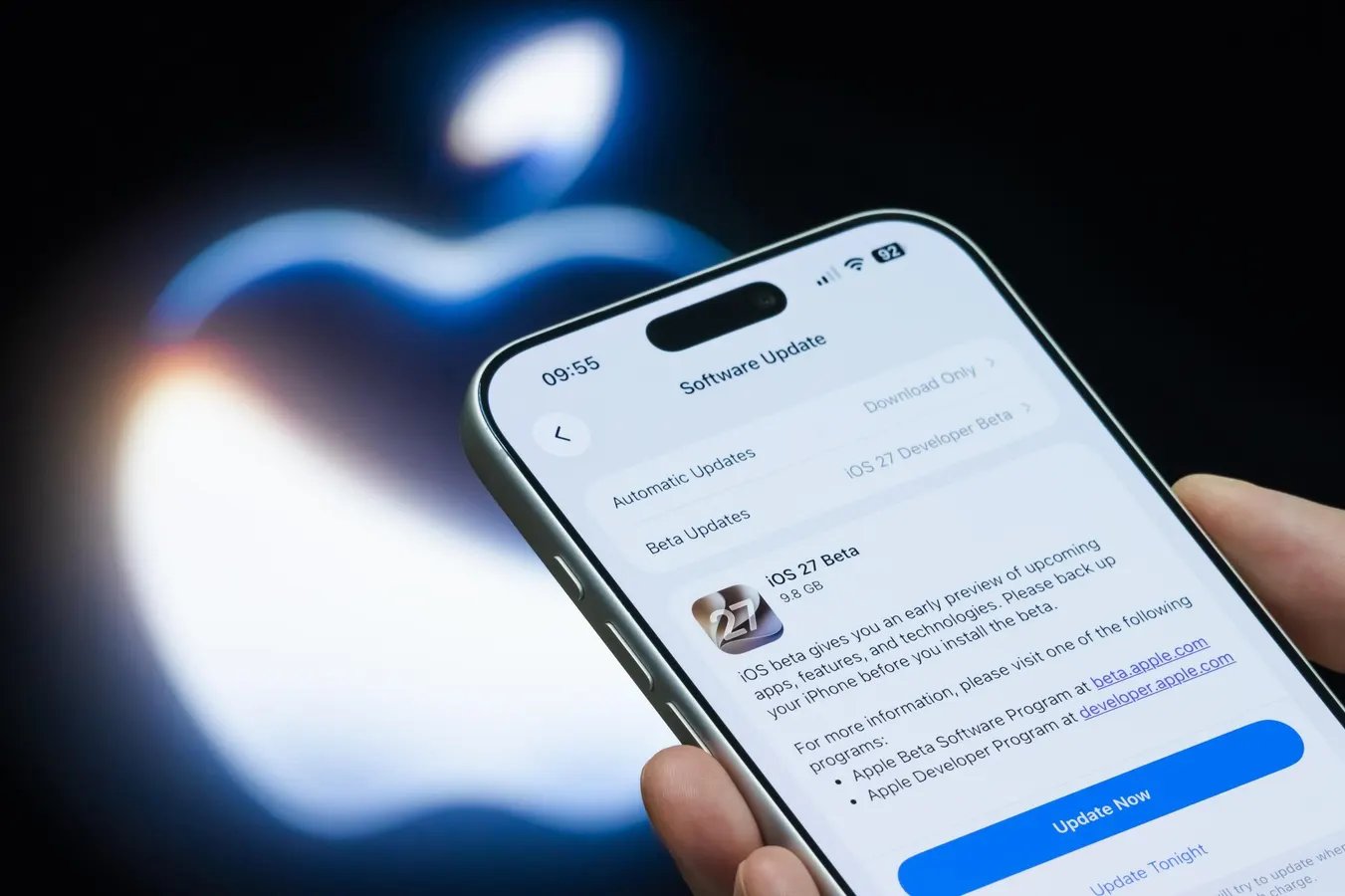
SHENZHEN, CHINA – JUNE 9: In this photo illustration, a smartphone displaying the Apple iOS 27 logo is seen in front of an illuminated Apple logo on June 9, 2026 in Shenzhen, Guangdong Province, China. Apple unveiled iOS 27 during its Worldwide Developers Conference (WWDC) 2026, introducing updates focused on Apple Intelligence, enhancements to Siri, redesigned system apps and user interface improvements across the iPhone ecosystem. (Photo illustration by Cheng Xin/Getty Images)
Getty Images
For years, Siri lived in the awkward middle distance of modern computing. It could set timers, place calls, start playlists, read texts and occasionally misunderstand a word so badly that it was instant comedy gold. Then ChatGPT arrived, Gemini matured, we became friends with Claude on a first-name basis,Copilot moved into work software, Alexa got a generative AI rebuild and the voice assistant category seemed to disappear from the main stage of technology. Where voice assistants used to be the whole conversation pre-LLM AI hype cycle, now it is a demoted and often ignored corner of the tech ecosystem.
At this week’s WWDC 2026, Apple tried to reverse that demotion. The company introduced Siri AI, a rebuilt version of Siri powered by the next generation of Apple Intelligence. Apple says the new assistant can understand personal context from messages, email, photos, and apps, answer questions based on what is on screen, take actions in apps, search the web for current answers and continue conversations inside a new dedicated Siri app. The features are available for developer testing now and are slated to reach users in beta later this year, first in English.
Craig Federighi, Apple’s senior vice president of Software Engineering, shared the announcement as a move from command syntax to personal utility. “With access to broad world knowledge for up-to-date answers on virtually any topic, along with onscreen awareness and personal context understanding, Siri AI can help users take action across apps more naturally than ever,” he said in Apple’s release.
The Assistant Wars Have Changed Shape
For Apple, Siri was never intended to be just a voice product. It was supposed to be a conductor in front of Apple’s orchestra of apps, services, sensors, and devices. However, pre-LLM and advanced AI models, the problem was that the conductor could often hear the audience, but not read the score.
The first voice assistant boom was built around the novel idea that we could speak to an otherwise interface-less product that could do our verbal bidding. Often called smart speakers, these voice assistants would use a “wake word” to active and perform activities. Tech companies practically gave them away in order to expand market share and reach people where web and mobile traffic had already been saturated. In this race, Amazon’s Alexa owned the kitchen counter, Google’s Assistant owned quick facts, Microsoft’s Cortana tried to own productivity before it tapped out and Samsung’s Bixby became a press release punchline. As part of this race, Siri owned the iPhone by default.
The market’s promise was ambient computing, but the daily reality was that these assistants performed mundane tasks. These smart speakers became timers, weather announcers, music streaming players, light and alarm interfaces and on-demand joke and fart machines.
Then Generative AI came and shook up the markets. Users stopped using assistants to answer questions such as “What’s the capital of Norway?” and started judging them by whether they could perform more complex activities such as booking reservations and trips. But without the interactive prompt-based interface that conversational LLMs proved to be powerful, the voice assistants seemed highly limited. Customers didn’t want just question-and-answer interfaces, but they wanted AI systems that could actually do stuff.
Google has been explicit about this pivot. At I/O 2026, it described Gemini 3.5 Flash as a model aimed at action and long-horizon agentic tasks, with the ability to plan, build, and iterate through more complex work. Microsoft has taken the workplace road, selling Copilot Voice as a natural, multilingual way to interact with an AI assistant through devices and software. OpenAI, meanwhile, helped reset consumer expectations for voice through Advanced Voice Mode, real-time conversation, and more natural speech in ChatGPT.
Now with voice mode on practically every LLM, and with voice-focused apps that let you interact with any AI system you want, voice assistants seem to be a quaint point-in-time solution to a problem that has found a better approach. Given the shifting market, is there even a place for voice assistants?
Amazon may be the cleanest comparison for Apple. Alexa+ was introduced in 2025 as a generative AI version of Alexa that could converse, organize, summarize, make reservations, manage smart homes, and help users get things done. Amazon then extended Alexa+ to the browser, pitching it as a cross-device assistant that combines information with real-world actions and carries context from one interface to another. The new market battlefield is showing that the device doesn’t matter much anymore. Voice is part of the AI experience, not just text-based chat.
What Apple Adds To The Picture
Siri AI is still primarily focused on the Apple environment and as such lives where Apple already has the richest map of a user’s digital life: iPhone, iPad, Mac, Apple Watch, Vision Pro, AirPods, CarPlay, Mail, Messages, Photos, Calendar, Notes, Maps, Safari, Spotlight and the system UI itself. Apple says Siri AI can search personal messages, emails, photos, and third-party apps that integrate with Spotlight. It can answer questions about screen content, draft an email, edit and share a group of photos, and turn a potluck text into a recipe note. So this is less about voice assistants and more about an LLM trained on Apple’s specific ecosystem.
This is still impactful. Old assistants were often trapped by app interfaces. They could launch an app or perform a narrow command, but they rarely understood details in the apps themselves or the messy work that happens between apps. Siri AI is evolving from its conductor role to more like an air traffic controller for personal computing. It sees the flight plan, the weather, the crowded runway and the passenger’s calendar.
Voice assistants have typically been ephemeral, with each conversation its own unique experience. You asked, they answered, and on the next interaction it’s as if the previous didn’t happen. Apple says the Siri app will let users revisit conversation history through iCloud and continue chats from Mac to iPhone, iPad, Apple Watch, or Vision Pro.
Privacy Issues Still Complicate the Voice Assistant Picture
The privacy angle has always been an issue with voice assistants. Amazon paid a $25 million civil penalty in 2023 after the FTC and DOJ said the company kept children’s Alexa voice recordings indefinitely by default and retained some data even after parents requested deletion. In 2018, an Echo device in Portland recorded a private household conversation and sent it to a contact, an incident Amazon attributed to an unusual chain of mistaken voice commands. Broader concerns over voice assistants as in-house “snoops” have caused many people to turn them off, unplug them and put them in a cabinet where they no longer provide any value.
While a phone-based assistant can’t be unplugged and put in a closet, that existing history of assistant misbehavior can cause users to disable an intrusive Siri. This poses challenges for Apple. To be useful, Siri must know more, but to be trusted, it must expose less. A personal assistant that cannot touch personal data is a toy. A personal assistant that touches everything without restraint is a liability.
Apple is trying to square that circle with on-device models and Private Cloud Compute. The company says Apple Intelligence can handle many requests locally, then send more complex work to Private Cloud Compute in a way that does not store personal data or make it available to Apple.
Are Voice Assistants Back Or Is Are LLMs In the Driver’s Seat?
When they were still a novelty, voice assistants were useful, unintrusive, and often comical, but rarely magical. Once LLMs captured public attention, the old assistants looked even smaller, like switchboard operators in an age of aircraft control towers. In the world of always-on agentic AI, the role for a sometimes-on voice assistant seems narrower. However, in a world where LLMs still are challenged by access to personal data, voice or chat assistants that make the phone, car, watch, earbuds, laptop, and home feel less like separate machines can carve a unique space in the market.
For Apple, the timing is uncomfortable but useful. The company took criticism for moving slower than rivals in generative AI. Yet late entrances can work when the distribution layer is already in place. Apple does not need to persuade users to install a new assistant. But it does need to persuade them that the old one has learned new tricks.
