

As Gamuda marks its 50th anniversary, its rise in the Forbes World’s Best Employers 2025 ranking proves a simple conviction: enduring infrastructure comes to life as much through people as through cement and machines.
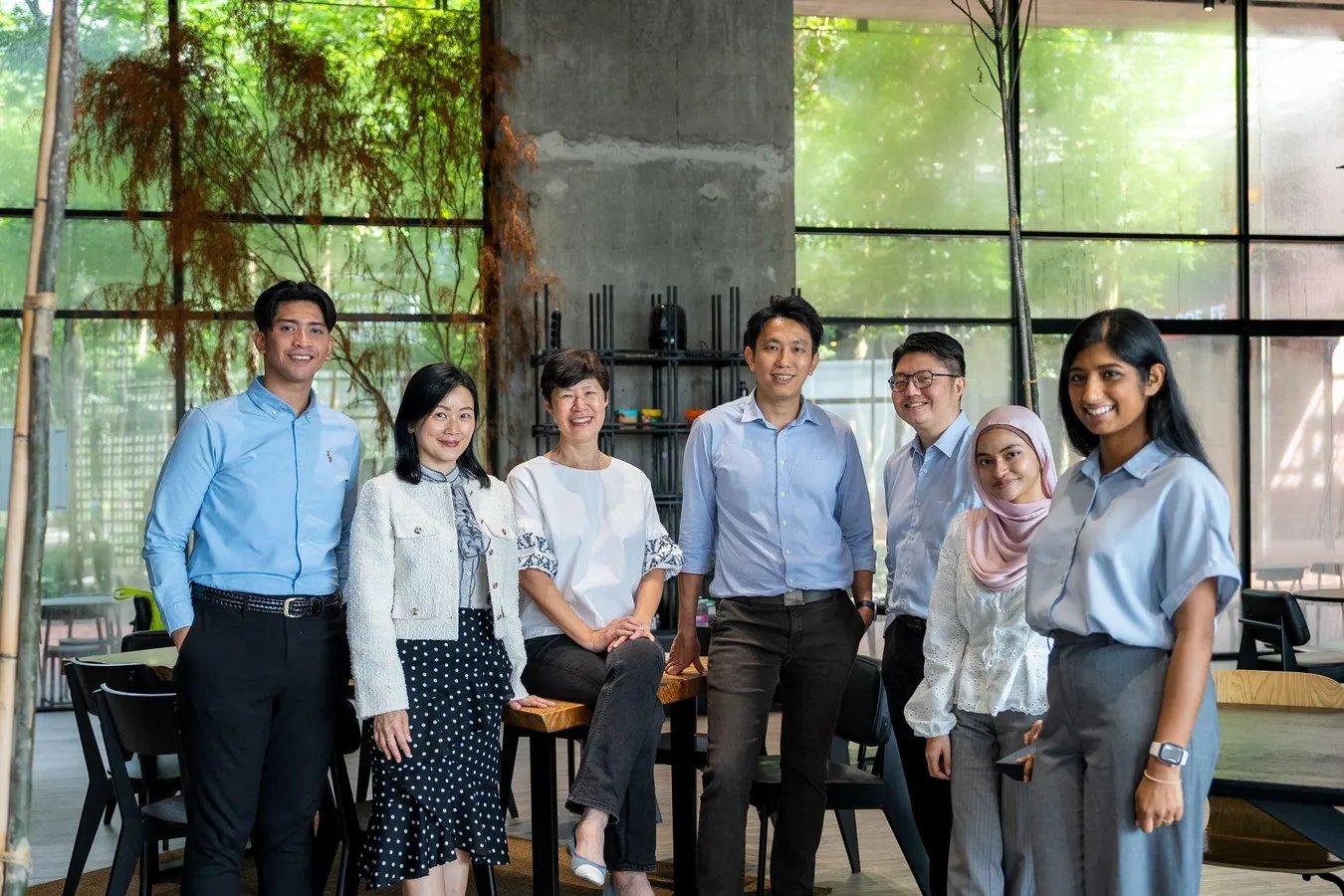
Across regional project sites and offices, Gamuda’s teams operate in diverse environments shaped by different markets, regulations and communities. This breadth of experience reflects the group’s emphasis on building capability through exposure, collaboration and shared expertise shaped by continuity, as (second and third from left) Jo-Ann Low, Group Head of HR and Administration, carries forward a strong legacy of people-first culture and talent development from her predecessor, Wong Lye Ling.
Gamuda
In an industry defined by complex timelines and heavy materials, Gamuda’s results reflect the initiative of its people as much as the technology it deploys.
That emphasis on developing talent has tangible outcomes. Gamuda climbed 152 places in the Forbes World’s Best Employers 2025 ranking from the previous year—a shift attributed to a decade-long investment in its 6,700-strong workforce.
“In recent years, we’ve shifted from being a local player to a regional multinational,” says Jo-Ann Low, Group Head of HR and Administration. “Our focus has been on ensuring our talent is as future-proof as the cities we build.”
At the core of the strategy lies a simple truth: employees stay where they see a credible path ahead, with expanding responsibility and global exposure alongside the company’s growth.
This principle finds its most concrete expression in how the company approaches learning.
Shaping Careers, Sustaining Talent
In an industry where turnover is often treated as inevitable, Gamuda’s attrition rate of 10% remains well below the Malaysian industry average of 12%. The company attributes the gap to a simple idea: people stay where they are growing. Growth means continuous learning, new responsibilities and expanding opportunities.
The commitment to learning begins early, with a scholarship pipeline bringing in young talent. Development continues throughout their careers, with digital resources and in-house training designed for complex projects.
Gamuda distinguishes itself by integrating growth directly into everyday performance. Digital proficiency and AI adoption are formally measured as part of the annual review, accounting for 50% of the performance criteria to cultivate a robust digital culture and mindset.
“The core mandate is AI for all,” explains Low. “Through our vision of the ‘AI-Assisted Gamudian,’ we see a future where AI handles the volume and humans apply the judgment.”
The vision is about freeing employees from repetitive tasks so that they can focus on higher-value work and drive efficiency. Yet in a business defined by decades-long projects, staying relevant requires more than continuous learning alone. At Gamuda, relevance is built collectively, across teams as well as individuals.
Low’s focus on future-ready talent, digital adoption and structured career development supports the group’s growth as a regional multinational.
Gamuda
Three Generations, One Journey
If learning drives the company forward, generational equilibrium ensures the company stays grounded.
Gamuda structures its workforce to balance risk, memory and innovation. About a quarter are under 30 years old, 60% are between 30 and 50, and roughly one in seven is over 50. Veteran engineers are paired with high-potential younger leaders, creating an ecosystem where new ideas are explored under seasoned guidance.
As Low puts it: “We value the experience of the past to anchor the innovations of the future.”
Building Careers Without Borders
As Gamuda expanded internationally, overseas assignments were used to transfer expertise and stretch employees. Over 190 employees have taken postings in Australia, Singapore, Taiwan, Vietnam and the U.K., not merely to fill roles but to navigate unfamiliar conditions.
At the same time, the company prioritizes local hiring to build in-market capability, ensuring teams combine global expertise with deep local knowledge.
Gamuda’s footprint in Australia has seen exponential growth from just 60 employees five years ago to over 2,000 today. Meanwhile, the Vietnam team has expanded by 44% in the same period.
“Australia represents Gamuda’s largest overseas workforce and with subsidiaries delivering infrastructure, tunneling and property development. As we continue to expand, ensuring our people remain connected across these entities is critical,” says Leon Izmiritlian, Executive General Manager of People and Operational Services at Gamuda’s Australian subsidiary, DT Infrastructure. “Our priority is ensuring teams have the right structure and systems in place so they can share expertise and solve challenges promptly, ensuring we remain ready for the next opportunities as we scale.”
(fourth from left) Izmiritlian’s people-focused perspective is crucial in supporting teams operating across varied project demands and environments. As Gamuda advances major rail and renewable energy projects in Australia, his role supports teams working across an increasingly broad project mix.
Gamuda
The aim is never about duplicating headquarters’ methods but empowering employees to adapt solutions to each new context.
“Vietnam holds the group’s largest overseas property portfolio. As a foreign developer, our success isn’t just built on concrete, it’s built on how effectively we navigate local norms and bridge cultures,” explains Le Thi Hoai An, Gamuda Land Vietnam’s Manager of Human Resources and Administration. “Engineering expertise is important, but equally important is our commitment to listening, understanding local expectations and aligning with partners and regulators. This cultural discipline is what allows us to sustain our position among the leading developers in Vietnam and across the region.”
Le Thi Hoai An brings a people-centric lens to growth, focusing on how teams build trust and navigate complexity in dynamic environments. With Gamuda Land recognized among the top foreign real estate developers and multiple award-winning developments, her approach is key to sustaining performance in a fast-evolving market.
Gamuda
Rather than exporting a rigid template, Gamuda selects secondees for skill and adaptability. As Low explains, the most effective approach is to send individuals with technical expertise and the mindset to lead in unfamiliar environments. “We look for people who can navigate local norms, stakeholder expectations and governance frameworks while learning along the way,” she says.
The flow of expertise is reciprocal. Employees returning from project sites and mature markets bring operational insights and digital practices that are woven back into the organization. For Gamuda, staff mobility is a proving ground, not a perk.
