

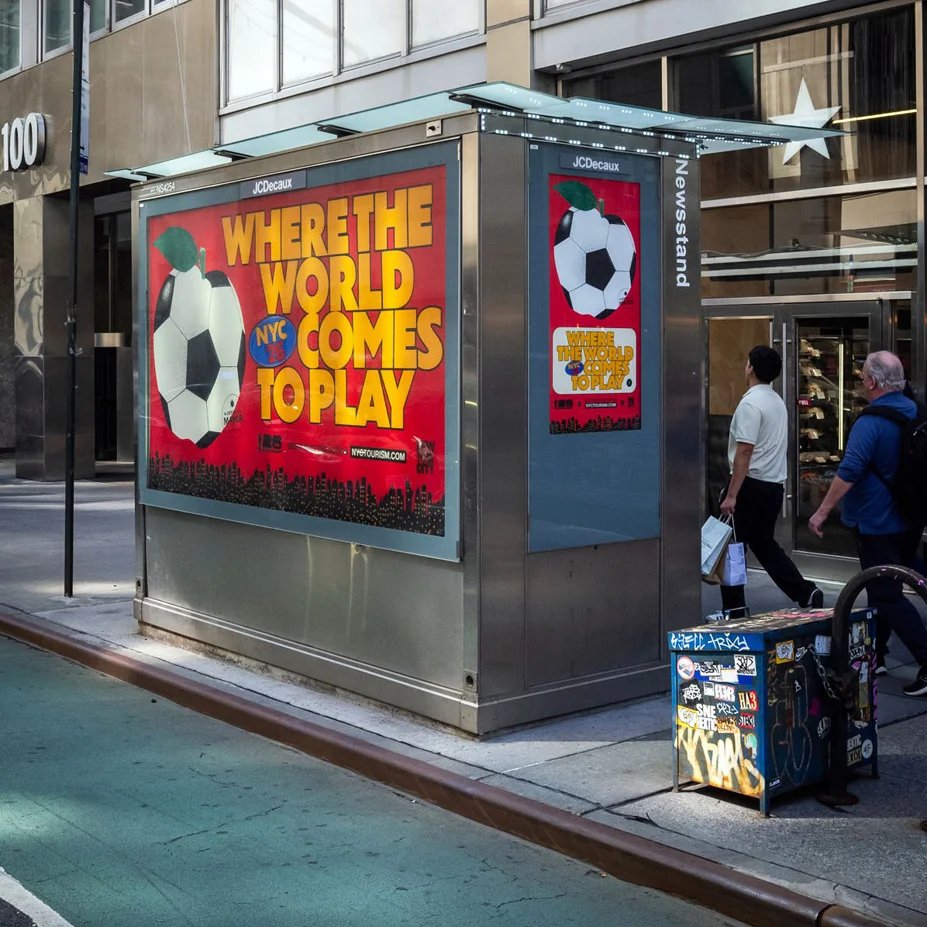
How do you build excitement among 8.5 million New Yorkers (and 1.2 million tourists) for the World Cup? You start with deep research on the city’s beloved colors and symbols and then turn that into something like the joyful, nostalgic, and vividly hued bus shelter posters, subway signs, souvenir cups, and jerseys the 34-year-old creative director Arsh Raziuddin designed for the citywide tourism campaign that the Mayor’s Office launched this week.
“There’s an energy that we wanted to capture and I think it’s matching New York as of right now in a way that feels really nice,” she says.
Since running for mayor of New York City, Zohran Mamdani has become a design icon for breaking the rules of political aesthetics, from his campaign poster and branding inspired by Bollywood posters and MetroCards to his charming and affable videos. Now that he’s in office, he’s applying his refreshing approach to visual communication on an even grander scale. The World Cup campaign is his biggest yet. What’s notable about the strategy is how it applies all the feel-good parts of sports fandom to New York itself.
While mega-events like the Olympics and the World Cup are touted as major economic drivers for host cities, the reality is usually more modest. Instead of benefiting FIFA or being in service of this summer’s tournament, the campaign—and the initiatives related to it, like free public watch parties, partnerships with family-owned restaurants, and public space improvements— advances the administration’s desire to make New York more inclusive and serves as a model for how other cities might conceive of mega-event branding.
“The World Cup is one of those rare moments when a city gets to see itself differently,” Raziuddin says. “Millions of people will be looking at New York, but New Yorkers will also be looking at New York. It’s a chance to celebrate the city and the communities that make it what it is.”
In April, the Mayor’s Office hired Raziuddin—who is best known for masterminding the cover of Salman Rushdie’s 2019 book The Knife and her editorial design work at The Atlantic, The New York Times, and literary journal Acacia—to develop a visual identity for the campaign. It builds off a slogan of “Where the World Comes to Play,” which NYC Tourism + Conventions launched last fall.
“It was two months of just insane effort,” Raziuddin says of the project. “I had to use all the juice I had to figure out the most ‘Mayor Mamdani New York’ collab I could think of.” Importantly, she adds, it speaks about the city rather than to the city. We talked to Raziuddin about how she did it.
This interview has been edited and condensed.
Tell us about how you began to conceive of the visual identity. The administration has a particular look and feel.
Mayor Mamdani is a part of this legacy of people who care about how design plays a role in New York. It is a great feeling as an artist, as a designer, to be around leadership that cares about communication design. It’s often overlooked, and it really can help set up a city in a way that feels enlightening and inspirational.
The brilliance of this administration in City Hall is that they don’t overdesign. They make things clear, readable, and legible. There is something unique about the energy of City Hall and of the Mayor of New York right now.
I balanced my style of being very scrappy, cutout, photography, collage with the look of the Mayor’s Office that is very vector forward.
What message needed to be clear through the campaign?
We wanted it to speak to everyone. We wanted a child to understand what it was. We wanted an elder to understand what it was. We wanted to see community and for people to focus on New York.
I’m trying to capture that energy and playfulness and community centricity without bringing in cliches of, like, everyone holding hands. That sensibility can be communicated through the language, color, texture, and composition.
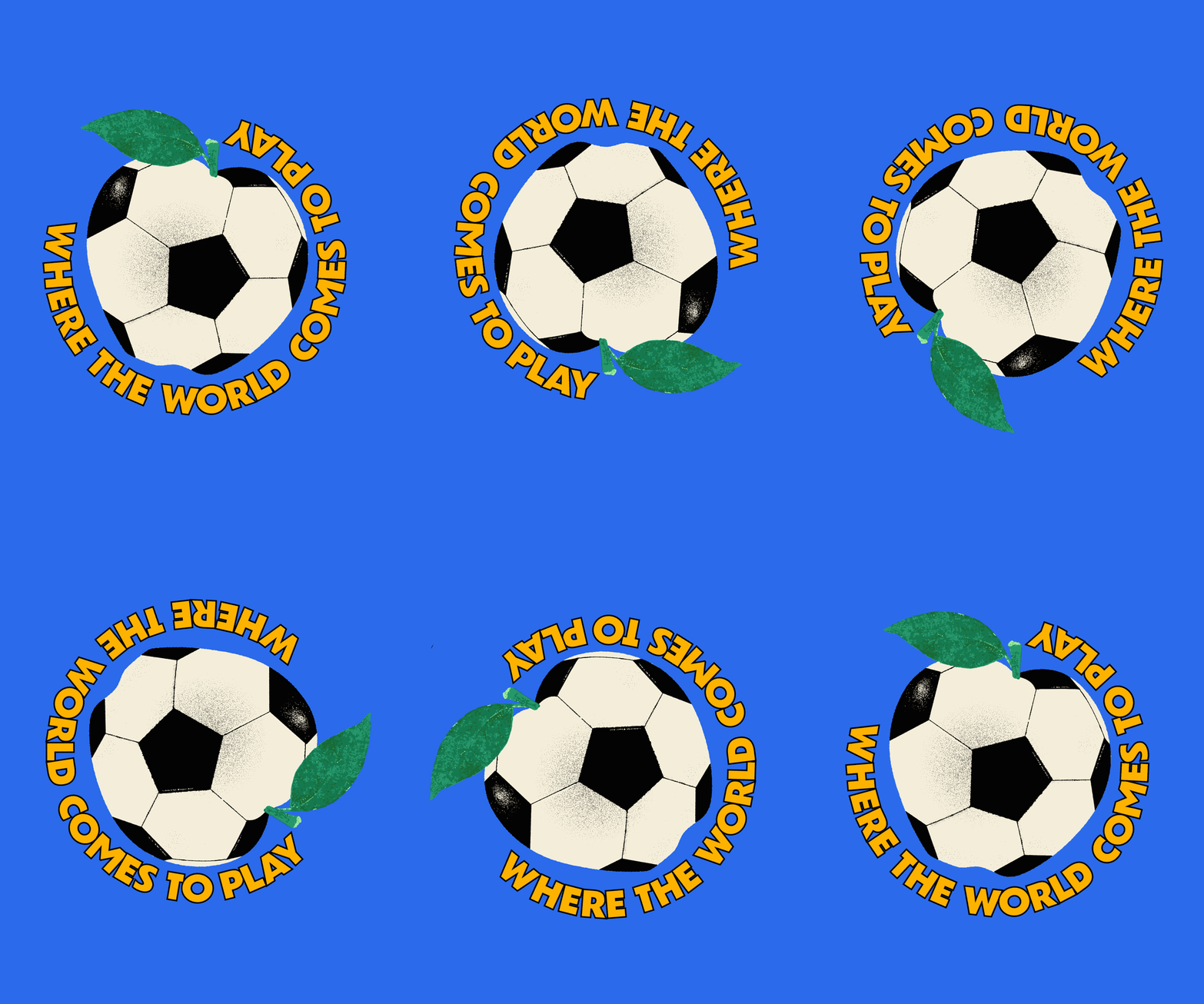
One of the campaign’s signatures is an apple whose skin looks like a soccer ball. How did that come about?
It was clear from the beginning that we needed a symbol. I went back to what my mentor, Peter Mendelsund, taught me: How do you put the thing in the thing?
In my process, I make a lot of lists. So what are the New York symbols and what is prominent about a soccer ball? So a soccer ball is black and white, it is circular, it has hexagons on it. And then I’m making a list of taxis, pigeons, apples, bridges, and trying to just literally create connections. I played off the idea of the world. We tried to use the Unisphere, in Queens. I tried a globe and the circles on the Subway map. I didn’t want to force an idea so it just became the apple.
Someone who might not be from New York knows the Big Apple. It’s an immediately recognizable symbol. The Apple has been done a million times, but how do you make that apple belong to this event?
What did research for the project look like?
Design is iterative. You make something off of fragments of information you have in your brain. It is difficult to be in a very over-stimulated digital world where you’re constantly taking in imagery that is made by someone else. When you’re seeing so much, it’s hard to have a focus and clarity of what you should be doing. What has really helped me is taking in different forms of art. I get inspired by reading about something or by going to the ballet or by going to the Met and seeing paintings by Old Masters.
For this, I went to the New York Public Library Picture Collection. There was an entire row of folders of New York City streets and signage. So I looked at sports, signage, magazine covers. I looked at food. I looked at different illustrations of apples. I looked at soccer, specifically, and World Cup and World’s Fair, but a lot of it came down to signage and just getting the nostalgic feel of New York streets. I also looked at Push Pin Studios and how graphic New York design is, like the heart in I ❤ NY.
I try to avoid mood boarding as much as I can in my own work because I think it can get distracting. When I do mood boards, I try not to only put graphic design on it. I’ll put a rug or a piece of textile or a sound bite that inspires me in some way.
Did you have a soundbite in mind when designing the campaign?
No, but I can imagine a sound coming off it. It’s like a cheery, “whistling down the street in New York” feeling.
How did the scale of the campaign affect the way you designed the identity?
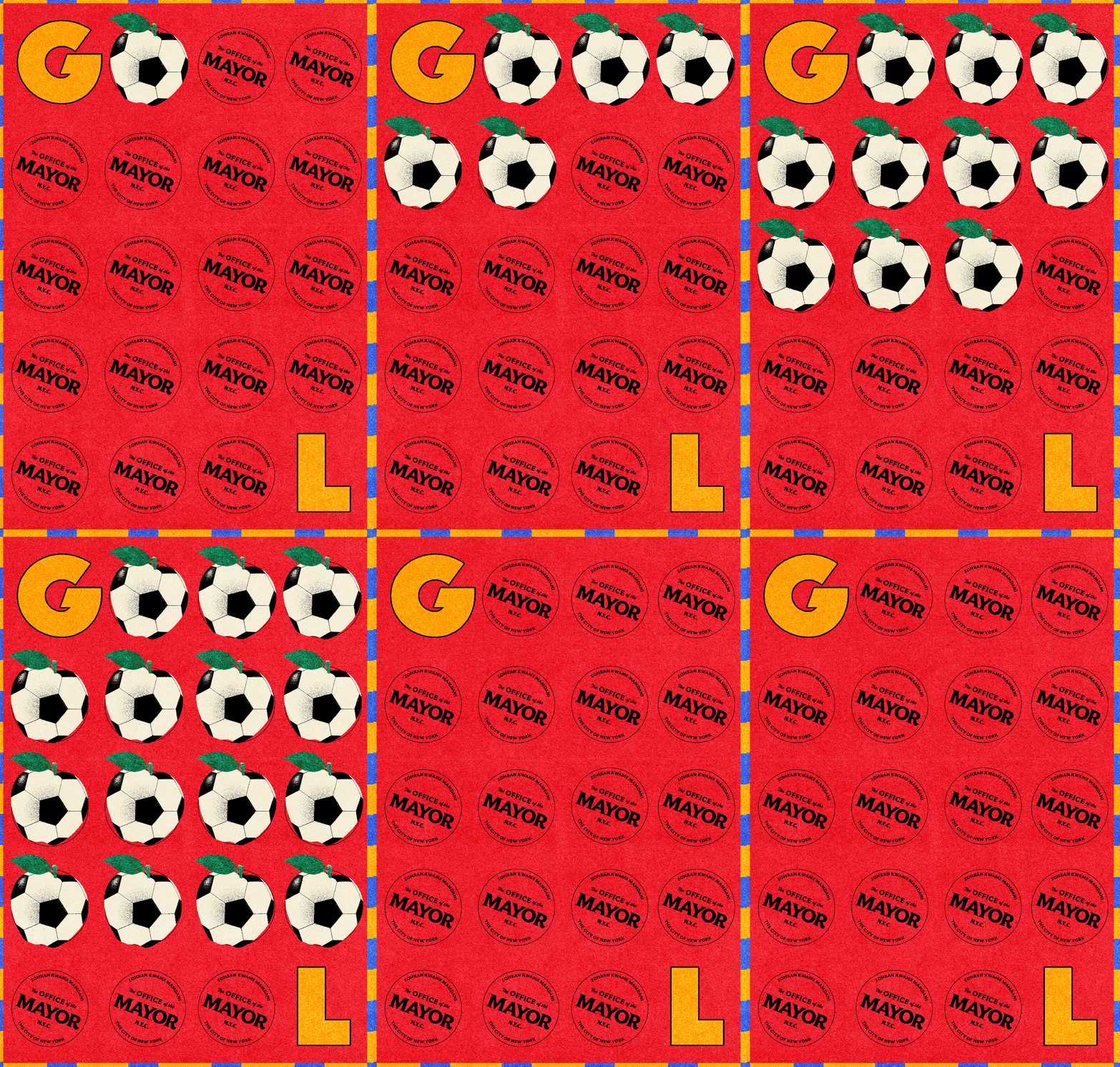
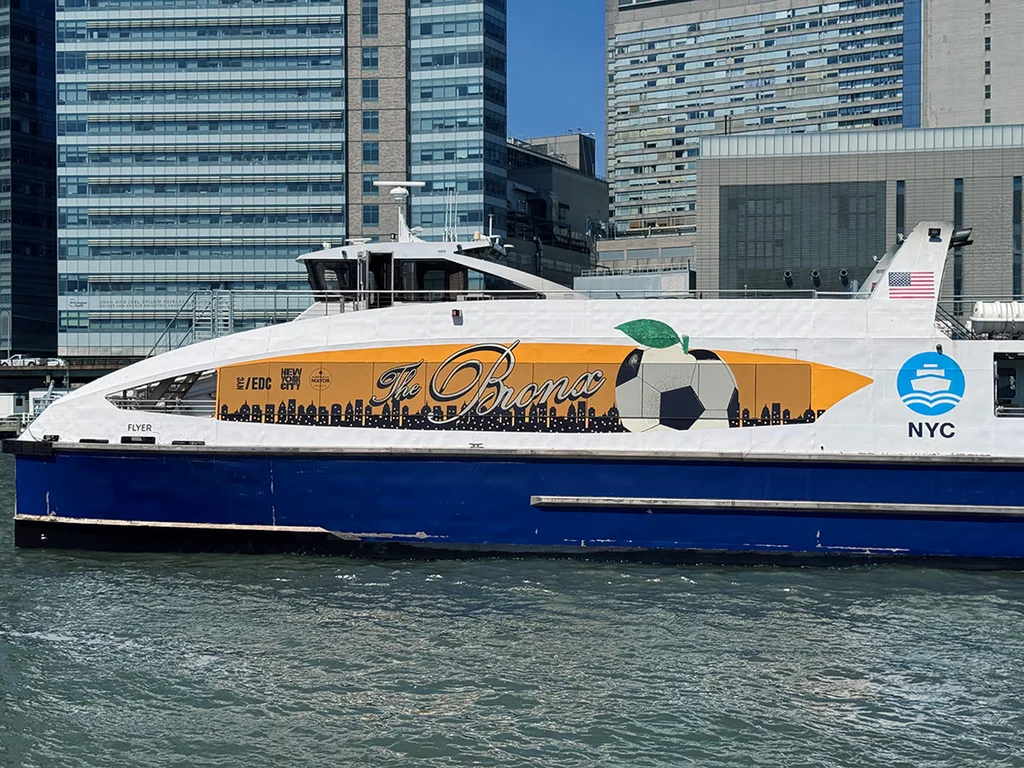
The challenge was designing something that could live anywhere. On a banner, a jersey, a subway platform, a pin, a tote bag, a community event, or a giant piece of city infrastructure. The beauty of this campaign is that it will be on your screens. It’ll be when you walk down the street, it’ll be on your body. It feels like it’s part of the fabric of the city. The point of us doing this for the World Cup is to make people feel involved and a part of something bigger than themselves.
I knew that this was going to have to be all over the city in ways I wasn’t sure of, so I wanted to create a system. I worked closely with Aneesh Bhoopathy [who designed Zohran’s campaign branding and is now a senior designer in the Mayor’s Office] to create brand guidelines.
We broke down the assets in ways that were easy for people to pick up quickly and use. So I knew that nailing one symbol that could appear on everything would be the main focus. The color palette is based on stuff that you walk past on your commute every day: subway green, the red “Thank You for Shopping Here” bags, and yellow taxis. One or two typefaces max was important for me. We used Dunbar Tall from Adobe Type Kit and the cursive font is Excelsior Script, but modified and redrawn a bit.
Design is a sum of all its parts, right? All together it’s this really wonderful, joyful campaign.
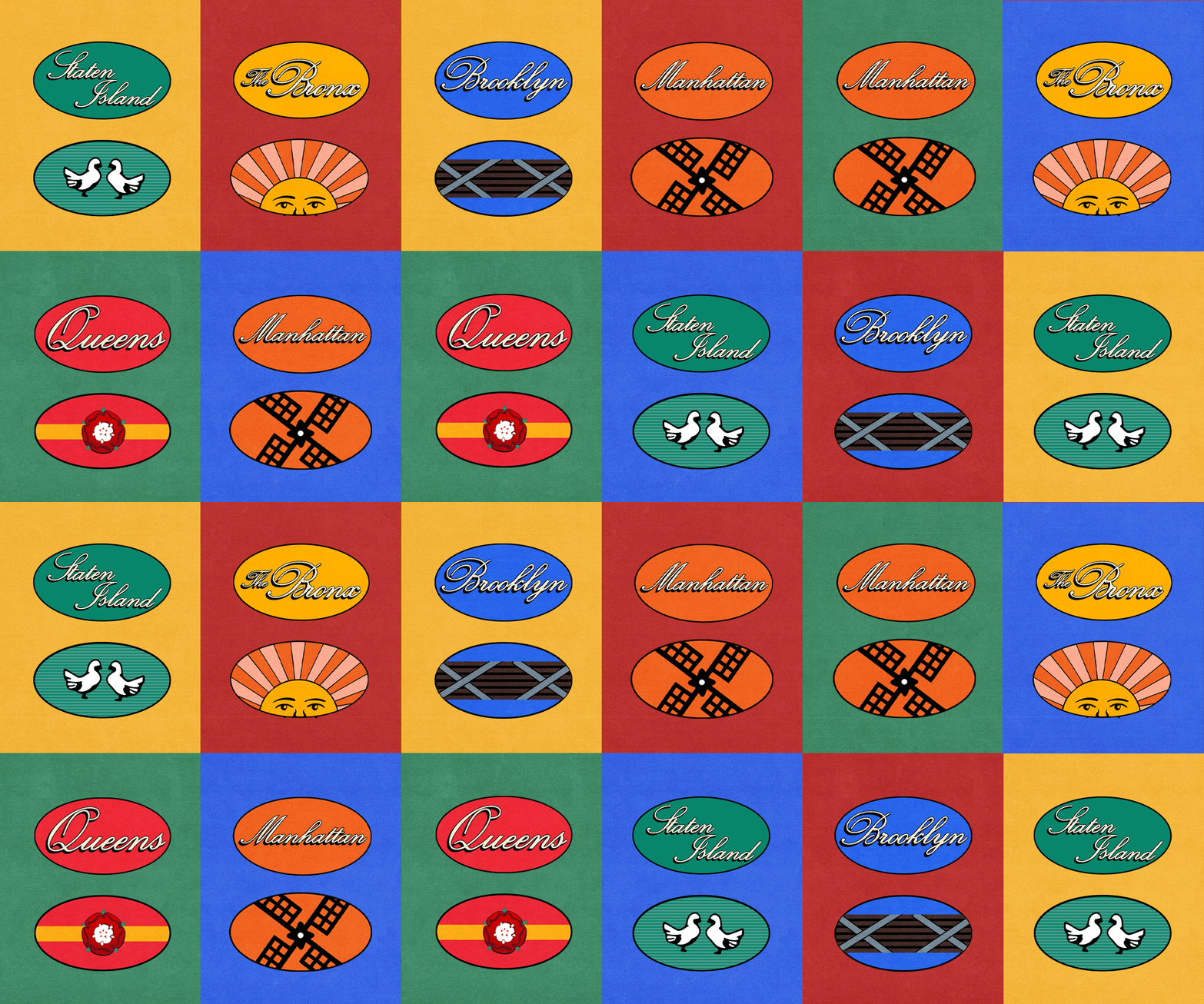
The campaign references all five boroughs. Tell us about integrating the whole of the city into the supporting graphics.
It was important to make sure everyone is included and it’s not just Manhattan. I noticed, actually on the ferry dock outside of Gracie Mansion, there’s a flag waving and it’s a Manhattan borough flag. I realized that every borough has a flag and they’re all quite intricate. It was too much to use the full flag on everything, but what I decided to do was pull out elements that were graphic and sweet from each one. I went through tons of iterations and pared down and pared down and pared down to just one symbol from each flag. Putting them in an oval frame came from the shape of a sticker on an apple. I wanted it to feel like old sports memorabilia, city signage, and a sticker collection all at once.
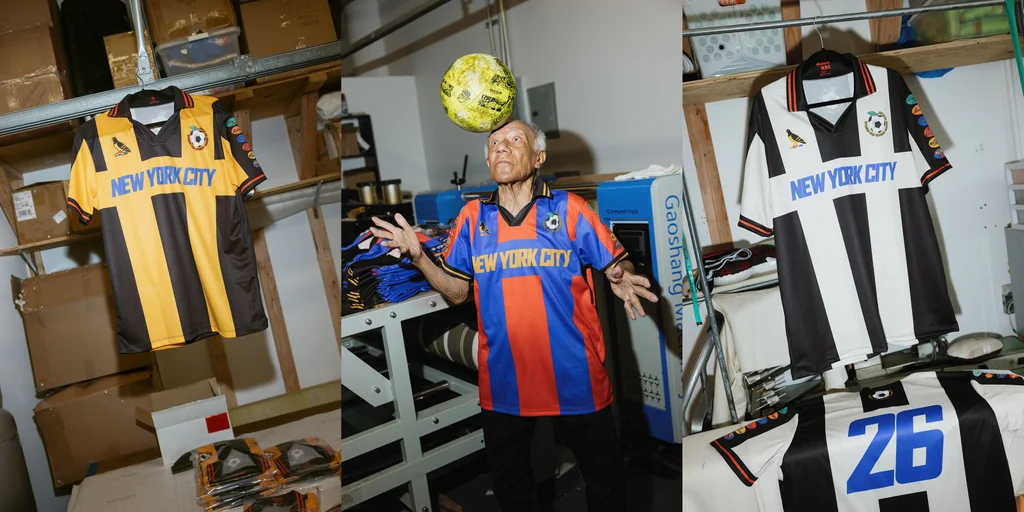
You also designed jerseys for the campaign, which are made in Brooklyn and feature those borough symbols on the sleeve, plus a drawing of a pigeon, apple soccer ball symbol, and the phrase “New York City” on the chest. How did you arrive at this?
We wanted to go retro, old-school, basic—like the jerseys you would buy from street vendors. It’s back to that place again of nostalgia. I made options that were quite sexy hypebeast vibes, but it wasn’t the right tone. We didn’t want them to feel untouchable or something that someone who maybe isn’t so fashionable would feel uncomfortable wearing. We wanted it to just feel natural to everyone.
Why was nostalgia something you wanted to lean into?
I think there’s something nostalgic about the World Cup. We feel nostalgic for major events that repeatedly happen. They bring back memories. When I think about the World Cup, I think about watching it with my dad and my brother when we all still lived in the same house. You think about the food you eat and the places you go. And now as an adult in New York, I’m building my own kind of memories.
Did the mayor give any feedback that was especially useful?
On the jerseys, the pigeon was his idea. I was adamantly, like, “I don’t think we should do a pigeon.” And then the pigeon just worked in the end. I initially designed “Where the World Comes to Play” in three colors and he asked to make it just one because it was too much. I did not want to change it. But now looking at it, I’m like, “Damn, he was right.”
The relationship between the United States and the World Cup has been uneasy, especially in regard to immigration policy and safety fears. Did that affect the way you thought of presenting New York in the campaign?
How I will answer this is: I believe in the Mayor’s approach to the world and to people. He approaches everyone with the same decency as the next person. He is inclusive and has high morals and wants the people of New York to feel like they belong to the city. That’s what guided us. Not everything is in our hands, but we really approached it with that idea of community inclusivity. There is a new energy in New York that is undeniable and I think it is incredible what the Mayor has done for the city.
How does it feel to see the campaign out in the wild?
I was really touched to hear how many people said they smiled when they saw it. Close friends texted me, “Oh my God, I want to take that poster when this is over from the bus stop,” and “I’ve been trying to figure out how to get a poster for my room.”
So will people be able to get posters without resorting to vandalism?
Don’t resort to vandalism! I do not condone that. I would just keep watching the @NYCMayor Instagram handle and things will drop eventually. But today, first things first, the jerseys are out and it’s an in-person purchase [from the City Store].
