

Published June 17, 2026 03:38AM
We’d been paddling the Owyhee River for four days, through the rugged basalt canyons and sprawling plains of eastern Oregon’s high desert. We’d drifted through stretches of water so wide and flat as to seem like the surface of a mirror, and navigated churning choke-points jammed with boulders.
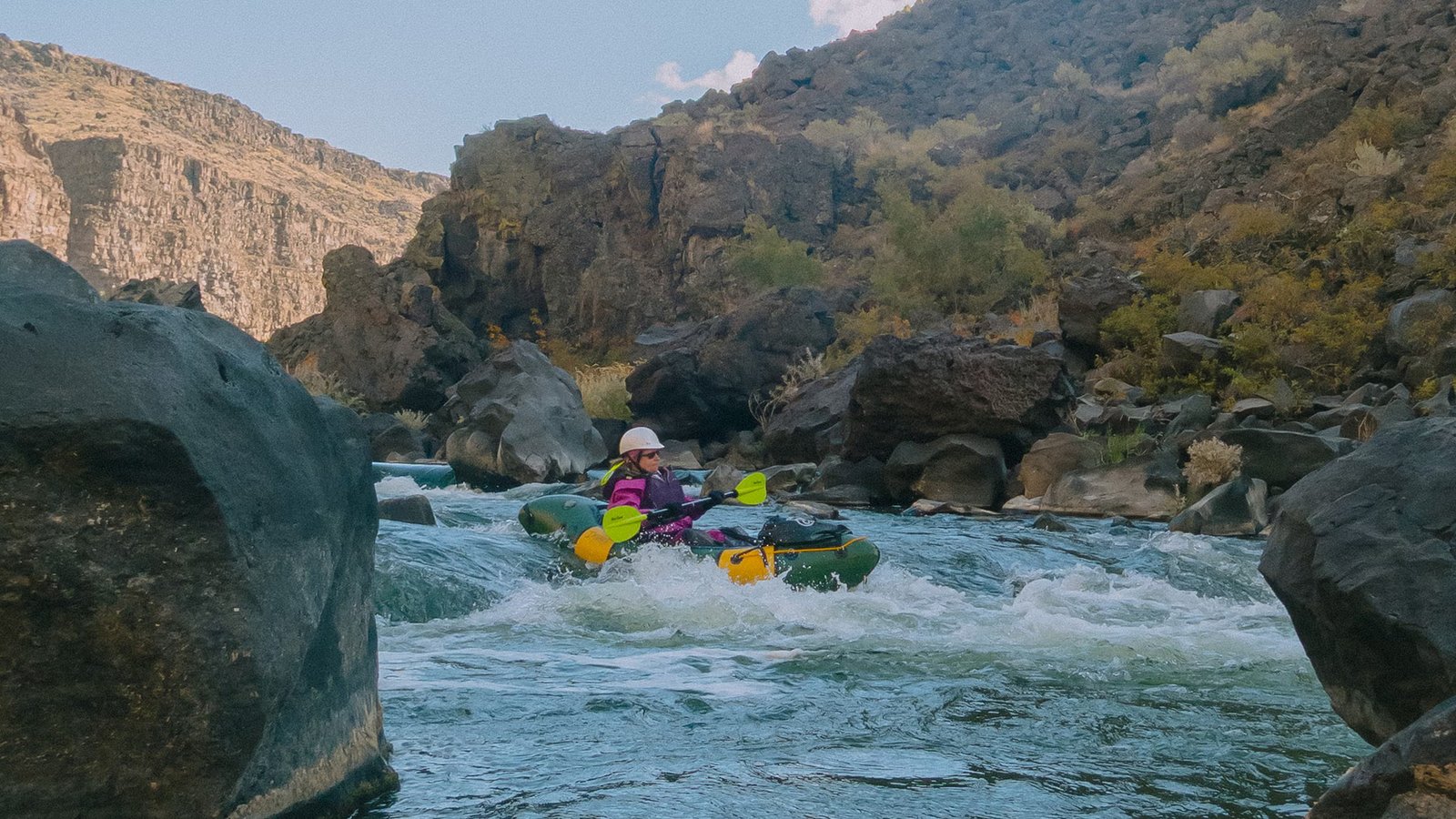
It was early October, and the river was low. At times it felt more rock than water. Now, we were in the deepest part of the canyon. We’d only managed to get here on ultralight, one-person packrafts, and these rafts were the only way we’d get out again, three days later.
Dan Sizer, a river guide, and I stood in knee-deep water along the bank, peering over reeds and cheatgrass to scout the rapids ahead. With one hand, I steadied my sky-blue inflatable as it bobbed in the current. Around us, reddish basalt walls rose hundreds of feet into the sky. A handful of flickers, small, woodpecker-like birds, erupted from a copse of trees along the bank, crossing the water and becoming lost in the beams of late afternoon sun.
“What do you think?” Dan asked. “Which way should we go?”
It was a strange question. Dan was the guide. I was the client. I’ve paddled rapids just a few times in my life, and we were dozens of miles deep in the backcountry, where a popped raft would have high consequences. But Dan wore a genuine smile. He appeared to actually want to know what I thought. Was this a test?
Through the reeds, I could see a boulder the size of a parade float rising out of the river, the water flowing around it on either side. On the river’s left was a smaller pyramid of rock, with a jagged prow that looked like it could cut bone. Avoiding this thing felt important. The right side of the river was gentler, but the water here was shallow, barely a foot deep. It was a thinly-submerged cheese grater.
I stepped out of the water and balanced on a mossy rock with one foot to get a better view over the grass, pretending to evaluate the situation.
“I dunno,” I said, picking at a bug bite on my chin and attempting to look pensive. “Maybe that way?” I gestured vaguely in the general direction of the river.
“You’re right, I think the best route is to go left of that rock there,” Dan said, pointing, “then catch that eddy and go between those two rocks there. After that we’ll want to stay right, it looks a bit deeper over there. Good call?”
“Right, right,” I said, nodding. “That’s exactly what I was thinking.”
The Owyhee River cuts through the heart of the Owyhee Canyonlands, a sprawling wilderness in the remote border region where Oregon, Idaho, and Nevada meet. Covering roughly seven million acres and including hundreds of miles of river, it is one of the largest, most ecologically intact wildlands in the Lower 48, and is often referred to by its very appropriate nickname, “The Big Quiet.”
Above the canyon rim, the landscape is rolling and covered in sagebrush, a critical habitat for threatened species like sage grouse and pronghorn antelope. But drop below, and the world falls into sheer-walled gorges shaped by millions of years of volcanic activity and rushing water. The canyon walls, towering cathedrals of red and brown rhyolite, are both a geological history book and a human one, too.
For over 13,000 years, the Shoshone, Bannock, and Northern Paiute people called this labyrinth home. Their petroglyphs, arrowheads, and other relics are still present along the riverbanks today. The name “Owyhee” also reflects a strange layer of history. It is an archaic spelling of Hawaii. The wilderness was named in honor of three Hawaiian trappers who disappeared there in 1819.
“What matters about the Owyhee’s history isn’t just how old it is, but how present it still feels,” said Tim Davis, the founder of Friends of the Owyhee, a nonprofit dedicated to preserving the wilderness. “When you enter those canyons, you feel the layers, from the first people who knew the river, by need and ceremony, to the settlers entering a country they barely understood, to the ranch families, miners, boaters, and the conservation fights unfolding today.”
The Owyhee River, which runs for nearly 350 miles through this high-desert wilderness, is one of the most desolate, remote rivers in the country. The 50-mile stretch we were paddling, known as the Lower Owyhee, is typically a spring pilgrimage. In April and May, fueled by snowmelt, the river surges at flows of 1,000 to 10,000 cubic feet per second (CFS). At those levels, the cheese grater rocks we were picking our way through are buried deep underwater, and 14-foot expedition rafts can blast downriver with ease.
But in autumn, the Owyhee is a different creature, one of skeletal, silent beauty. The flow drops to nearly nothing, the water we paddled was a mere 110 CFS. That’s essentially a trickle—little more than an irrigation ditch, at some points. At this level, a normal raft is a liability, a massive rubber anchor that would need to be dragged over miles of abrasive rock.
For decades, this closed the Owyhee to commercial boating after June. Our expedition, with Dan’s company, Go Wild: American Adventures, was the first commercial trip ever to receive a permit to descend the river in the fall.
“The Owyhee in the fall is a really special place,” Dan told me. “Almost no one’s on it, and the water completely changes color, from the sediment-filled, brown river it is in spring, to a river so clear that you can see the fish swimming beneath you.”
“But the thing I really love,” he added, “is that you don’t know what you’re going to get every time you go in. It’s not an easy place to go to; you have to be prepared for anything. If something goes wrong, the only way out is through. That’s what keeps me coming back.”
This is also how our packrafts changed the calculus. Originally designed for Alaskan traverses, these one-person inflatables can weigh just a few pounds and draft only inches of water, compared to a full-sized raft, which weighs 200 pounds and, when fully loaded, may dip six inches down.
These rafts have become increasingly important on rivers across the West, especially amid the dry and disappointing 2026 season. Rivers across the West, from Colorado to Oregon, are running at historically low levels this spring and summer due to the paltry snowfall in the Rockies. In Colorado, the Arkansas River, the most rafted river in the country, was running at 350 CFS in early June. The lowest flow needed for a traditional raft is around 300 CFS, the Colorado Sun reported.
Our trip on the Lower Owyhee was only possible thanks to packrafts: nimble, capable, and able to go where larger boats can’t. When the river braided into shallow channels that would trap a larger boat, we just slid over the rocks, or in the worst case, stood up and walked our boats like dogs on a leash until the channel deepened.
At night we enjoyed fresh-cooked meals and remote campsites along the banks. Every morning we broke camp and stuffed all of our gear—tents, sleeping bags, pads, stoves, food, and more—into the inside of our rafts’ pontoons, which are accessible using giant, airtight zippers. This internal storage system is both a way to keep your raft free of loose gear and a technical advantage. By storing heavy gear inside the tubes rather than strapping it on top, your center of gravity is lower, and your boat is more stable.
“Packrafts have opened up so much for wilderness travel,” Dan explained. “They’re light and packable enough to throw in a backpack, and small enough to get down rivers that rafts can’t. Packrafting gives you the solitude of backpacking with the adrenaline of whitewater rafting. It’s a whole different style of adventure.”
The packrafts allowed us both to survive the low water and to access a version of the American West that almost no one else gets to see. Piloting these little rafts, we drifted past the ramparts of basalt and past the watchful eyes of mule deer along the banks, navigating a silence so profound it felt heavy. For seven days, I didn’t see a single human except for Dan and the other three people in our small group.
Despite its remoteness, the region faces an array of existential threats. Illegal routes and unmanaged recreation scar the fragile desert soil, and the specter of development looms, because the unique geology that creates these stunning canyons also harbors deposits of lithium and uranium, making the area a target for mining claims.
Parts and parcels of the Owyhee region are protected by state and federal agencies, like the Bureau of Land Management. The stretch of the river we paddled, for example, is protected under the federal Wild and ScenicRivers designation. But these protections are limited—just five percent of the canyonlands are permanently protected—and fragmented.
There is no overarching protection for the greater Owyhee ecosystem, and thus no consistent rules and regulations governing access and use across county and state lines. This is a problem, because ecosystems don’t adhere to property lines. A river is a continuous artery, and runoff from a mine on an unprotected ridge inevitably poisons the protected water below.
“Friends of the Owyhee sees this place as more than a collection of designations and boundary lines,” said Davis. “It is river, rimrock, sage, cattle ground, old camps, migration country, dark sky, clean water, and the kind of solitude that has almost been made illegal by modern life.”
That silence and solitude is also a fragile resource. If industrial development is permitted on the canyon rim, technically outside a protected river corridor, the “Big Quiet” below becomes an acoustic amphitheater for the noise above. Without holistic protections encompassing rim, watershed, and migration corridors, the region risks becoming a wilderness museum exhibit: protected behind glass, but decaying from the inside.
For many years, a coalition of local Indigenous tribes, conservationists, fishermen, hunters, and other outdoor enthusiasts has tried to change this, galvanized by dogged nonprofits like Davis’s Friends of the Owyhee. A representative from the group joined us on our packrafting trip.
In 2024, these efforts nearly led to the passing of legislation that would have designated over one million acres of the Owyhee as national wilderness, but although the bill passed the Senate, it died in the House of Representatives. Another push seemed poised to see the Owyhee Canyonlands’ designation as a National Monument, as a presidential proclamation under the Antiquities Act of 1906, but former President Joe Biden didn’t make the proclamation before he left office. Under the current executive administration, protective efforts have stalled.
Davis said the efforts aren’t intended to make the region off-limits, but to responsibly steward the land while providing a space for not just recreation, but hunting, fishing, off-roading, ranching, and all the other uses the land has had over the years.
“Protecting the Owyhee has never meant putting a fence around it and telling people to stay out,” he explained. “That would miss the point. This country has always been lived in, worked in, traveled through, fought over, and loved hard.”
Being here in October, with the water too low for the crowds and the canyon walls insulating me from the horizon, the idea of patchwork protections for this place felt absurd. The river doesn’t know where a BLM border ends and a mining claim begins.
Which brings me back to the river and the rapid.
I grabbed my paddle, belly-flopped back into my packraft and swung my legs inside, and then scooted the little boat off the rocks. The current, sluggish at first, grabbed the bow and swung me toward the large boulders.
The water below me was so clear I could see a small catfish darting beneath my boat. A red-tailed hawk glided overhead. The canyon walls, a rainbow of maroons and ochres and tans, seemed to swim, just like the water of the river. For he first time in a while, I found that my mind had quieted down enough that I was distracted, not by TikTok or Instagram, but by nature.
I was perhaps too distracted.
My boat slammed into the parade float boulder, pitching violently on its side. My sunglasses became so fogged up with spray that I was effectively blind, but I could tell that several gallons of water had poured over the gunwales.
Now steering the equivalent of a bathtub, I spun wildly to the right of the rock, my paddle smacking against the boulder with a large crack, and then began bouncing my way through the shallow, gravelly riverbed beyond. One rock collided so heavily with my tailbone that it was left numb, and I began to wonder if I’d shit myself.
For a moment, my boat became stuck on another stone. I shifted my weight, wiggled my hips, making a series of strange, involuntary grunts as the river again poured over the gunwales. My little boat finally popped free, sliding over the lip and splashing back into deeper water beyond.
“Nice one!” yelled Dan.
