

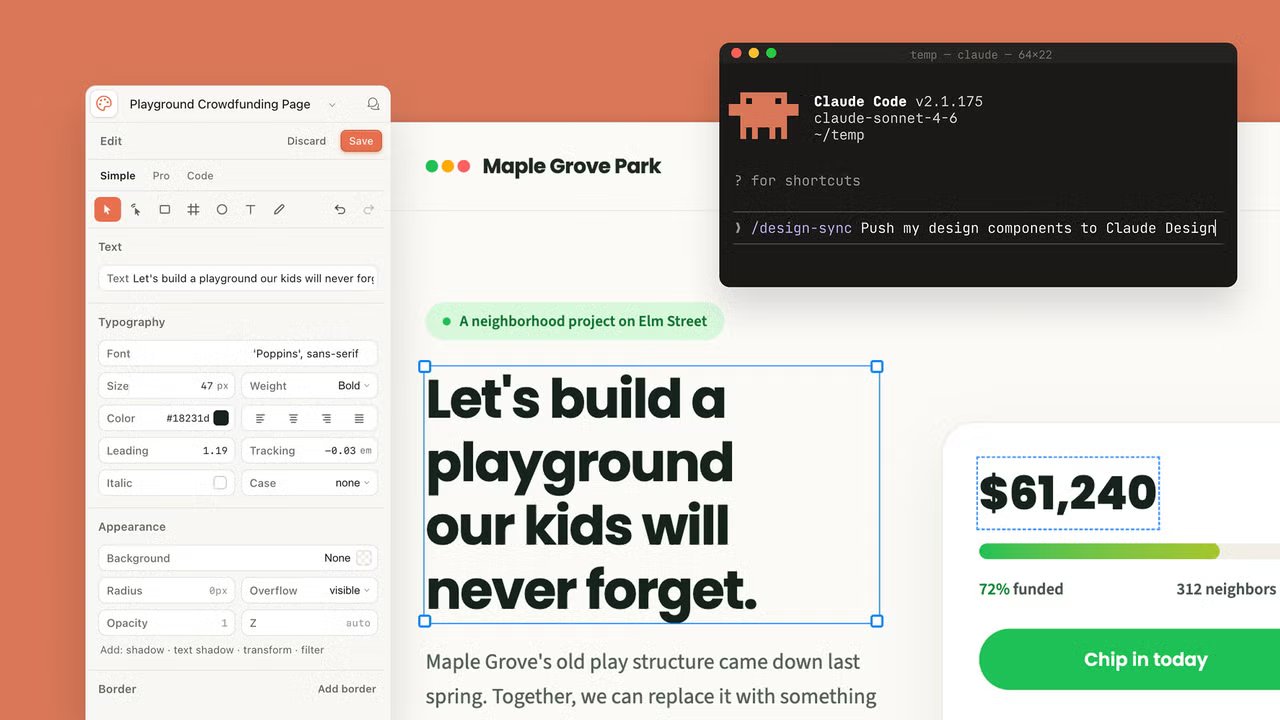
Claude Design, Anthropic Lab’s AI design tool, launched in April to a crowded market of vibe-coding design programs. Now, after a few months in the hands of designers, Anthropic is launching a big update to Claude Design that addresses their biggest pain points.
The company says Claude Design is now better at adhering to design systems, has more finely-tuned editing controls, and users can also do more with fewer tokens.
Anthropic designer Nate Parrott tells Fast Company that the previous version of Claude Design lacked some consistency when it came to applying design systems across generated prototypes. The new version has been improved so non-designers using the tool can create prototypes that align with brand and style guidelines, and design admins can better control the output. “We’ve been continuously hill climbing our ability for Claude to adhere in the sort of qualitative, vibe-y ways that real designers of real companies want that stuff to happen,” he says.
Part of the update includes improved editing tools, which allow for finer-tuned control over things like layout, type choice, and button styles, while working in an interactive prototype.
“You can go in and you can edit things directly and try your hand at what it looks like with a different font or a different color, and you can get some of those direct controls that you might have had in other tools that designers are familiar with,” he says.
Meanwhile to make Claude Design more efficient, it now shares usage limits with chat, Claude Cowork, and Claude Code. “People can’t get enough Claude tokens, and so we got a lot of work on the engineering side to make Claude Design do more with the same amount of tokens,” Parrott says.
The goal is for Claude Design to become a go-to tool for the moments when designers are brainstorming and testing new ideas. “It’s much more about, how can we stake our claim to the beginning of the design process, rather than the end,” Parrott says.
The big unlock is helping teams get to an idea that actually works faster than they could have previously. “A lot of these AI tools have made it way easier to go from conviction to production,” Parrott says. “What we’ve seen internally is that so much more of our time now is spent on, like, we have a million ideas and a million directions we can go in. Which ones are the right ones? How do we build conviction?”
Already, teams are adopting AI as a sort of “pre-conviction” tool to iterate early, like Disney Imagineering, which developed its own bespoke AI tool with Adobe to iterate designs for Disney parks and cruises. There value comes from making quick first passes on ideas.
“Previously, somebody would come to me with an idea that was half sketched out or on paper,” Parrott says. With AI design tools, “we can even decide if it’s worth bringing to engineering or putting on the road map or exploring in depth with more of a designer’s time.”
He says the big thing he’s heard both internally and externally is “that everybody’s trying to figure out what the stack for designers looks like in this era.” More designers are empowered to code now, and Anthropic is hoping with its new improved tools, it can make up a larger part of that stack.
