

Published June 18, 2026 09:05AM
Catalan ultrarunner Kilian Jornet was jogging up the slopes of 14,021-foot Wilson Peak in Colorado’s San Juan Range this past September when he saw an abandoned mining cart sitting against the rocks. Jornet, who was ascending all of the peaks above 14,000 feet in the contiguous United States for a project called States of Elevation, was startled at the discovery.
“It’s abandoned, it’s not active anymore, but still it’s very shocking,” Jornet, 38, told Outside. “It makes you reflect on all the extraction that has been there.”
Jornet took a personal lesson from the ore cart: when industrialization comes to the wild backcountry, the impact will last for decades or centuries.
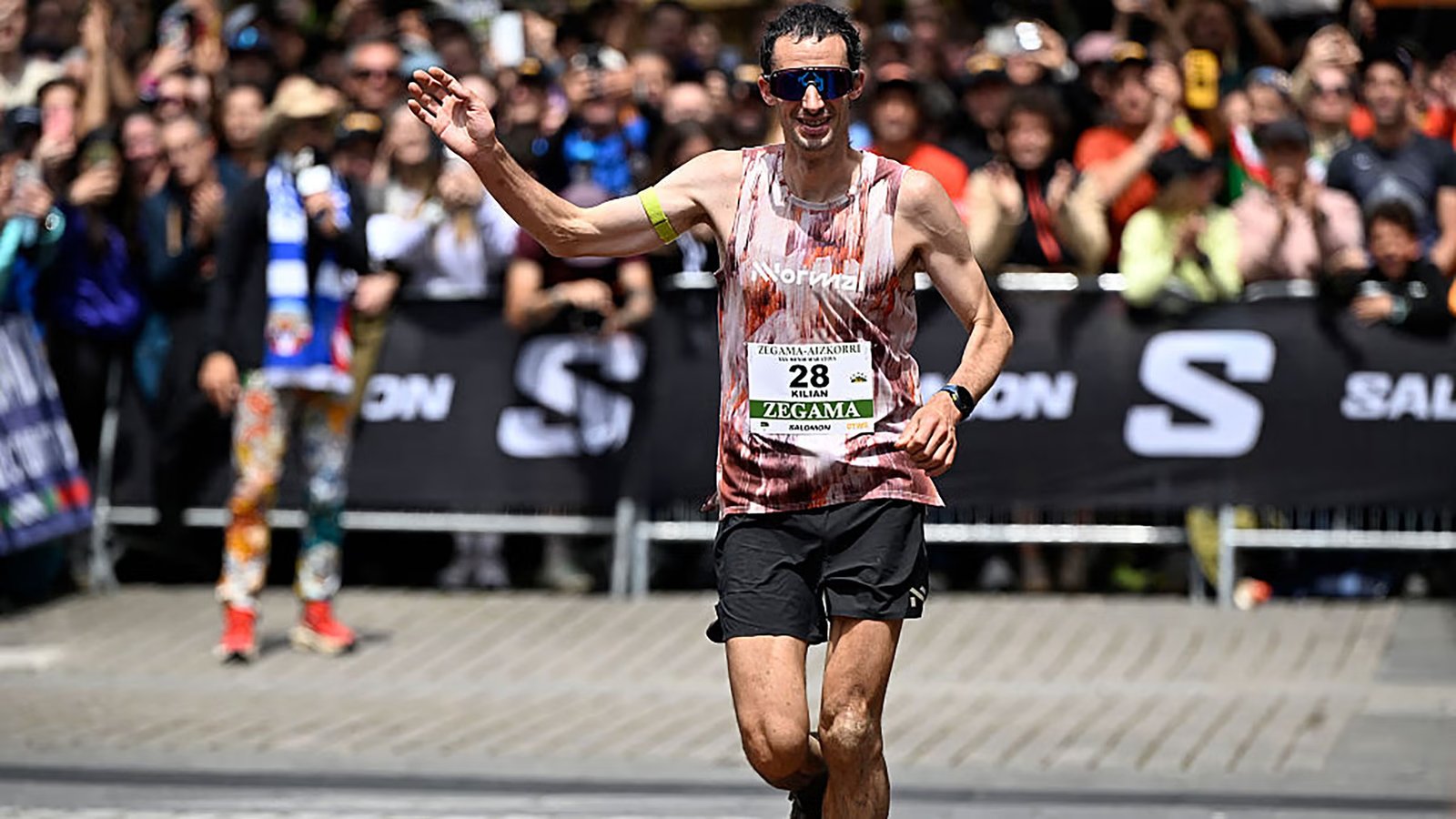
This year, Jornet is dedicating his ultramarathon racing to a campaign born of this realization. He is promoting the protection of U.S. public lands through branding, online messaging, and interviews. When he lines up for California’s Western States 100 Endurance Run on June 27, he will race wearing a hat emblazoned with the slogan “Keep Public Lands in Public Hands.”
Jornet posted a letter to his website on June 18 detailing his thoughts on the state of U.S. public lands. “If States of Elevation taught me anything, it’s that the privilege of access comes with a non-negotiable cost: responsibility,” Jornet wrote. “It means advocating for the wild spaces that cannot speak for themselves.”
During his States of Elevation project, Jornet summited 67 different peaks and traveled between them by running or biking.
He told Outside that during the project, the legacy of mining in the San Juan mountains was impossible to ignore. Old mine sites appear in the otherwise beautiful alpine landscape as weathered industrial ruins: gray wooden buildings, collapsed ore bins, rusted machinery, tailings piles, and gaping mine portals cut into steep slopes.
“You can see that it’s polluted,” Jornet said. “In a place that’s otherwise very clean, you can see the rubbish, and the pollution in the colors of the waters and in the rocks.”
Jornet’s push comes as the federal government has rolled back environmental protections across millions of acres of public lands. In May, the Bureau of Land Management rescinded the Conservation and Landscape Health Rule, also called the Public Lands Rule, which placed conservation on equal footing with mining, grazing, and drilling across 245 million acres of public land. Also in May, the Trump Administration inked an executive order that opened millions of acres of protected public lands to dirt bikes, trucks, and all-terrain vehicles. Amid the current U.S. government’s push for “energy dominance,” Jornet is concerned that public lands face growing pressure from development, including mining and oil and gas exploration. And once industrial development starts, there’s no going back, he said.
“Seeing so many exploited areas, now barren without animal or plant life, I saw the way the ecosystem was compromised,” he said. “It will never be the same. It can become a different ecosystem, but it can never go back to what it was.”
Viewing U.S. Public Lands From a European Perspective
In Western Europe, where Jornet was born and raised, large tracts of undisturbed nature like those that still exist in the U.S. West are rare. “There are villages and roads everywhere,” he said. “It’s not possible to run for 50 miles without finding human things.”
Because so little open land remains, Jornet said citizens tend to be aligned in the belief that it should be protected. In the Alps, for example, after decades of ski resort expansion, many people now oppose further corporate infrastructure projects and are willing to stand up against them.
In the U.S., he said, the abundance of open public land can create the opposite response: complacency. People can take it for granted, at least until the road goes in and other signs of development begin to appear. And then it’s too late.
Jornet pointed to the Trump administration’s proposal last summer to rescind the “Roadless Rule” as a direct threat to undeveloped backcountry. The 2001 Roadless Area Conservation Rule, a U.S. Forest Service policy adopted at the end of the Clinton administration, generally protects large undeveloped areas of national forests from being cut up by new roads.
“People say, ‘Oh, it’s just a road, it’s not like we’re selling off a national park,’” Jornet said. “But that’s how truly wild places are lost, not all at once, but road by road, lease by lease.”
Norway’s Right to Roam Rules
In Norway, where Jornet has lived for the past decade, he’s used to a different relationship with the land. The “right to roam,” known there as allemannsretten, gives people broad freedom to walk, ski, swim, paddle, forage, and camp on uncultivated land, even when it is privately owned, as long as they do so responsibly (i.e., leave no trace, respect wildlife and livestock, keep clear of homes, farms, and cultivated fields).
This right is legally protected under Norway’s Outdoor Recreation Act. Sweden and Finland have similar access rights, as do some other parts of Europe, including Scotland.
“It means that even on private property, you can’t own nature,” Jornet said.
In Jornet’s view, that shared access also helps protect the land from being treated as a resource controlled by any one person or entity. If the land is degraded or overused, the system fails for everyone.
Jornet acknowledged that a public access system like Norway’s would be difficult to transplant directly to the U.S. His point is that there is no single way to preserve nature. “There are many different ways, set up to match the context of the place,” Jornet said.
The key is not to be complacent. “There’s a real threat to public lands right now in the U.S. with the current administration,” Jornet said. “Everyone needs to be talking about this. What you have is rare and worth fighting for.”
Jornet’s Activism at Western States 100
Jornet’s “Keep Public Lands in Public Hands” cap was made by NNormal, the outdoor gear brand he co-founded with Spanish footwear company Camper in 2022. After racing the Western States 100 wearing the cap, Jornet will raffle it off to raise awareness and support for efforts to protect U.S. public lands.
He’s also hosting several events, through the Kilian Jornet Foundation, during the ten days he’ll be in Northern California, including trail building and community runs, and information sessions with local ecologists and public lands advocates.
Jornet told Outside that he initially second-guessed whether, as a European, he was the right person to speak up for U.S. public lands. He said he knew that public lands management was a highly polarized topic in America, and that he was opening himself up, as a professional athlete and as a person, to criticism.
“I decided I’m at a point where I don’t care if people criticize me,” he said. “As for my image, well, we all end up in the ground being eaten by worms. So why preserve an image if it’s better to preserve what we care for?”
Jornet hopes that 100 years from now, people will still be running long-distance trails in the U.S., through landscapes that remain wild.
Jornet’s Open Letter About Public Lands
During last year’s States of Elevation project, I made my way through many different landscapes across the American West. High alpine ridges, forests, deserts, volcanoes, long empty roads, and places where I could move for hours without seeing many signs of human presence.
Many of the places I crossed are public lands. That means they are not owned by one person or one company but held in common. They are places that can be accessed, discussed, cared for, and protected by the public.
Many of these landscapes have histories that are much older than the idea of public land itself. Long before they became public lands, they were home to Indigenous communities, whose relationships with these places continue today.
Remembering this is important. It reminds us that access, ownership, and stewardship are never neutral ideas.
But public lands ownership and stewardship is not a passive guarantee of safety. It is an active, ongoing pact.
No management system is perfect. Even when land is public, decisions are complicated. Funding can be limited. Bureaucracy can be slow. Different interests can collide: conservation, recreation, grazing, mining, energy, trail maintenance, restoration, access.
So the question is not only whether these lands remain public, it is also how they are managed, who gets to participate in those decisions, and how we take care of them.
Public ownership matters because it gives people a voice. It creates space for debate, accountability, and democratic oversight. It can also act as a vital firewall to help protect landscapes from permanent changes that are difficult, or impossible, to reverse: unchecked development, fragmentation, or resource depletion.
For those of us who run, climb, ski, bike, or hike, public lands can feel like stadiums, sanctuaries, and testing grounds. It is easy to see them as places for our goals, our training, our escape.
But we are not only users of these places. We are part of them, and we benefit from them every time we breathe clean air, drink from a stream, move through a forest, or find quiet in a wild space.
Because we rely on these lands for both physical and emotional refuge, we cannot afford to be passive visitors.
If States of Elevation taught me anything, it’s that the privilege of access comes with a non-negotiable cost: responsibility.
It means advocating for the wild spaces that cannot speak for themselves.
We are temporary visitors passing through landscapes that have existed for millennia. By stepping up as active stewards today, we ensure that the untamed wilderness remains intact, vibrant, and free for the generations running right behind us.
Public lands need advocates, and there are many local and national organizations across the United States working every day to protect them. Through the Kilian Jornet Foundation, we want to help give visibility to these efforts by showcasing their work and sharing opportunities for engagement.
