

Published July 13, 2026 05:12PM
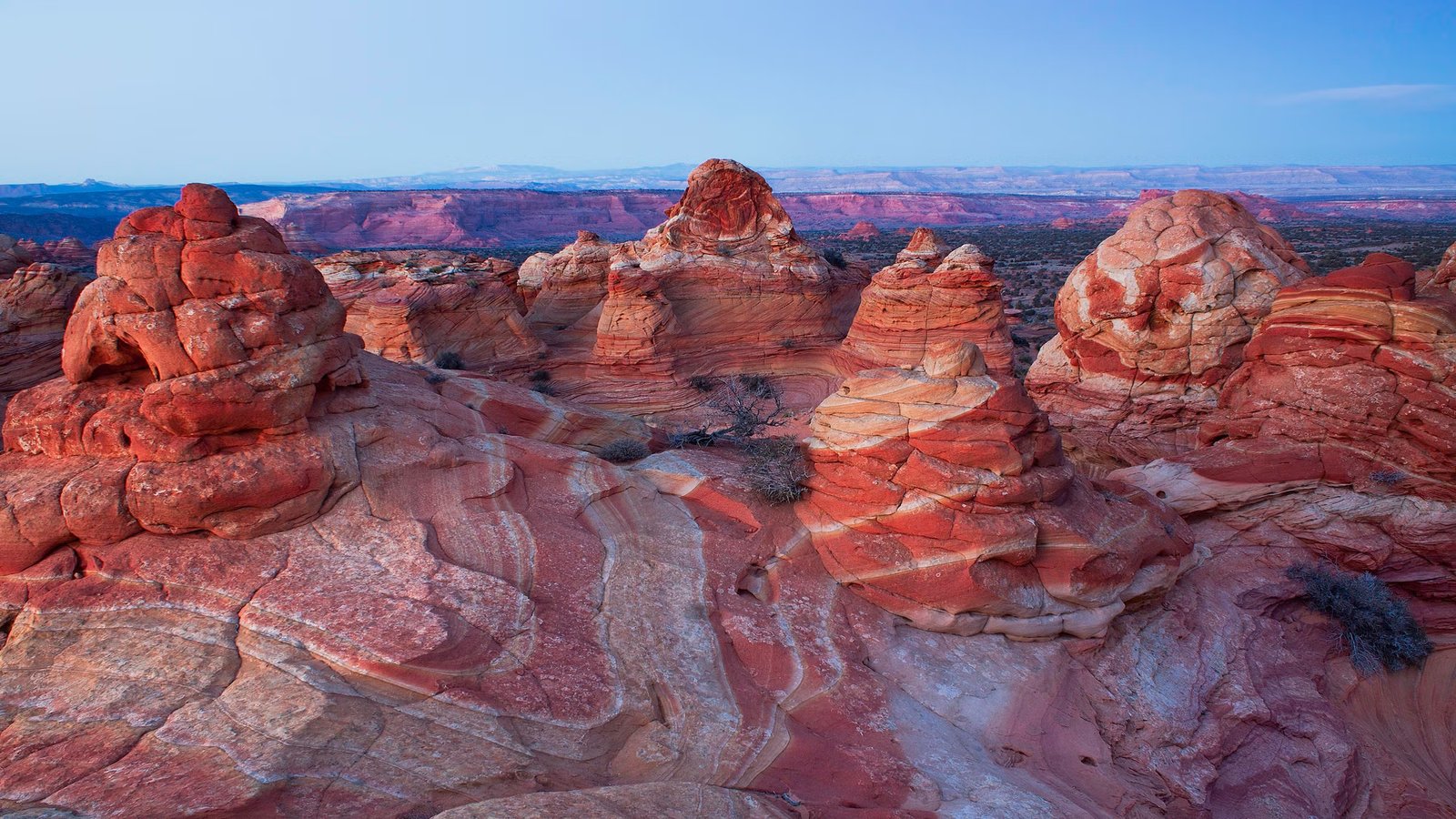
President Trump on July 13 signed an executive order reducing the size of two national monuments in Utah by nearly 3 million acres combined, leaving them at a fraction of their originally designated size.
Under his newly signed order, Trump reduced Bears Ears National Monument to approximately 121,000 acres and Grand Staircase–Escalante National Monument to approximately 182,000 acres.
Previously, Bears Ears National Monument encompassed 1.36 million acres and Grand Staircase-Escalante totaled 1.9 million acres.
Utah Senator Mike Lee, a Republican, praised the move.
“For too long, presidents have weaponized monument designations to lock up millions of acres, close roads, restrict grazing, and cut rural communities off from lands their families have lived on and worked for generations,” Lee said in a release. “I thank the President for correcting this abuse and keeping his promise to the people of Utah.”
Tribes and Advocates Denounce the Executive Order
The move generated a swift move from advocates, Native American tribes, and other lawmakers, who denounced the move as an attack on federally protected public lands.
“Our Tribes were not informed of or asked about this decision, and that’s unacceptable. The federal government must honor its Trust and Treaty obligations to our Tribes—it is not optional,” said Autumn Gillard, a member of the Southern Paiute tribe and the coordinator of the Grand Staircase-Escalante Inter-Tribal Coalition.
President Obama used his authority under the Antiquities Act to establish Bears Ears National Monument in 2016. Five Tribal Nations known as the Bears Ears Commission contributed to the original proposal, including the Navajo Nation, the Hopi Tribe, the Pueblo of Zuni, the Ute Mountain Ute Tribe, and the Ute Indian Tribe.
According to SUWA, nearly 100,000 irreplaceable archaeological and cultural sites were covered by the proclamation.
U.S. Senator Martin Heinrich, a Democrat from New Mexico, said the move shows the administration’s willingness to “put billionaires and powerful industries ahead of America’s public lands.”
“These are not museums. They are living cultural landscapes that hold deep meaning and direct connection to Tribal communities today. To issue this executive action without government-to-government consultation is a slap in the face to all the Tribes who have fought for generations to protect these sacred places,” Heinrich said in a release.
Tracy Stone-Manning, the president of the Wilderness Society and former head of the Bureau of Land Management, said the move was “on the wrong side of history.”
“National monuments protect extraordinary wildlife, irreplaceable cultural and Tribal heritage, and our freedom to explore some of our country’s iconic landscapes. They belong to all of us,” Stone-Manning said in a statement. “As our nation marks 250 years, these public lands should be handed down, not over to drilling and mining interests. The Wilderness Society will fight this attack and stand with everyone working to protect these remarkable places.”
For decades, politicians have battled over the size of the two monuments, with many Republicans pushing for more local control to pave the way for grazing and other industries. Presidents have also see-sawed on the monuments’ size, with Trump shrinking their acreage in 2017 and President Biden restoring them in 2021.
“We’re deeply disappointed but not surprised that at the urging of anti-public land zealots like Senator Mike Lee, President Trump appears poised to once again attack the Grand Staircase-Escalante and Bears Ears national monuments,” Steve Bloch, legal director of Southern Utah Wilderness Alliance (SUWA), told The Salt Lake Tribune.
An Attack on the Antiquities Act
In his order, president Trump said in his order that the monument’s designation “suffers several flaws under the Antiquities Act,” which requires that the reservation of Federal lands for a national monument be confined to the “smallest area compatible with the proper care and management of the objects to be protected.”
The proclamation also claims that the monuments’ designation was unnecessary to protect many of the historical and scientific resources.
“The relative commonness of these cultural resources within the broader area suggests that the specific instances of such objects found within the Monument are not of particular historic or scientific interest,” the order reads. “For instance, lithic scatters, projectile points, prehistoric campsites, petroglyphs, and pictographs are found across the American West and are not unique to the Bears Ears region.”
Conservationists disagree, noting that the two areas are home to thousands of years of Indigenous history and culture and hold ecological value.
“For Utahns, Bears Ears and Grand Staircase-Escalante aren’t political talking points—they’re living landscapes that sustain wildlife, support local economies, and connect people to some of the most extraordinary places in the world,” the Sierra Club wrote in a statement. “Any attempt to dismantle these monuments disregards years of work by Tribal Nations, local communities, scientists, sportsmen, businesses, and conservationists who have fought to protect these landscapes.”
Under the executive order, the Secretary of the Interior and the Secretary of Agriculture will jointly maintain a management plan for the monuments. The proclamation is expected to go into effect within 60 days, on September 11, 2026.
