

Opinions expressed by Entrepreneur contributors are their own.
Key Takeaways
- In elite racing environments, high-performance teams define who decides what, ensure technology sharpens judgment instead of clouding it and execute without second-guessing.
- Organizations also need clear ownership of AI-informed decisions in advance. Without it, every recommendation becomes a debate and every dashboard spawns another meeting.
- Most business decisions are reversible “two-way doors” and should be made quickly. Treating them with the same weight as major, irreversible choices is where decision velocity collapses.
On Lap 25 of the 2024 Abu Dhabi Grand Prix, one of the leading teams found itself facing a split-second call that would determine whether it secured its first constructors’ championship in more than two decades. A rival had just attempted an undercut, forcing an immediate strategic response.
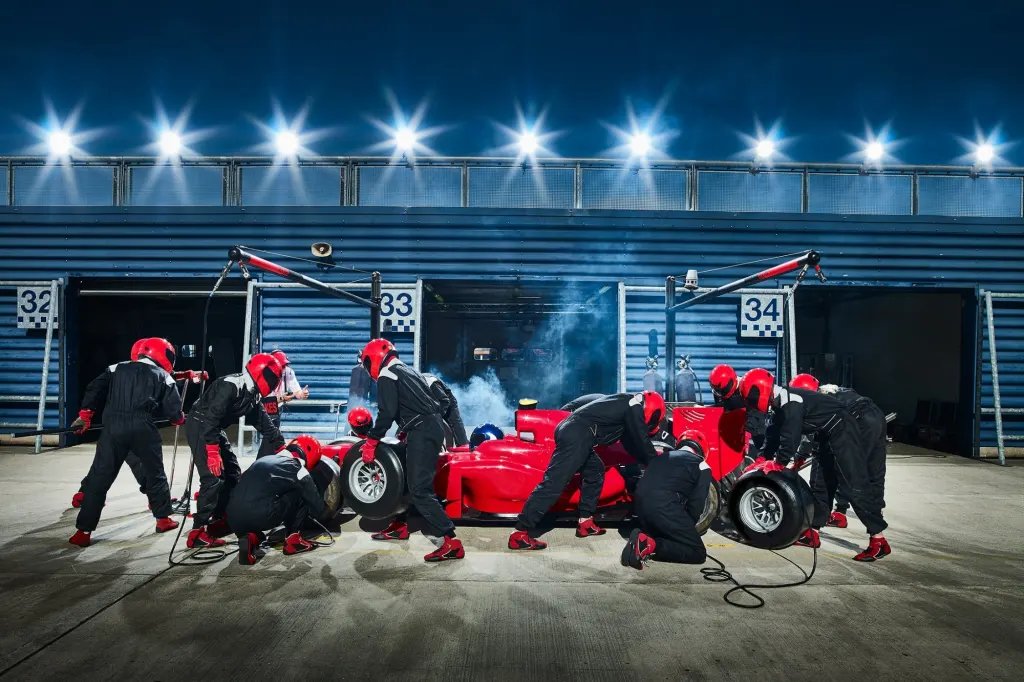
The pit wall had seconds to decide whether to bring its lead driver in or keep him out. AI-powered simulations had already run thousands of scenario projections. Telemetry was streaming in real time. But it was a human — the race engineer — who made the call. The crew executed a lightning-fast stop, the driver retained track position, and the championship was sealed. In Formula 1, advantage is measured not just in data but in decision velocity.
That moment captures something most boardrooms haven’t yet internalized: The AI didn’t win the championship. The human who knew how to use it did.
Most boardrooms have access to more data than any F1 team, yet decisions that pit crews make in seconds can take executive committees weeks to approve. According to 2024 Gartner research, 65% of organizations use data primarily to validate decisions they’ve already made, rather than letting data drive decision-making.
The bottleneck isn’t information; it’s the absence of a clear model for where AI ends and human judgment begins. Across elite racing environments, a consistent pattern emerges: High-performance teams define who decides what, ensure technology sharpens judgment instead of clouding it and execute without second-guessing.
Digital transformation fails when organizations confuse data collection with decision clarity. The pit wall offers a different model, one where human authority over AI inputs determines outcomes.
The problem isn’t a lack of data
Organizations invest millions in analytics platforms, real-time dashboards and AI systems meant to accelerate decision-making. The data flows faster than ever, but the decisions do not. What’s missing is decision design.
The European Data Protection Supervisor’s 2025 TechDispatch on human oversight makes this explicit: Automated recommendations shape the decision environment and can steer human judgment through automation bias, blurring the boundary between machine output and human accountability.
At the same time, governance maturity continues to lag AI ambition. CIO reporting from 2026 highlights a familiar pattern: While many organizations claim to have AI governance processes in place, only a small fraction consider them mature. Adoption is accelerating faster than authority models.
This is why decision speed collapses inside the enterprise. Without clearly defined ownership of AI-informed decisions, every recommendation becomes a debate. Every dashboard becomes another meeting. Every algorithm triggers escalation instead of action.
In contrast, F1 teams operate with precision-defined authority structures. The race engineer owns tire strategy. The technical director owns car setup changes. The team principal owns broader competitive calls. When conditions change, roles do not.
Most enterprises, by comparison, operate with ambiguous decision rights. When humans, AI systems and platforms intersect, ownership blurs, meetings multiply and decisions stall.
More data creates more analysis. More dashboards spawn more alignment sessions. More AI recommendations generate more debate about whether to trust the algorithm.
The gap between data investment and decision speed widens.
1. Define decision rights before the crisis hits
F1 teams don’t convene a committee meeting when rain starts falling on Lap 32. Decision authority is assigned before the race even begins. The AI runs its simulations. The telemetry streams its data. But everyone on that pit wall already knows which human makes the final call and when. When conditions change, there is no ambiguity about where the machine’s role ends and the human’s begins.
Business leaders can apply the same principle by mapping decisions to individuals based on proximity to information and speed requirements. The framework isn’t about seniority — it’s about positioning the right decision maker at the point where information converges with urgency.
Amazon’s approach to launching Web Services in 2006 demonstrates this at scale. Jeff Bezos distinguished between “one-way door” decisions that were nearly irreversible and “two-way door” decisions that could be easily reversed. For AWS (a one-way door that required massive infrastructure investment), Bezos spent two years analyzing market demand, technical feasibility and competitive landscapes. Today, AWS generates more than $100 billion in annual revenue and represents around 60% of Amazon’s operating income.
The lesson: Defining which decisions require deliberation and which require speed prevents organizations from treating every choice with equal weight. Most business decisions are two-way doors. Treating them like one-way doors creates the bottleneck.
Map your most critical recurring decisions and assign clear ownership before the next one arrives. When the moment comes, execution replaces debate.
2. Use technology to accelerate judgment, not replace it
Leading F1 teams rely on real-time telemetry and AI-powered simulations to inform pit wall decisions. But the race engineer still makes the call. Technology’s role is not to decide, but to surface the right data at the right moment and eliminate noise.
The trap many organizations fall into is asking AI to make the decision instead of using it to inform faster human decisions. Effective deployment looks different: AI narrows options from 100 to three. Humans choose from the three based on context that the algorithm can’t see — competitive dynamics, organizational politics, strategic timing, market sentiment.
Research from MIT’s Center for Collective Intelligence, published in October 2024, analyzed 370 effect sizes from 106 experiments on human-AI collaboration. Human-AI teams often underperformed against AI alone on pure decision-making tasks. But for tasks requiring contextual understanding, the combination outperformed either alone. Michelle Vaccaro, MIT doctoral student and study co-author, found that “humans excel at subtasks involving contextual understanding and emotional intelligence, while AI systems excel at subtasks that are repetitive, high-volume or data-driven.”
Stop trying to automate judgment. Automate the analysis that precedes judgment. Use AI to compress the time between question and insight, then let humans apply the strategic context only they possess.
3. Build systems that reward speed over consensus
Pit wall decisions happen in three to five seconds because the system is designed to give humans confidence in AI inputs, not to keep debating them. The race engineer doesn’t poll the garage for opinions when tire degradation accelerates unexpectedly. The AI has already done its work. The human acts.
Business leaders can establish similar velocity by implementing the two-way door framework at the operational level. Reserve consensus-building for truly irreversible choices, such as acquisitions, market exits and fundamental strategy shifts. For everything else, establish decision velocity metrics alongside decision quality metrics. Track how long it takes a human to act once AI has delivered its recommendation. That gap is where competitive advantage is won or lost.
Most decisions are reversible. The cost of a slow decision often exceeds the cost of a wrong one that gets corrected quickly. Organizations that treat speed as a feature create competitive advantage through accumulated marginal gains.
Establish clear criteria for what constitutes a one-way door versus a two-way door in your organization. Publish the framework. Train teams to categorize their decisions. Then reward the teams that move two-way door decisions fastest while maintaining quality on one-way doors.
The gap between data and decision
If we return to the 2024 constructors’ championship, the lesson is clear. Advantage did not come from information abundance; it came from clarity about who decides, confidence in the inputs and the discipline to act without second-guessing.
The pit wall advantage isn’t better AI. It’s knowing exactly where human judgment takes over from machine analysis, having the confidence to intervene decisively and designing systems that make that intervention instinctive rather than political.
Races are won between the AI output and the human decision. So are businesses.
Key Takeaways
- In elite racing environments, high-performance teams define who decides what, ensure technology sharpens judgment instead of clouding it and execute without second-guessing.
- Organizations also need clear ownership of AI-informed decisions in advance. Without it, every recommendation becomes a debate and every dashboard spawns another meeting.
- Most business decisions are reversible “two-way doors” and should be made quickly. Treating them with the same weight as major, irreversible choices is where decision velocity collapses.
On Lap 25 of the 2024 Abu Dhabi Grand Prix, one of the leading teams found itself facing a split-second call that would determine whether it secured its first constructors’ championship in more than two decades. A rival had just attempted an undercut, forcing an immediate strategic response.
The pit wall had seconds to decide whether to bring its lead driver in or keep him out. AI-powered simulations had already run thousands of scenario projections. Telemetry was streaming in real time. But it was a human — the race engineer — who made the call. The crew executed a lightning-fast stop, the driver retained track position, and the championship was sealed. In Formula 1, advantage is measured not just in data but in decision velocity.
That moment captures something most boardrooms haven’t yet internalized: The AI didn’t win the championship. The human who knew how to use it did.
