

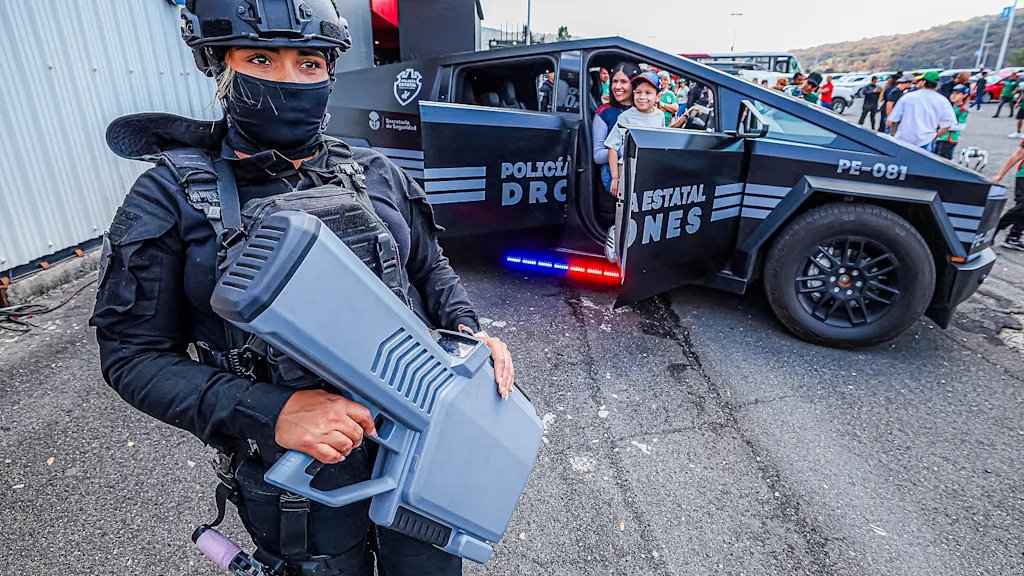
As the threat of drone attacks grows, the federal government is turning this summer into a proving ground for U.S. efforts to shore up aerial defenses at events like the World Cup. It may also serve as a launchpad for defense tech firms hoping to sell systems designed to intercept unmanned aerial vehicles.
“Out of the World Cup, you’ll see the baseline for what law enforcement and critical infrastructure sites will then buy at scale,” says Jon Gruen, CEO of Fortem Technologies, which signed a multimillion-dollar deal to provide artificial intelligence systems, radar, and drone interdiction technology to U.S. cities hosting the tournament. “You’re going to see how it worked, and see how it all fits together.”
A run of mega-events over the next few years, including this summer’s World Cup, expected to draw roughly 5 million international visitors for matches and fan zone parties, the nation’s 250th birthday, and the 2028 Olympics, has elevated drone defense as a national priority. It has also raised alarms among civil liberties groups about expanding law enforcement surveillance capabilities.
Drones are increasingly being used for asymmetric warfare, says Michael Robbins, President and Chief Executive Officer of the Association for Uncrewed Vehicle Systems International. One of the most notable examples is the Ukrainian Spiderweb attack, which secretly positioned remote-operated drones to devastate part of Russia’s bomber fleet.
“What’s different about the World Cup is the scale,” says Robbins. “It’s 11 Super Bowls at once.”
Robbins has been engaged in drone defense since 2018, when a high-profile drone intrusion at Gatwick Airport in the United Kingdom shut down airspace for two days and caused significant economic damage. In the United States, the federal government was slower to respond; for years, only a small number of federal officials were trained to take down drones.
“We don’t have the training, we don’t have the equipment, and we don’t have the number of personnel that are skilled in mitigation technology and the use of mitigation technology, particularly the application of that technology in really highly dense radio frequency environments or urban environments,” says G.B. Jones, chief safety and security officer for the FIFA World Cup 2026, in November.
