

Published April 7, 2026 03:27AM
I stepped off the bus from Tokyo and into a dense fog. The town of Kazuno, in Japan’s rural Akita prefecture, looked nearly abandoned. I’d arrived expecting the pastoral whimsy of a Miyazaki film. Instead, I seemed to have wandered into a level of Silent Hill.
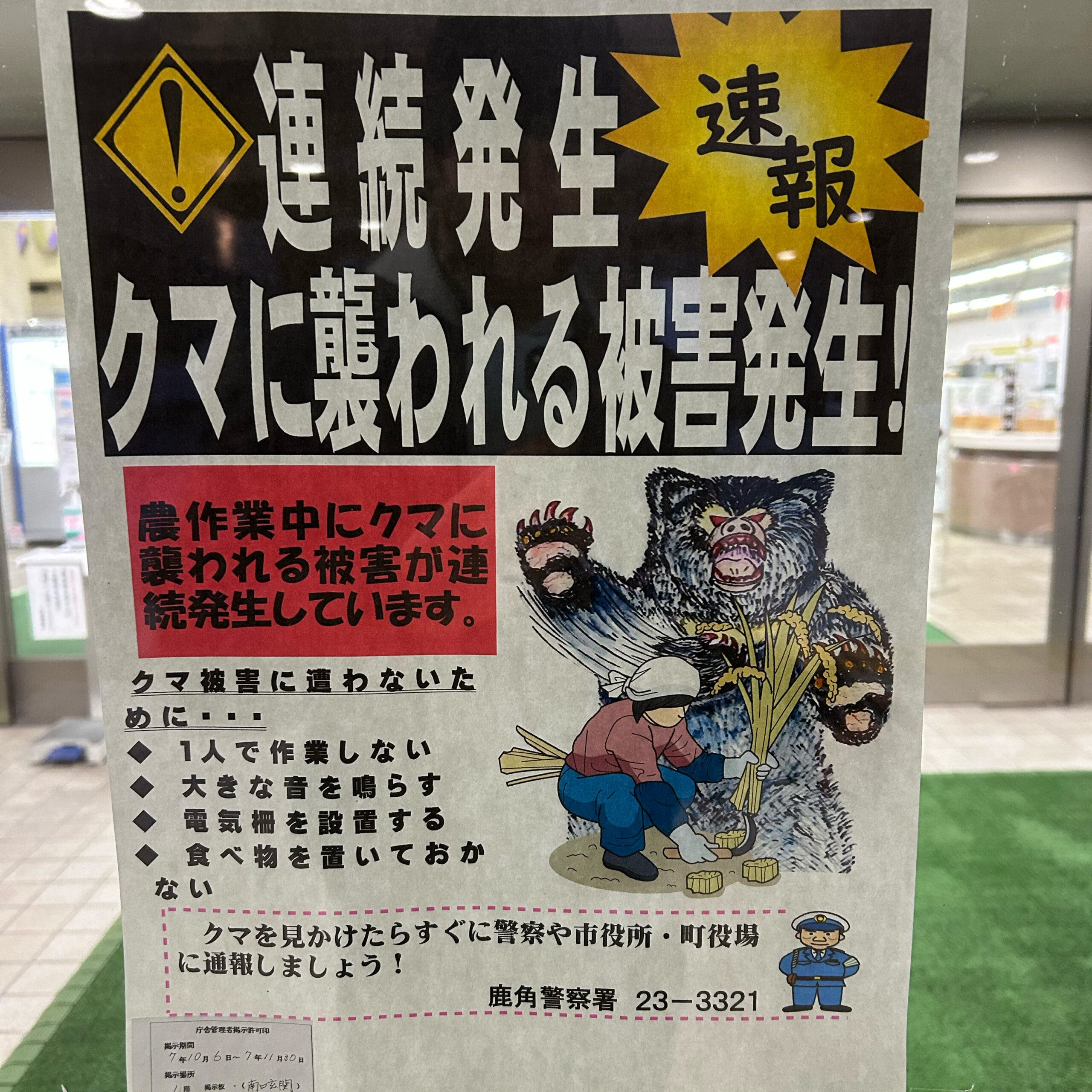
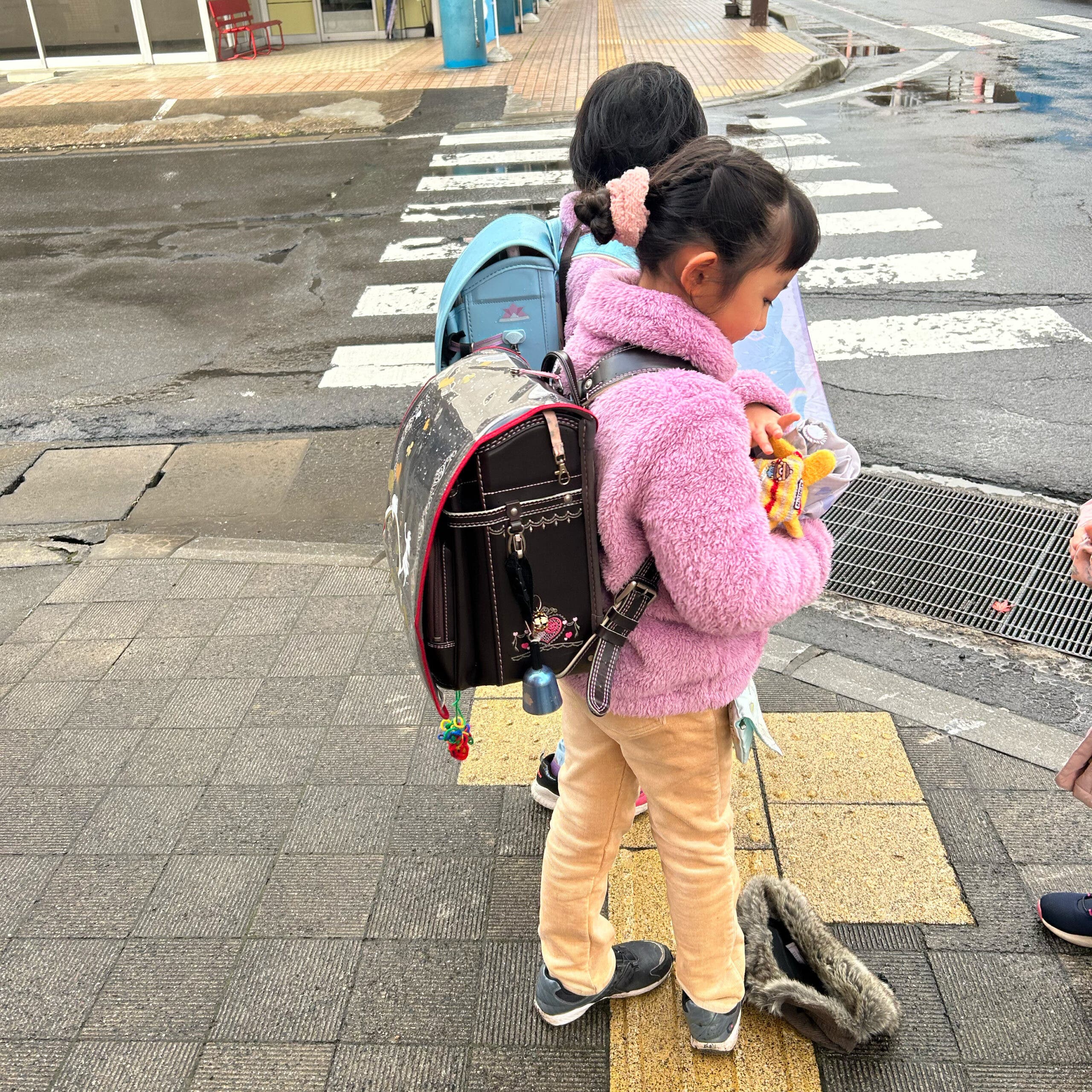
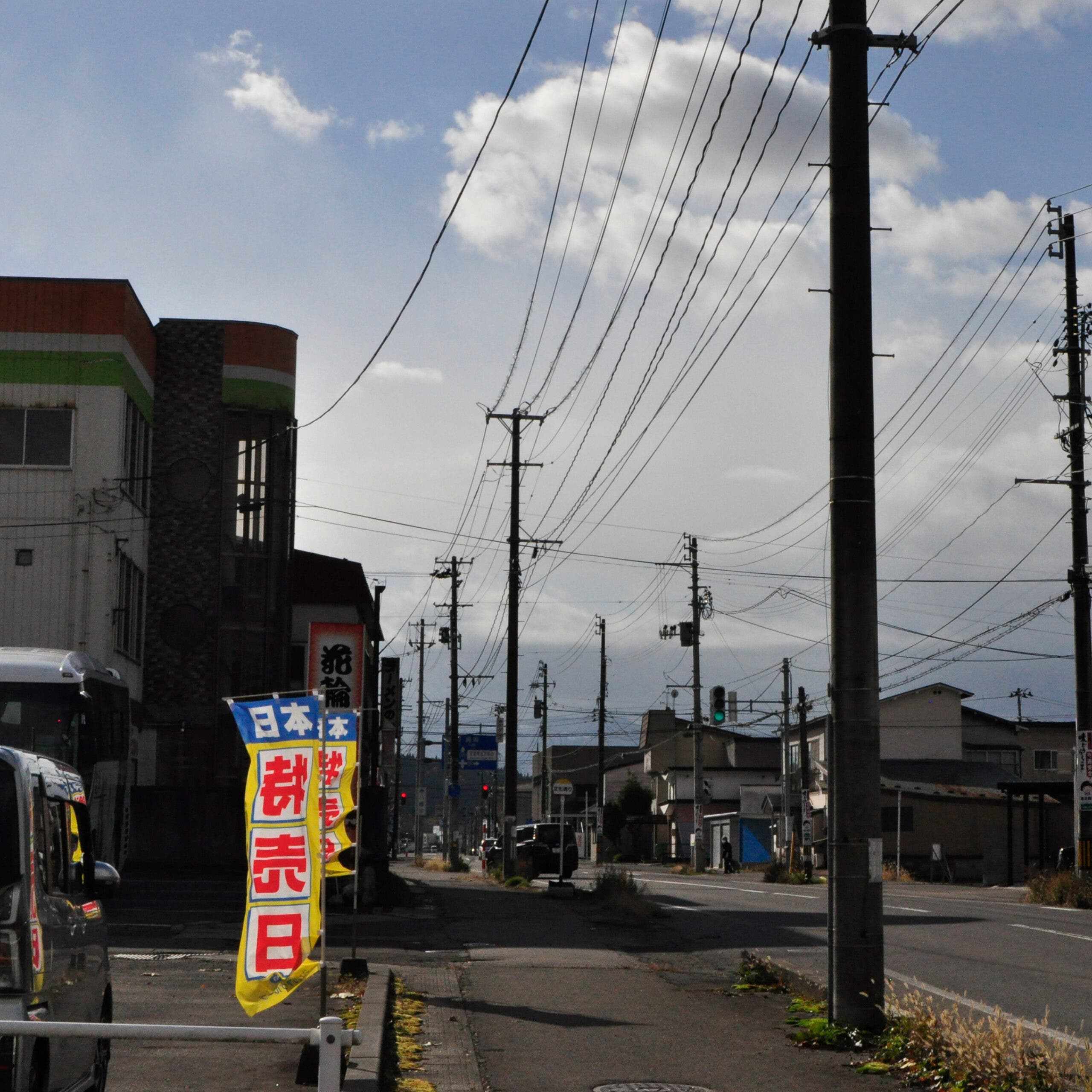
I crisscrossed the street, peering into mostly vacant shop windows, many of them plastered with flyers warning locals about bears. I saw more signs of bear safety when two elementary-aged girls passed me. Small golden bells hung from their backpacks, and long after the little girls disappeared into the fog ahead, I could hear the bells tinkling in the distance. Then, a trio of military transport trucks sped through the mist.
Kazuno, population 28,000, is a farming community in the far north of Japan’s main island, Honshu. The town is essentially one long road, wedged between the Ōu Mountains, Japan’s longest range. Rice paddies stretch for a half-mile east and west of town before the land rises into the peaks, which are carpeted by dense forests of rich, green cedar trees, interspersed with beech.
Kazuno is also ground-zero for Japan’s increasingly deadly conflict with wild bears. According to the country’s environmental ministry, from April until December, 2025, 13 people were killed by bears, and 230 were injured in separate attacks. Fifty-eight of those attacks occurred in Akita, prompting the government to take swift action. I arrived in Kazuno in mid-November, shortly after the Japanese government deployed the military there and in other towns to address the bear crisis.
The animals weren’t just attacking hikers on remote trails or farmers in their fields, either. They were increasingly venturing into residential areas, often in broad daylight, and although most of the victims were alone, bears also attacked groups of people. On October 7, a bear broke into a supermarket near Tokyo, rampaging through the sushi aisle and injuring two customers. On October 24, shortly before I arrived in Japan, a bear attacked a group of four people working outside in a small town, Higashinaruse, killing one and severely injuring three others.
Stepping into a convenience store to buy a coffee, I noticed a poster on the glass sliding door warning customers to keep it shut to prevent bears from entering. Another was even more aggressive: ANYONE, ANYTIME, ANYWHERE IS AT RISK OF ENCOUNTERING A BEAR!
Over the next ten days, I traveled through Kazuno and the surrounding towns, interviewing locals, scared residents, hunters, wildlife experts, and town officials to try and understand the bear crisis. Why were these towns so uniquely vulnerable to an apex predator, and what did the psychological toll of that constant, looming threat look like?
What I found was a story far more complex than hungry animals wandering out of the woods. The surge in attacks across Japan represents a strange new frontier in human-wildlife interaction, driven by a massive demographic shift. Today, places like Kazuno are forced to reckon with a difficult question: How do you protect a community from the wilderness when the community itself is disappearing?
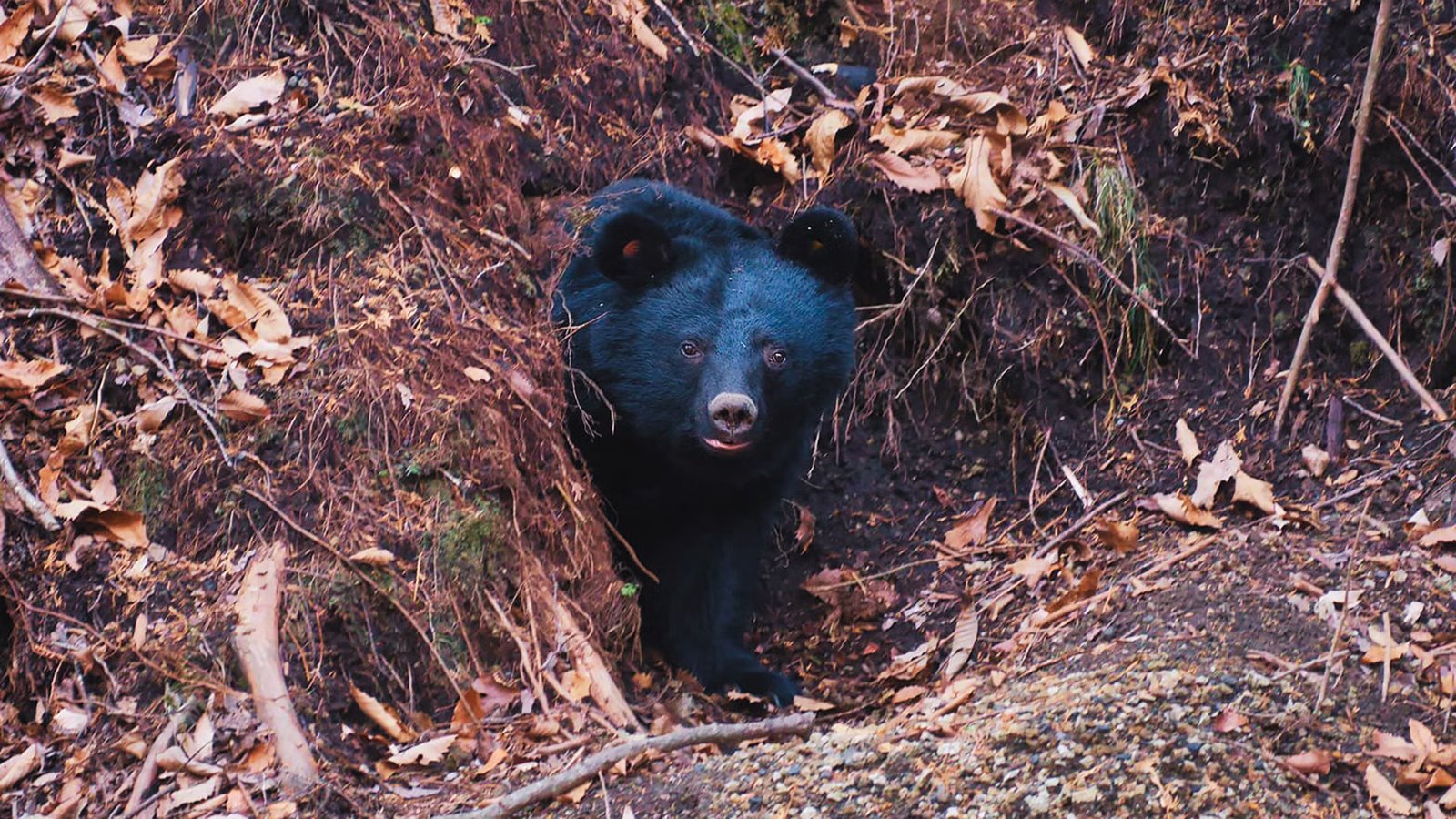
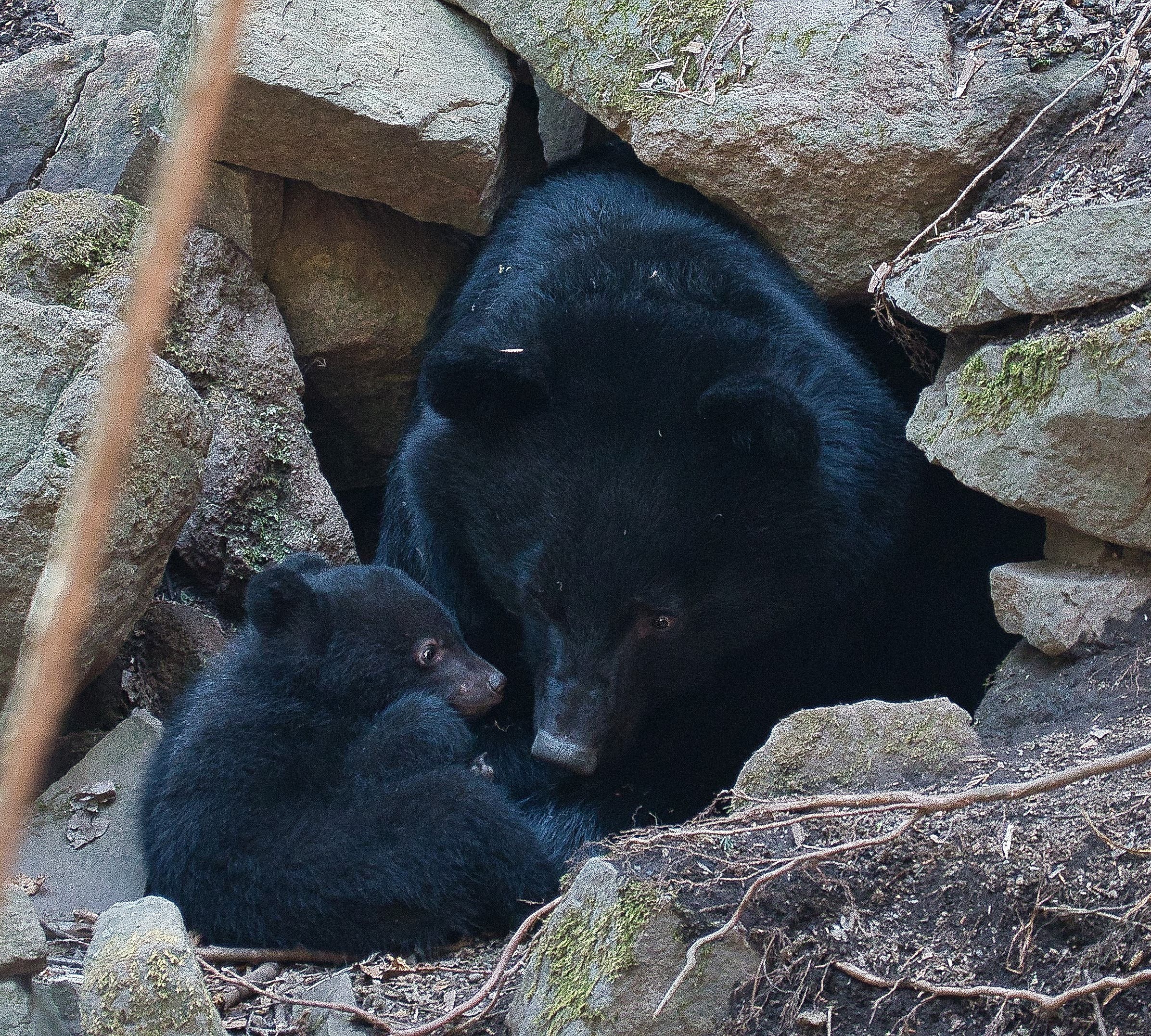
Two species of bear call Japan home. Ussuri brown bears, similar in size to the Kodiak grizzlies of Alaska, are found only on the northernmost island of Hokkaido. But on the main island of Honshu, the mountains belong to the Japanese black bear.
Dubbed “moon bears” for the white crescent pattern on their chests, these animals are smaller than their American cousins, usually weighing under 200 pounds, and subsist mostly on nuts, ants, and fruits. But these little bears, not the brown bears, were responsible for over 97 percent of the 230 attacks in Japan in 2025.
To understand the sheer density of this crisis, look at California. Japan and California are roughly the same geographic size, and the latter has even more bears (between 50,000 and 70,000, according to the state’s fish and wildlife department). Yet the outcomes are wildly different. While California deals with thousands of nuisance reports of bears each year, there has only been a single documented death in the state’s history. Meanwhile, between April and September of last year alone, Japan saw over 100 casualties and 5 fatalities.
The attacks ramped up in October, when Japan’s bears begin looking for food to build fat reserves in preparation for hibernation. On October 3, 4 mushroom pickers were mauled in the mountains of Miyagi Prefecture. One of the victims, a 70-year-old woman, later died of her injuries. On October 8, the body of another elderly woman, 73, was found near a dam in Iwate Prefecture, with injuries suggesting she’d been killed by a bear. Two days later, another man in his seventies was found dead with multiple claw marks in Iwate. The violence continued on October 16, when a famous ex-wrestling referee, aged 60, was dragged into the forest and eaten alive while cleaning an open-air hot spring.
For the survivors, the aftereffects of an attack are often mental as well as physical. When 68-year-old Akita candymaker Keiji Minatoya had his scalp nearly torn off his head by a bear outside of his garage in 2023, the encounter left him traumatized. “While it was on me, there was this terrifying roar, the sound of a wild animal. Its mouth was right here,” he said, pointing to his ear, in an interview with The Telegraph. “That sound is burned into my head.”
Billy Halloran, a 32-year-old New Zealand expat, was out for a jog near the town of Myoko in October when he saw a pair of moon bears 100 feet ahead. He tried to back away, but the bears were aggressive, and one charged. Even Halloran, young and fit, had no chance to flee. He told The Guardian that the creature’s speed and power was astonishing. He barely had his time to bring up his arm to shield his face.
“It knocked me to the ground and bit my arm,” he said. “ In that one bite, it was broken.” The bear then let go of his arm and began mauling Halloran’s leg before backing off. He survived, but his arm was broken in three places, all from a single bite.
On October 27, just a few days after the Higashinaruse rampage, an elderly man and woman were killed in two separate attacks in Iwate and Akita on the same day, bringing the death toll to 12. By this point, Akita Prefecture governor Kenta Suzuki was desperate. Nearly half of all the bear attacks in the country had occurred in his prefecture and the neighboring one, Iwate, as had eight of the fatalities. “The situation is beyond the scope that prefectures and municipalities can handle,” he wrote on Instagram that day. He noted that the prefecture was deploying as many bear traps as it could, and ensuring schoolchildren had bear spray to travel safely to and from school. But his team was tapped out, so he had formally requested aid from the Ministry of Defense.
A few days later, on November 3, a 79-year-old woman was found dead in the woods in the south of Akita. The military couldn’t arrive fast enough.
Complicating the frantic response was a glaring blind spot. It’s unclear exactly how many moon bears live in Akita. In fact, it’s unclear exactly how many moon bears there are in Japan, period. The last national bear population study was in 2011, and even this was scattershot, estimating populations ranging from 13,000 to 20,000. That’s approximately the same number of black bears living in Colorado, according to that state’s fish and game department.
In recent years, media outlets have reported moon bear populations as high as 54,000, but zoologist Amelia Hiorns, who works for the conservation organization Picchio in Karuizawa, Japan, questioned that number’s accuracy. Hiorns told me that count is based purely on increases in overall sightings (47,814 in 2025) and attacks.
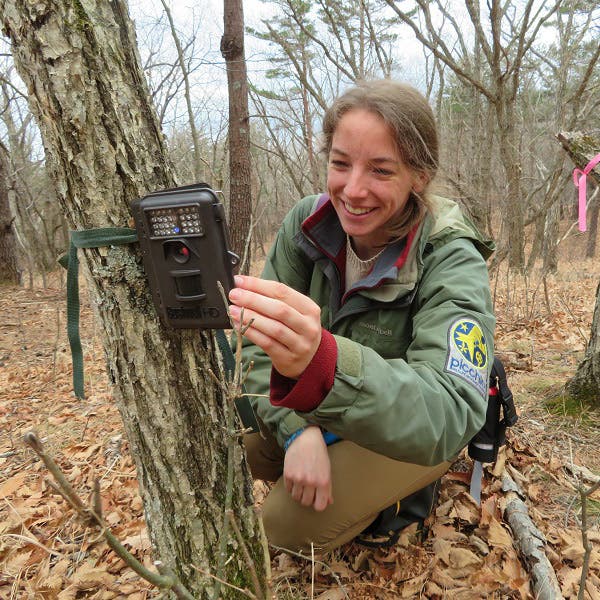
The 30-year-old Hiorns is originally from the United Kingdom, and has lived in Japan working with Picchio for six years. She specializes in animal behavior, with a focus on bears, and is part of a four-person team that Picchio employs to monitor the bears living around Karuizawa.
“I don’t think we can reliably say how many bears there are in Japan anymore,” she admitted. “It’s a real problem.”
While the government plans to launch a nationwide study in 2026 to gather more accurate numbers, in the meantime, the authorities are using lethal force. By the time I left Japan in late November, the Japanese government’s military operation—which saw soldiers tracking and trapping the bears, and local hunters killing them—had led to the capture and culling of nearly 10,000 moon bears.
It was twilight on November 10 when I rode my skateboard to Kazuno City Hall, along rainsoaked streets, past more military convoys and abandoned shops and homes. I asked to speak to the mayor in my clumsy Japanese, aided by Google Translate. The staff appeared perplexed, and when I told them I was a journalist, they became apprehensive.
A security guard approached and appeared poised to escort me out, but after conferring with a younger man in gel-slide house sandals and a suit, he relented. The town’s mayor, Shinji Sasamoto, was on a trip to Thailand, trying to drum up tourism. So instead, I met with Makoto Aoyama, the official in charge of Kazuno’s Forestry Management Division, which handles wild animal interactions.
Aoyama, a slight, middle-aged woman with long dark hair, agreed to answer my questions in writing. In a follow-up email, she explained that although bears have lived in the area since ancient times, attacks on humans in Kazuno began to steadily increase starting in 2016.
The beginning of Japan’s modern bear problem occurred in Kazuno in May of that year, with a horrific series of attacks known as the bamboo-shoot killings. A 79-year-old local man ventured into the dense mountain outskirts to harvest nemagaridake (bamboo shoots), a local delicacy. He didn’t return. His body was found later with severe lacerations. At first, authorities assumed it was a tragic but standard defensive attack by a startled bear. That same day, a husband and wife, also picking bamboo, were attacked, though the man managed to beat the animal back with a cane.
Over the following days, despite warnings broadcast over the town’s loudspeakers, three other elderly men were attacked in the exact same mountainous pocket in three separate incidents—two of them fatally. In early June, the situation reached a boiling point when a 74-year-old woman was killed in the same area. Her injuries were so severe that authorities had trouble identifying her.
Local hunters finally tracked down and shot a 150-pound female Japanese black bear nearby. When they examined the animal’s stomach, they found human remains. For the citizens of Kazuno, a terrifying reality set in: the bear had learned that humans in the bamboo groves were not a threat, but a remarkably easy meal.
Before that year, bear attacks were an incredibly rare phenomenon, Aoyama said. A mere eight fatal attacks were recorded between 1979 and 2015 on the entire main island. But after 2016, attacks began to ramp up, and since 2023, the danger has become untenable. Early mornings and late evenings are when attacks are worst, she said, but recent weeks have left some Kazuno citizens afraid to go outside alone, regardless of the time.
“People are in a situation where they could be attacked by a bear as soon as they open their front door,” she told me. “Their safe, daily lives have been completely destroyed.”
Kazuno is a hotspot for bear attacks because it’s nestled in a basin completely surrounded by the Ōu, the longest mountain range in Japan. It is essentially a bowl of human habitation surrounded by prime bear habitat. When climate change and unpredictable weather cause the acorn and beech nut crops to fail in the high mountains, the geography naturally funnels starving bears directly down into the Kazuno basin.
Pamphlets distributed by the Akita prefectural government classify bear attacks into three types: defensive attack, accidental interactions, and aggressive attacks, and explain that the vast majority of all bear attacks are defensive. But Hiorns told me some bears have actually acquired a taste for human flesh, while others can become violent after traumatic encounters.
“Bears are quite individualistic,” Hiorns explained. “So there are a variety of theories about what leads certain bears to attack.” Hiorns said that the bear who ate the man cleaning the hot spring, for example, was believed to have previously eaten meat. “There’s also a theory that if bears don’t hibernate properly, then they come out of hibernation with a weird level of hunger that their normal plant diet wouldn’t deal with,” she said.
Hiorns also described a phenomenon in which male bears kill a female’s cubs to make her available for mating. “If the mother survives, she could become highly aggressive, hyper-protective of future cubs,” she explained.
Regardless of the cause, Aoyama told me that Kazuno’s residents “want the danger of bear attacks to be eliminated as soon as possible” even if most citizens of her town don’t wish harm on all bears, just the ones who attack humans. “People love nature, including the presence of bears,” she said. “We hope that the gentle bears living in the distant forests will continue to thrive for generations to come.”
Leaving the city hall building, I faced an hour-long walk back to my lodging in the dark. Aoyama’s assistant had repeatedly advised me to leave earlier due to the growing darkness, and said that if I wanted to stay later, I would need to travel only on the main road, which was lit by streetlights.
The next morning, I learned that during the night, an 80-year-old man had been attacked by a bear outside his house just a few hundred feet from the nearby high school—and not far from the home where I was staying. The school immediately canceled all after-school outdoor activities and banned students from cycling or walking home.
Throughout my stay, I rented a room from Maki Ambo, a middle-aged woman who was a member of Kazuno’s city council. One morning, Ambo drove up into the hills and bought several pounds of bear meat from a local hunter. After boiling it for four hours into a stew, she threw a dinner party. A group of elderly men and women came over, and we shared bowls of dark, chewy bear meat, and watched news reports of bear attacks. One of the guests was a professional bear hunter.
Through a translator, he introduced himself as Metoki and told me that he was 70 years old and had been killing bears since he was 20. Soft-spoken and hunched, with a limp handshake, he looked more like a painter than a killer. He was entirely bald, but a tuft of white hair several inches long sprouted from the tip of his chin.
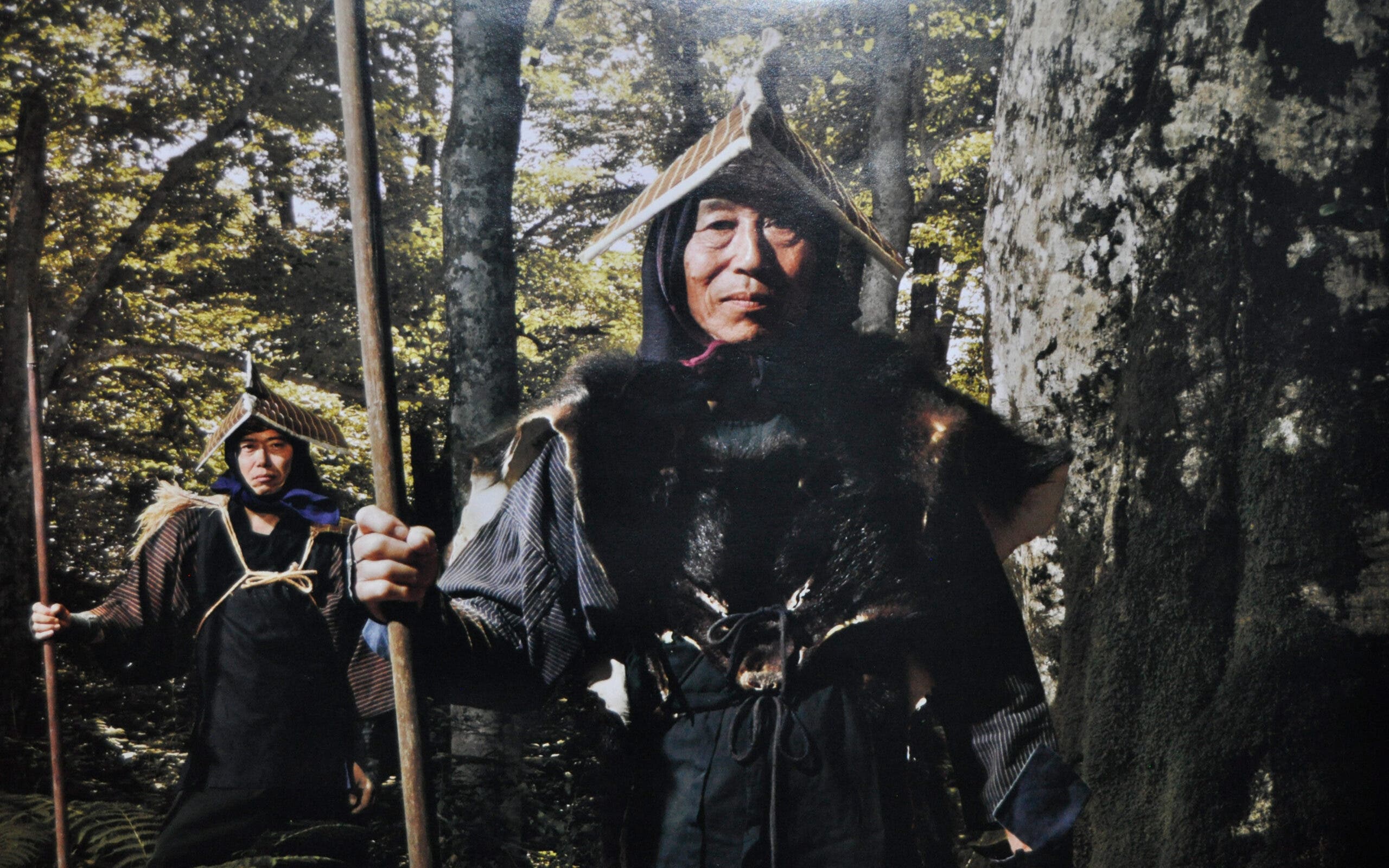
Bear hunting has a rich history in Japan. Indigenous bear hunters, known as matagi, have been active in remote, mountainous regions like Akita for hundreds of years. According to legend, the first matagi, a man named Banji Banzaburō, was given a license to hunt by the Emperor Seiwa in the mid-9th century as a reward for killing a great serpent god. This spiritual heritage is woven into the culture. Similar to the Indigenous peoples of North America, the matagi worship the bears they hunt, performing complex rites to honor the animals. The meat is eaten, furs are used for rugs, and organs serve medicinal purposes; many believe bear gallbladders, for example, can treat diabetes.
Historically, matagi were accompanied by Akita dogs, and killed the bears using large, multipurpose knives called nagasa. These knives have hollow handles, allowing a stick to be inserted to transform them into a spear.
The actual hunts are highly coordinated group efforts. One man acts as a tracker and spotter, another drives the bear ahead toward a third, who lies in wait to ambush it. “We use sake to attract the bear,” Metoki told me, grinning and gesturing to the carafe we were sharing. “They like the smell.”
Metoki, who works as a forester during the summer, said that during prime hunting season, from November to February, he kills an average of five bears a week. But the last few years have been different.
“In the mountains, there is no food for bears,” he explained. In 2025, the oak, chestnut, and beech trees failed to produce nuts, so the moon bears began wandering to find sustenance. “Bears are coming into the orchards to find apples, persimmons, and peaches to eat,” he said.
While some experts blame climate change for the lack of nuts, and thus for the bear problem, Metoki pointed to another problem: there simply aren’t enough hunters. He told me that a typical bear hunter in Kazuno is old, and there are few young people to be trained as the next generation.
Japan also has some of the strictest gun laws in the developed world. The only firearm the average civilian has a reasonable chance of acquiring is a shotgun, but the process entails classes, mental health evaluations, background checks, and marksmanship tests. Even then, a shotgun is near-useless against a bear. You’re more likely to enrage than kill it, Metoki told me.
To hunt bears, you need a high-caliber rifle. But to get one in Japan, you must have already possessed a shotgun permit for ten years. Aside from the decade-long waiting period, even the ammunition is prohibitively expensive. Metoki told me a single rifle round can cost ¥600 (nearly $4). Still, he said, these laws and restrictions are part of what makes Japan safe from gun violence.
It’s a far cry from the American West, where acquiring a hunting rifle takes an hour rather than a decade, and thousands of hunters roam the backcountry in search of bears. In many parts of the U.S., the management of predator populations is reliant on hunters. Florida, for example, just legalized bear hunting in response to rising bear populations. In Japan, the shrinking pool of professional hunters like Metoki is the only check on the bear population.
When I asked Metoki if Japan would be better off if the government adopted gun laws similar to those in the United States, he looked me in the eyes, slung back a cup of sake, and gave me the firmest answer he’d given all night.
“No.”
If guns aren’t the answer, Japan is trying everything else to chase bears away.
Watching the news one night, Ambo and I saw a clip of a moon bear encountering a highly unorthodox deterrent. An elderly farmer in a high-vis vest wielded Roman Candles fireworks like a gunslinger, firing colored balls of flame at a bear, which was in his cabbage patch. Any reasonable animal would have scampered away. But the bear looked at him lazily, more perplexed than frightened, and continued eating.
Ambo told me in Kazuno, the townspeople say that bears have become immune to traditional deterrents. It used to be enough to wear a bell—like the ones on the girls’ backpacks—to scare a bear off. Now, people carry bear spray religiously. Farmers install high-voltage electric fences around their properties. Hiorns and her bear research team use a hardy, highly-trained breed of canine called the Karelian Bear Dog to chase bears away from settlements.
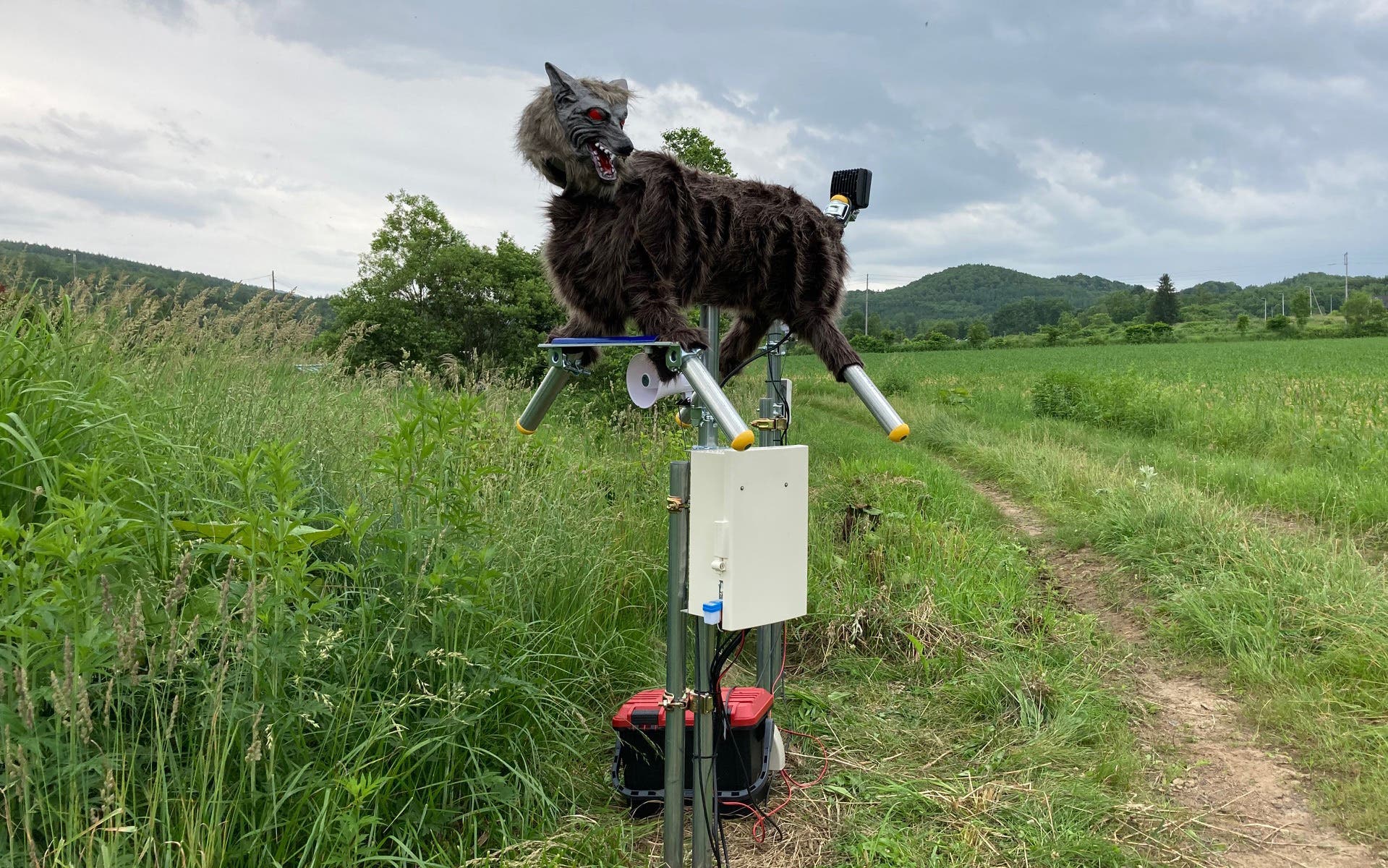
Some farmers have turned to an even more unlikely deterrent: a robotic scarecrow dubbed the “Monster Wolf.”
A faux-wolf with thick grey fur and blazing LED eyes, the Monster Wolf sits on a five-foot-tall stand. When its infrared sensors detect movement, its head swivels, its eyes shoot out laser lights, and its throat erupts with a cacophony of horrific sounds, from howls to gunshots and human screams.
Motohiro Miyasaka, the creator of this unnerving robot, told me his product recently attracted a glut of media attention. Miyasaka got the idea after hearing about children suffering epileptic seizures from flashing lights on TV shows, and realized sensory overload could be a weapon.
“Many footage clips show bears fleeing the instant their eyes meet the Monster Wolf’s,” Miyasaka said, adding that not a single bear has dared to attack one of his robo wolves.
His wolves sell for around $4,200, and he’s sold more than 350 already. He told me he is currently testing a mobile version that could patrol crops—an eerily familiar tool to one featured in the popular science-fiction show Black Mirror.
“All animals will flee when it approaches,” he promised me.
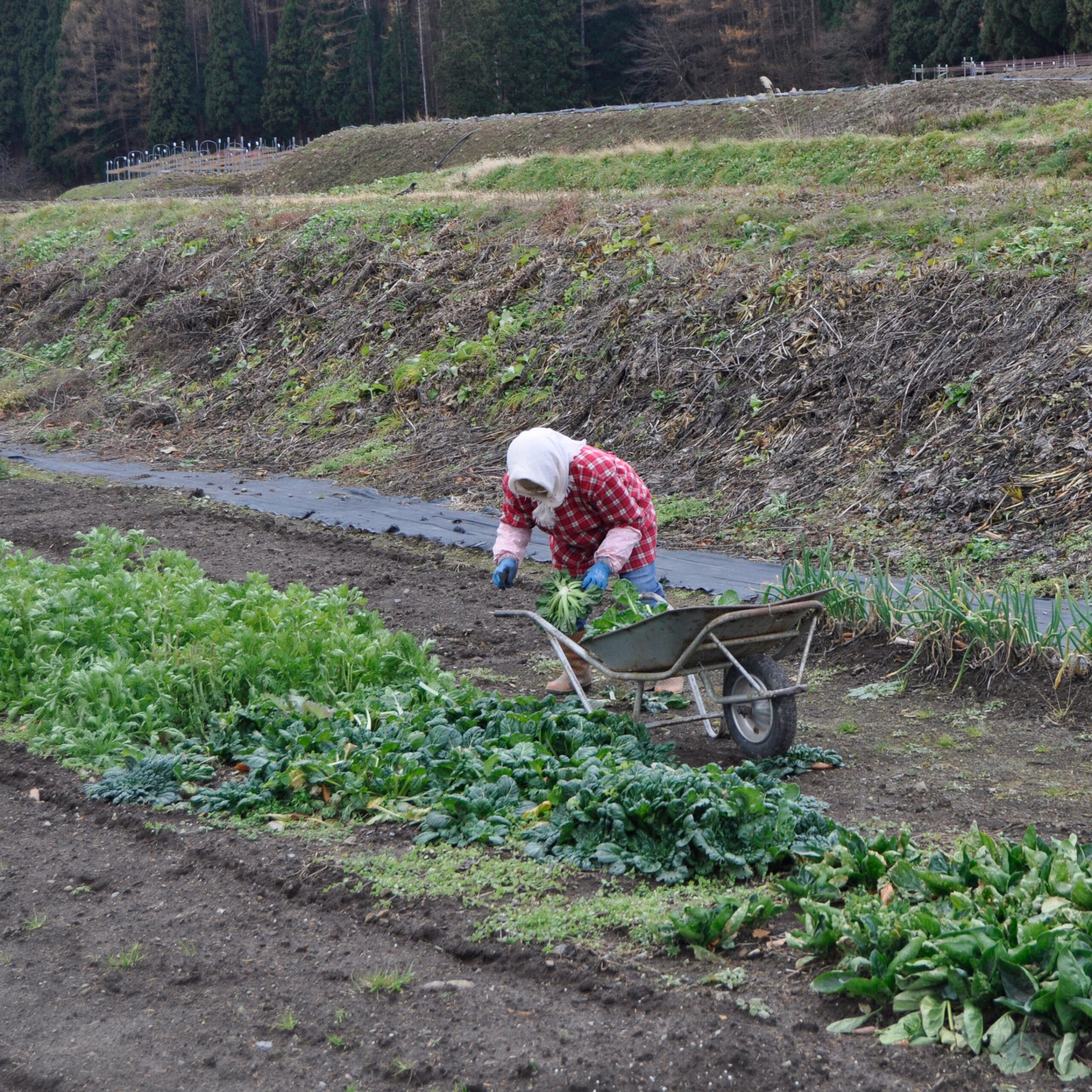
After wandering the streets of Kazuno for ten days, I was struck by the odd demographics of the town. Elderly people tended to rice paddies and apple orchards, and they milled about the local businesses. Rarely, if ever, did I see an adult under the age of 40. I saw schoolchildren here and there, but not many.
During one of my walks, I asked a local elder about the curious lack of young people in town. “What happens to these little kids when they grow up?” I inquired, gesturing to a nearby group of schoolchildren.
“They leave,” he said, shaking his head. “They go to school in Tokyo, they get jobs, they never come back.”
Japan is rapidly aging. According to statistics published by Japan’s Ministry of Health, Labor and Welfare in 2024, only 686,000 babies were born in the country, the lowest birth rate since 1899, when record-keeping began. The United Nations now classifies Japan as a “super-aged” nation. Rural areas like Akita—the country’s most geriatric prefecture—are particularly hard-hit. According to the most recent census, the average person in Akita is over 50 years old, and nearly 40 percent of the population is over 65.
This aging populace is also shrinking; Kazuno’s population has contracted by nearly a third since 1995.
Daniel Aldrich, a professor of political science and Asian studies at Northeastern University and co-director of the Global Resilience Institute, believes this staggering demographic shift is contributing to the country’s bear crisis. Alrdrich’s research focuses on how dense, closely-knit populations can boost a community’s resilience in times of disaster.
“Japanese young people don’t want to live out there,” he told me during a phone call. “They call these places inaka no naka—basically ‘bum-fuck nowhere.’”
Without enough young adults living and having children in these rural areas, towns like Kazuno are declining in population, and as they do, Aldrich explained, the zone separating civilization and wilderness can get blurry. “There are fewer vehicles on the roads, fewer hunters in the woods, fewer farmers in the fields,” he said. In some rural villages, residents replace missing neighbors with mannequins and puppets to combat loneliness.
This conclusion was echoed by Masashi Soga, a professor at the University of Tokyo’s School of Agricultural and Life Sciences. Soga’s research focuses on what he calls extinction of experience: as people move to cities, or as villages age, they lose their connection to and understanding of nature.
“Historically, rural human activity itself functioned as a form of landscape management,” Soga told me. “Active agriculture, forestry, and daily human presence created a buffer zone between dense forests and residential areas. These semi-managed landscapes reduced encounters between people and wildlife.”
In vast areas of rural Japan, farmland is returning to forest, and towns are melting into the natural world, Soga said. “As these lands revert to forest, the ecological boundary between human settlements and bear habitat disappears,” he said. “Bears are not necessarily invading human areas. Rather, the socio-ecological system that once separated humans and wildlife is collapsing.”
The flight of young people to the cities has another unintended consequence, Aldrich added. The elderly who remain in these communities are vulnerable, and they cannot respond to emergencies as quickly or effectively as young adults. “With these bear attacks, elderly people get so badly hurt because they’re by themselves, with no one to assist,” he said.
So, is there an answer to Japan’s bear problem? The solution has nothing to do with robotic wolves, roman candles, or bells, Aldrich and Soga told me. Aldrich said the country should consider a radical retreat from its rural areas. In areas where businesses are closed and homes are empty, the government should step in and relocate people to densely populated towns and cities.
“In these depopulated areas, you simply tell people, ‘We are no longer supporting services in this area. You have six months to move out,’” Aldrich said. “‘We will support you to get a new apartment or a condo someplace else.’”
Soga agreed, but noted that such a drastic urban retreat wasn’t inherently negative, and that consolidating the population in cities may improve not only people’s safety, but their quality of life. It’s important to recognize, he argued, that depopulation doesn’t necessarily mean the decline of a society.
“My own work suggests that meaningful contact with nature—both physical and psychological—plays an important role in human wellbeing and environmental stewardship,” Soga told me. “So the challenge is not simply shrinking, but redesigning society around different forms of prosperity.”
Near the end of my trip to Japan, I finally saw a moon bear. The animal wasn’t in the rugged mountains around Kazuno, but rather behind a glass wall in Ueno Park Zoo in Tokyo. The bear I saw was about the size of a large dog, playfully batting an orange buoy around like a volleyball. The scene was giving Paddington, not Predator.
These little guys were the killers?
They are—but experts told me that the bears themselves are only part of the reason why attacks on humans are on the rise. The people I interviewed for this story—from Metoki the hunter to Hiorns the biologist to Aldrich and Soga, the academics—agreed that the country’s shrinking population, specifically in its wild and rural areas, is also increasing the dangerous encounters.
“All manner of wildlife are reclaiming depopulated land in rural Japan,” Hiorns told me. “Boar, deer, monkeys, they’re all taking this land back. We just don’t notice because they’re not killing people.”
Aldrich believes other countries with aging populations should take note of Japan’s bear crisis and its underlying problem. “It’s having these problems of depopulation, low birth rates, and human-wildlife interaction before other developed nations, but it will happen to us, too,” he said.
As I watched the little moon bear batter its buoy around its glass enclosure, I thought of the empty shops and houses in Kazuno and the creeping forest edge. The military with their guns, the farmers with their firecrackers and robotic wolves.
All this defensive action felt destined to fail, because the moon bears really weren’t invading. The humans, it seemed, were simply retreating.
