

Published April 8, 2026 09:14AM
It felt like off-roading on another planet. Crumbly black cinders crunched beneath my tires, as I explored an otherworldly region of volcanic cones and craters. The overlapping 4×4 tracks and scattered stands of pine trees were the most familiar terrestrial features.
It was a warm June evening, seven years ago, at the Cinder Hills OHV Area in Northern Arizona. I’d spent the past 17 days rowing rapids on the Colorado River through the Grand Canyon, including our final night floating out under the stars. Now I was too tired to drive back to my seasonal base near Moab, Utah, so I was searching for a quick campground in the mountains outside Flagstaff.
Where on Earth is this? I wondered. The area looked like it had been hit by not just a volcanic eruption but possibly a meteor strike. Turns out, the Cinder Hills were bombarded in the 1960s. Not by extraterrestrial impactors but with explosives triggered by scientists from the USGS and NASA. They were recreating a portion of the Sea of Tranquility to prepare Apollo 11 astronauts for their Moon landing in 1969.
When I was a kid, I was fascinated by space travel and interstellar exploration. Then I became a wilderness and whitewater raft guide in college, and my interests shifted to having my own adventures here on Earth. But I never stopped looking up, and stumbling across a forgotten astronaut training site restoked my enthusiasm for the Space Age.
This time, instead of simply watching the missions unfold above our planet, I fanned out in search of space adventures down here on the ground. The next one I found was just a few miles up the road, another astronaut training site with great hiking trails through lava formations, at Sunset Crater Volcano National Monument.
There’s more to explore than most people realize, plus visiting space sites really helps bring the off-world events to life. The results of this fun mission led to a book I wrote: Space Age Adventures: Over 100 Terrestrial Sites and Out of this World Stories.
On April 6, when the Artemis II crew traveled farther from Earth than any other human in history, I was reminded of how much so many of us love space. As it happens, some space adventures are perfect for outdoorsy travelers. In addition to the ones above, here are a few of the best.
White Sands National Park and the New Mexico Space Trail
New Mexico
Tucked into the remote Tularosa Basin of Southern New Mexico, White Sands National Park is a particularly unique place to visit. It protects about 40 percent of the world’s largest gypsum dune field. It’s home to the oldest human footprints in North America, possibly dating to before 20,000 years BCE, though scientists continue to debate the precise age. Oh, and the park is surrounded by military installations.
The adjacent White Sands Missile Range is where America’s leading role in the Space Age began. In the early 1950s, in the aftermath of World War II, the U.S. Army brought captured Nazi engineers here with their V-2 rockets. The reassembled V-2s were launched for rocketry research, with several taking the first photos of the Earth from space. Other V-2s flew astray, with one landing over the border in Mexico, setting off an international incident. In time, lessons learned at White Sands led to improved rockets like the Saturn V that carried astronauts to the Moon—even as the controversial origins of the U.S. space program cast a pall over the triumphs.
Today, the park offers dune sledding, cycling, and a series of longer and shorter hiking trails leading through the dunes. The strenuous Alkali Flat Trail is a five-mile loop that leads to an ancient lakebed and offers views toward the missile range. You can get an even closer look by visiting the nearby White Sands Missile Range Museum. It’s located on base, so follow the instructions to pick up a visitor pass.
Those are just two worthwhile stops on the New Mexico Space Trail, a futuristic driving loop with an Apollo-era website. In the park gateway town of Alamogordo, there’s the excellent New Mexico Museum of Space History. To the east, in the Sacramento Mountains, you can walk the grounds at Apache Point Observatory. Further west, guided tours are possible at Space Port America, home of Virgin Galactic’s space planes. Or head to Socorro for a self-guided walk below the Very Large Array, the string of radio telescopes made famous by the 1997 movie Contact.
The Green Bank Observatory
West Virginia
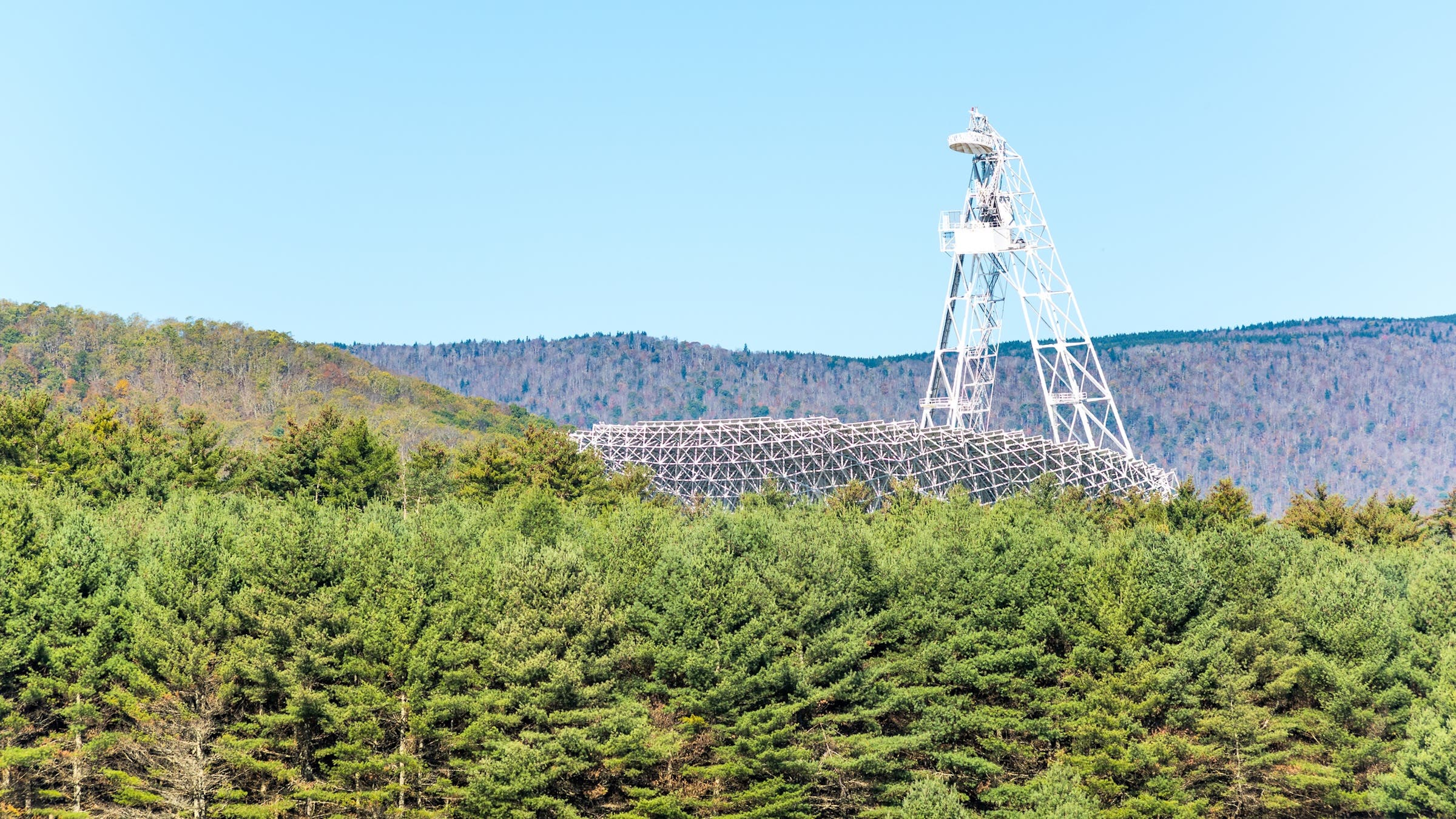
In 1958, the National Radio Quiet Zone was established in a remote part of the Appalachians. One purpose was to limit radio-frequency interference at the Green Bank Observatory, an astronomy facility in the Alleghany Mountains.
Radio telescopes work by pointing massive dishes at the sky to collect radio waves emanating from celestial objects. Since the dawn of the Space Age, such telescopes have been involved in fascinating astronomical discoveries related to the Big Bang, Black Holes, and more. In 1977, the Big Ear radio telescope in Ohio recorded the mysterious Wow! signal, long debated as the most promising sign ever detected in the search for extra-terrestrial intelligence.
Like other radio observatories, Green Bank has nearly a dozen working and retired telescopes, including one of the largest in the world. Unlike most facilities, Green Bank also has about a dozen miles of paved and unpaved trails, which are free to access, snaking through its campus.
After touring the small museum, leave all electronics in your vehicle, a requirement to protect the sensitive instruments. Then go on foot or hop on a bike for a surreal ride through the Space Age. Further trails and adventures can be found in the surrounding Monongahela National Forest, with one highlight being the hiking trails and rock-climbing routes at Seneca Rocks.
The Extraterrestrial Highway
Nevada
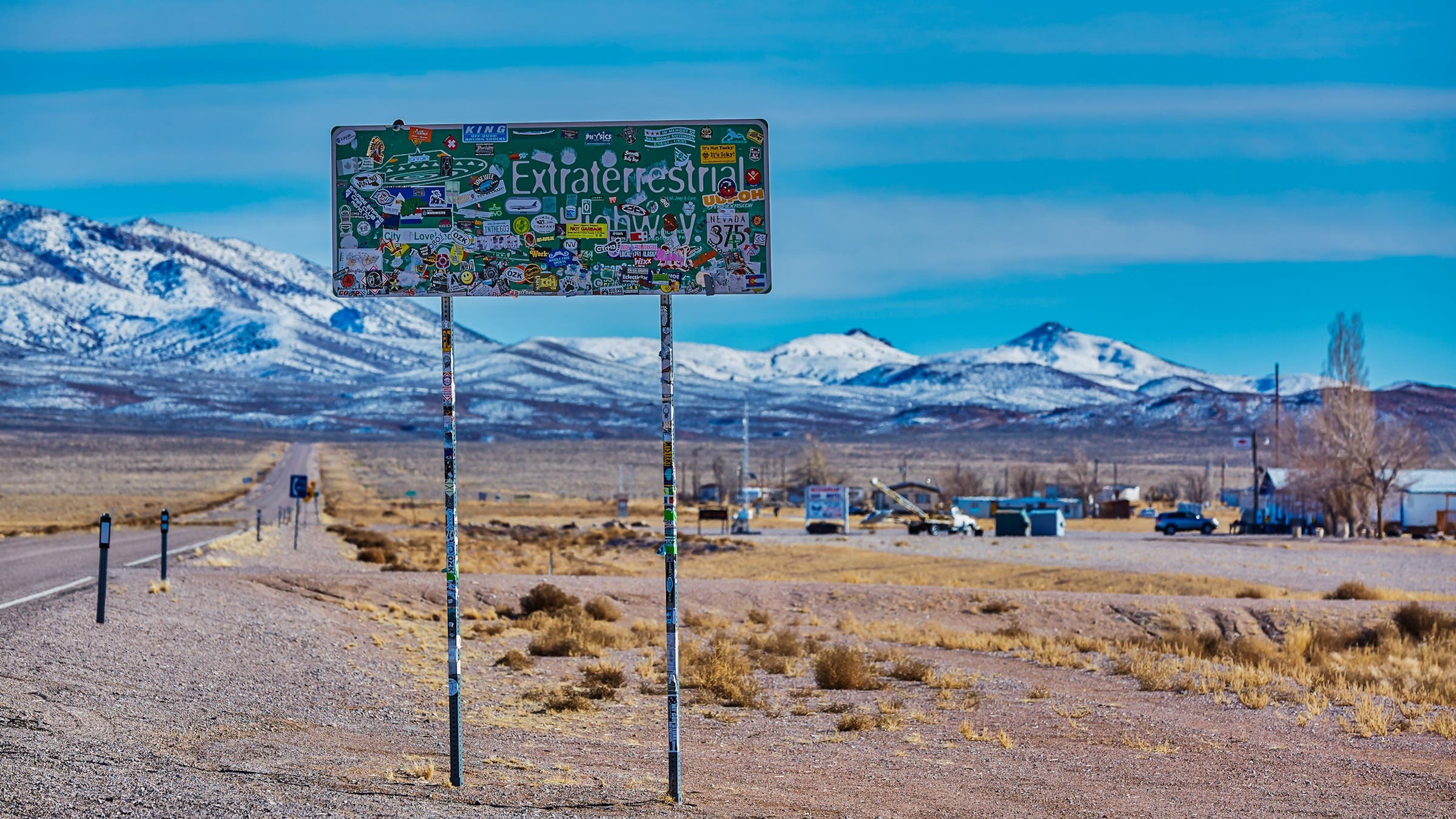
The Silver State has its share of kooky attractions. A city of sin called Vegas. The biggest little city in the world called Reno. And an infamous military base called Area 51. That’s where conspiracy theorists claim the government hides evidence of aliens. So, of course, the entrance gates were “stormed” in 2019, by about 150 charismatic influencers seeking attention the truth.
Passing through it all is the so-called Extraterrestrial Highway, a roughly hundred-mile stretch of NV-375. The north end is at a random junction near Tonopah. The south end is a random junction near Alamo. In between, it’s a scenic desert known for UFO sightings, campy artwork, and strange stops from the Space Age.
One highlight, if you can call it that, is the former atomic weapons testing ground officially named the Nevada National Security Site. Apollo astronauts learned about crater formation and ejecta here. Today, the government site can occasionally be visited on guided tours through the National Atomic Testing Museum in Las Vegas.
For an outdoorsy detour, head north from the ET Hwy on US-6 and dirt roads to Lunar Crater. This free site is an undeveloped national natural landmark on BLM land, named for its resemblance to impact craters on the Moon. However, this feature was actually created by a terrestrial volcanic process. For that reason, it was visited by Apollo 16 and 17 astronauts who hoped but failed to find comparable volcanic features on the lunar surface.
Impact Craters
Arizona and Utah
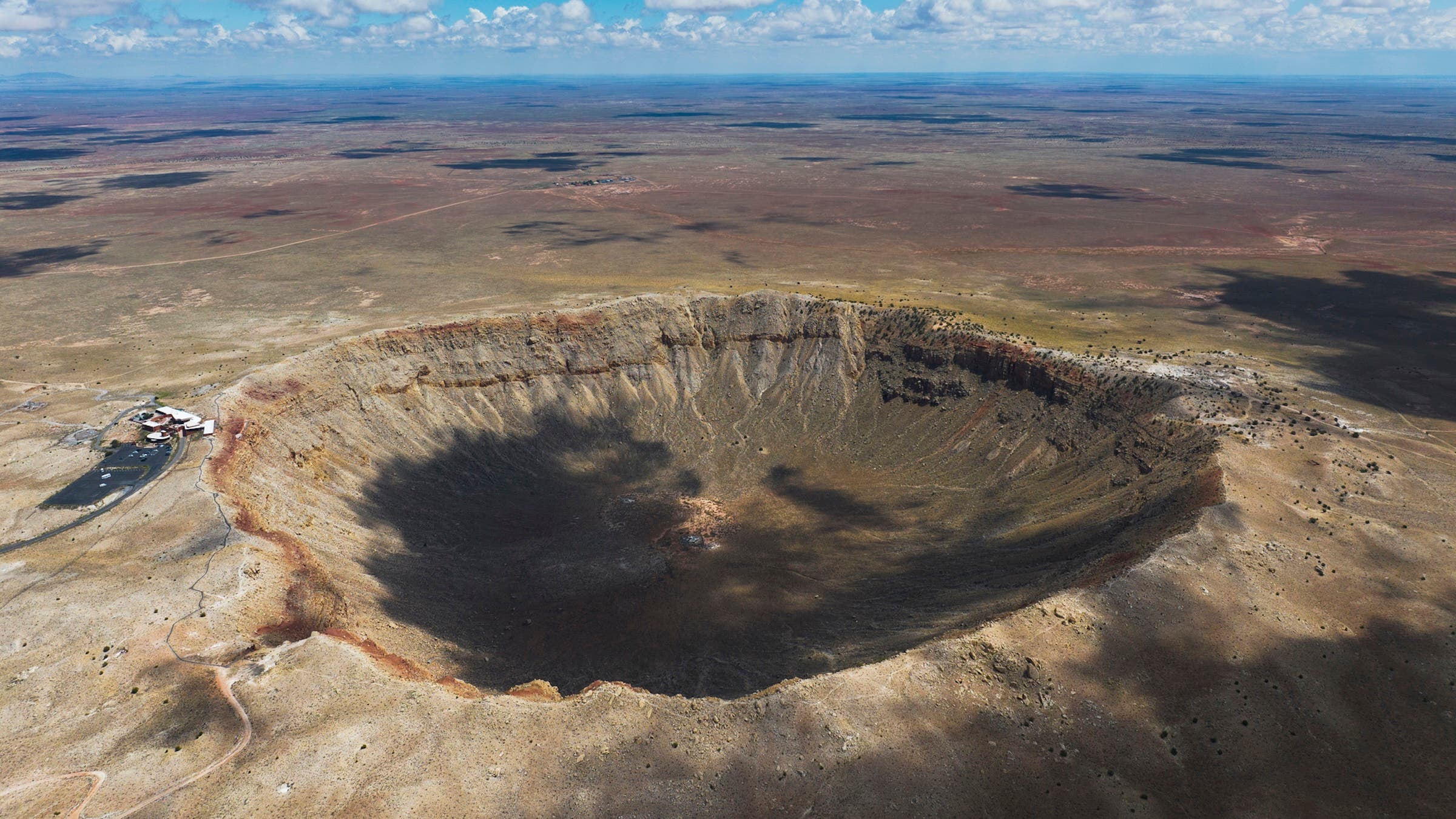
It’s wild to realize that until about 65 years ago, Meteor Crater in Arizona was widely thought to be volcanic. In fact, until the 1960s, the prevailing belief among most scientists was that all craters on Earth were calderas formed from either collapsing volcanoes or a hypothetical process called crypto-explosions—(doesn’t exist, calm down, fintech bros).
It wasn’t until humans started launching satellites and crewed missions, and the Space Age was about ten years old, that a major shift in knowledge occurred. With better images of the Moon and other planets came a sudden realization: some terrestrial craters were the result of space rocks and comets whizzing around the cosmos and occasionally striking ground.
Today, Meteor Crater near Winslow, Arizona, is widely considered to be the best-preserved impact feature on Earth. It’s also the site of a privately owned indoor-outdoor science museum.
For an even bigger adventure, head across the state line into Utah. Aim for Canyonlands National Park, more specifically, the northwest corner of the Island in the Sky District. Your target is Upheaval Dome, the most otherworldly formation in a region known for its stunning geology, including arches and spires.
The exact mechanism behind Upheaval Dome’s creation remains uncertain, but evidence increasingly points to an impact. Shorter hikes lead to viewpoints from above. The Syncline Loop heads down into the upheaval. It’s the toughest trail in the district, over ten rugged miles, including the must-see side hike inside the bizarre central crater. It’s an outdoor mystery that’s straight out of the Space Age. Just don’t forget to look up.
