

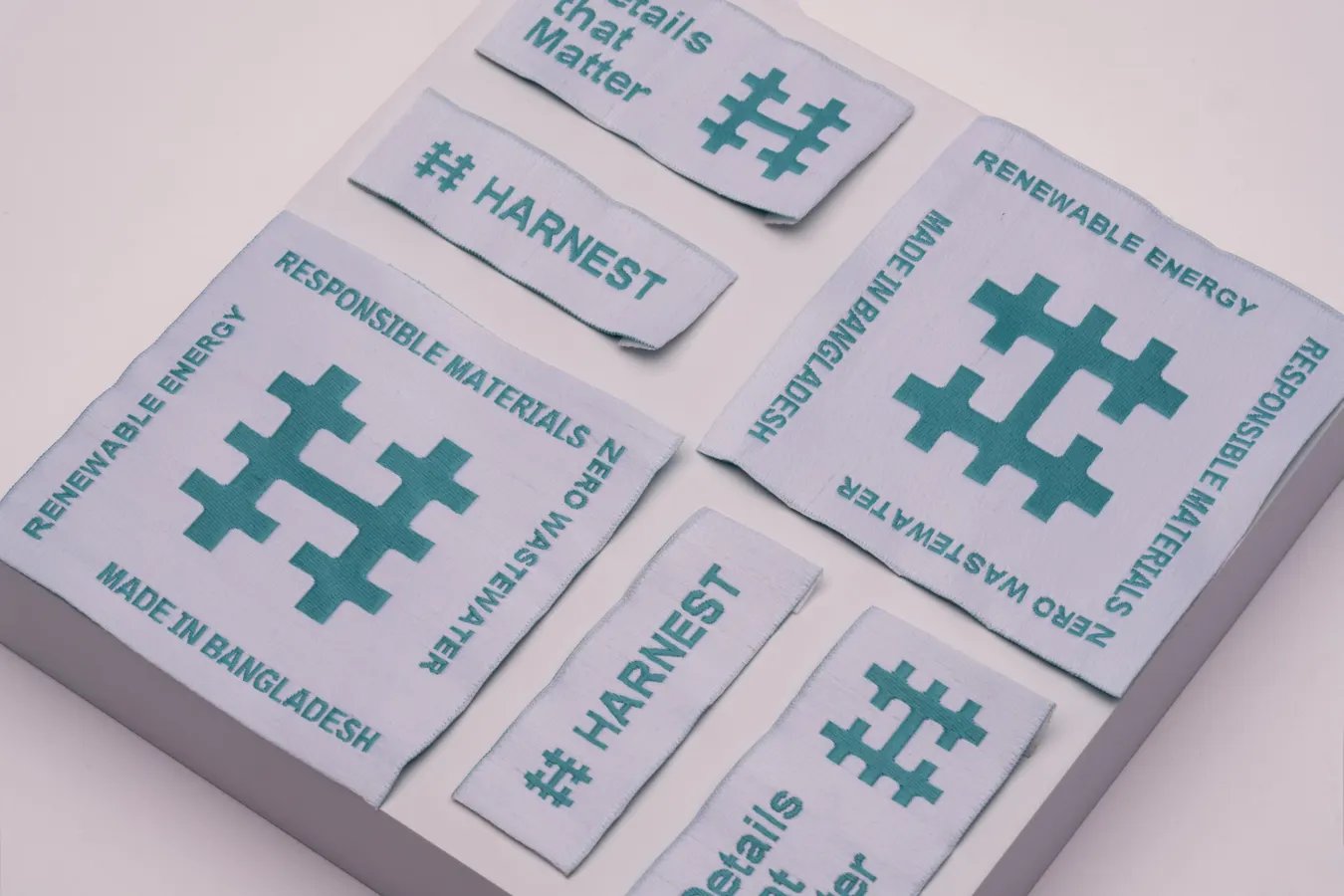
Harnest Oceansafe biodegradable garment labels
Harnest
Four decades ago, Bangladesh’s garment industry consisted of small sewing workshops assembling pre-cut garments from Korea. Today, Bangladesh is the world’s second-largest garment exporter, with exports climbing from $31 million in 1983 to $39 billion by 2025. That 1,000× increase was powered by abundant, low-cost labor and expertise in producing cotton-rich knitted garments and woven shirts and trousers.
But Bangladesh’s garment industry is now reaching the limits of a low-cost manufacturing model and must move into more sophisticated, value-added production, according to World Bank analysis. The country knocks on the door of graduation from ‘least developed country’ status, meaning it will lose some duty-free trade benefits; and rising wages already mean countries like Ethiopia and Cambodia can offer lower cost production. Can Bangladesh transcend its cornerstone ‘basic, low price cotton garments’ reputation? Is its manufacturing infrastructure evolving, and are brands’ sourcing strategies in Bangladesh changing with it?
Why Bangladesh’s Garment Industry Must Move Beyond Low Cost
Four years ago, UK-based Equip Outdoor Technologies began sourcing from Bangladesh, following 18 months of due diligence with support from partner FairWear. Matthew Bingham, buying and sourcing director, says, “We make cotton t-shirts [there] like everyone, through to synthetic insulation jackets, taped rainwear, wovens, knits and fleeces.” Their three suppliers, one Chinese-owned and two Bangladeshi-owned, now account for a quarter of all production for their two brands: Rab and Lowe Alpine.
Rab Force Collection UV protection base layer
Lena Drapella
Equip Outdoor Technologies has grown from $27 million to $143 million in annual revenue since Bingham joined the company twelve years ago, with key supplier relationships in China dating back 25 years. “[Our] preferred factories in China can’t recruit workers as the economy progresses,” says Bingham, prompting expansion to Bangladesh to mitigate this risk. The brand’s growth has also contributed to the decision. “[Product] categories that are growing need to be split across geographies and factories.” But the expansion has introduced logistical and cultural challenges, he says.
“We make technical apparel from fabrics that are specialized and come from China. Bringing fabric in from China to Bangladesh takes a month via Chittagong’s deep sea port, compared to 2 days in China”. He says transporting goods out of Bangladesh can take a month, but “the infrastructure has gotten better in the past year”.
How the Garment Industry Is Expanding Beyond Final Assembly
A pain point in Bangladesh’s supply chain is that it’s still geared toward final garment assembly, but more manufacturers are expanding to fabric and yarn production so that fabrics do not have to be imported. This expansion, however, has mostly been in knitwear and cotton-rich textiles. One example of such expansion is Viyellatex.
Established in 1996 as a garment manufacturer, Viyallatex’s operations now include yarn spinning, textile production, dyeing, printing, and embroidery. “Our expansion was from pain– when we struggled with fabric and yarn [supply], we set up fabric manufacturing, then a spinning mill,” says founder, chairman, and CEO, David Hasanat. Vertical integration has enabled the family-owned company to invest in regenerative cotton and low-impact dyes and chemistries, which have acted as drawcards for premium brands such as Ralph Lauren, according to the brand’s factory list.
Amir Hasanat, Director at Viyellatex and son of David, says their eyes are now on synthetics. “Man-made fibers are something that we need to focus on – it’s a journey we need to start”. Currently, most synthetic materials, like those sourced by Equip Outdoor, are imported. While Viyellatex has conducted test runs of synthetic garment assembly, Hasanat explains that certain characteristics related to snagging and quality control require careful consideration and expanded skill sets that, while possible, require new setups and expertise.
Can the Garment Industry Scale More Technical Production?
Consultant and former Puma Chief Sourcing Officer, Anne-Laure Descours, has worked with Bangladeshi suppliers for more than three decades. Descours encouraged the installation of the country’s first seamless knitwear machines at Urmi Group to produce leggings and underwear that fueled the athleisure boom. These products still rely on imported synthetic yarns, though. “On the machinery side, they have been investing in Tier 2 and 3; this is already in traction”. Descours says they are becoming a “tech-driven workforce–they build systems and processes internally, not to a China level, but with a lot of improvement”.
Descours recounts that Bangladeshi suppliers were “one of the first ones scaling mechanically recycled cotton from post-industrial waste to [include] 25% recycled cotton” for high volume production. “DBL is very strong on this–our first [quantities] came from them”. While this innovation meets the sustainability demands of brands and aligns with Bangladesh’s strength in cotton knits, another manufacturer is tackling a more challenging segment further up the supply chain.
Why the Garment Industry Is Investing in Trims and Synthetics
Harnest is a rare local producer of synthetic yarns for sock, sweater, and hosiery production, as well as sewing threads, elastics, drawcords, garment labels, and other related components. The company was acquired by family-owned pharmaceutical company Drug International Limited in 2015 and has invested heavily in infrastructure at its landmark zero-wastewater-discharge plant, increasing its capacity 10-fold in the past two years.
Harnest yarn spinning, Gazipur, Bangladesh
Kazi Shumon Reza, eCarnival Limited
“Trims are painful [to produce] and extremely specific, yet critical,” says the Harnest Chief Executive, Assef Shaikh. “Setting up a trims facility requires significant capital–far more than a garment factory” and is the reason more companies in Bangladesh are not doing this at scale, according to Shaikh, whose family owns the parent company. “We are part of a larger debt-free conglomerate with healthy reserves, so we can make these investments without always having to have a healthy return. Our risk is just investment in the new feedstock [that] drops into [our] infrastructure”.
The Chief Executive speaks of investments in recycled, ‘next-generation’ and biodegradable raw materials to produce their sewing threads, elastics and drawcords. Their new endeavor – the ‘Responsible Trims Collection’ – matches the performance and price of conventionally made trims, but meets the ‘preferred’ and ‘low impact’ materials criteria that brands are setting in the wake of regulatory pressures. Simultaneously, major consumers of synthetic fabrics have publicly announced ambitious sustainability goals, including Lululemon’s ‘100% preferred materials by 2030’ and ‘fully circular ecosystem’ targets, yet many of these preferred or recycled fibers have struggled to achieve commercial scale to make such targets achievable.
Harnest Oceansafe biodegradable elastic
Kazi Shumon Reza, eCarnival Limited
Harnest’s partners in the responsible trims venture include OceanSafe, Ambercycle, BlockTexx, Indorama Ventures, and Jiaren, which provide secured feedstock of lower-impact raw materials. The company is betting on establishing direct sourcing agreements with brands, allowing them to nominate the use of their locally manufactured, responsibly sourced trims in garment manufacturing, in place of imported conventional ones. It’s a timely move with increasing volatility in global markets, meaning that local sourcing with more flexible lead-times could help reduce sourcing and supply chain risks, and boost expanded production in Bangladesh beyond ‘bread and butter’ fabrics and garments.
What Global Brands Still Need From the Garment Industry
Sustainable materials and trims are focal areas for Ashish Ahlawat, Head of R&D at Swedish retailer Ridestore, which owns brands Dope and Montec. Serving ski, snowboard, and outdoor enthusiasts, the retailer’s annual sales hit $100M in 2023 and continue to grow, with Bangladesh among its sourcing countries. Unusually, Ahlawat sources textiles, not garments, from Bangladesh. “We have one style of polyester fabric that we share [bulk orders of] with other big brands – it’s those kinds of products Bangladesh is super good at,” he says. The textile is an internal insulating component of puffy ski jackets constructed in Vietnam, with the outer materials made in Taiwan.
Ahlawat says that, given the specialized requirements of their technical gear, working with suppliers who are extremely systematic and rigorous is paramount. “There is nothing fundamentally wrong [with the approach in Bangladesh], but they lack that back office function [which means] the thoroughness is missing sometimes.” The Head of R&D is exploring ways of expanding production in Bangladesh, but the technical knowledge gap could be a limiting factor: “They can make beautiful products with beautiful craftsmanship, and the people are amazing, but [ultimately], I need the FDS [Fabric Datasheet] with all the information”. But there are management and engineering advances on the horizon.
Ridestore brand Dope’s bestselling ‘Spartan’ jacket
Oskar Kultje Nystrom
The aforementioned World Bank report on Bangladesh’s innovation gap highlights the emergence of the sector in Bangladesh without significant foreign direct investment (unlike Vietnam, Cambodia, and others) and, therefore, the dominance of family-owned businesses that are less likely to hire external managers who bring such systems with them. The next generation of managers is now stepping in, bringing international education and experience to reshape the future of their family businesses–Hasanat and Shaikh included.
Another potential limiting factor for expanded sourcing could be the perception of ‘Made in Bangladesh’, says Ahlawat. “It’s challenging because when we say Bangladesh, people think of Rana Plaza, and unfortunately, there is that negative perception sometimes,” he adds.
Over the two decades he has sourced from Bangladesh for various brands, the R&D expert says one of the biggest challenges has been convincing internal teams to travel to Bangladesh for the necessary factory audits to commence business there. He says that if they have the option to go to Vietnam instead, they will. Furthermore, technical outdoor wear typically has margins that allow flexible sourcing, so decisions are never just about price, compared to ‘bread and butter’ cotton basic apparel, for example.
The Next Phase for Bangladesh’s Garment Industry
While the capabilities of Bangladesh textile and garment manufacturing are expanding, companies, including Viyellatex and Harnest, are working to fill any potential gaps in local engineering and technical know-how. As Descours puts it, “Bangladesh has been developed by Bangladeshis”–a nod to the entrepreneurial self-sufficiency that has taken its garment sector from tens of millions to tens of billions.
But the next phase of Bangladesh’s garment industry demands more sophisticated skillsets and infrastructure for added-value production to maintain its export competitiveness. Despite the challenge, which follows a string of others, including Covid-related order cancellations, political upheaval, and environmental disasters, “Bangladeshis are very gritty, they will never stop showing up,” concludes Ahlawat.
