

Topline
The full flower moon — named for spring blossoms across North America — will turn full on Friday, May 1, 2026. This year’s flower moon will be best seen rising at dusk on May Day, glowing low on the eastern horizon shortly after sunset. It will be the first of two full moons in May, with the second on May 30 dubbed a blue moon.
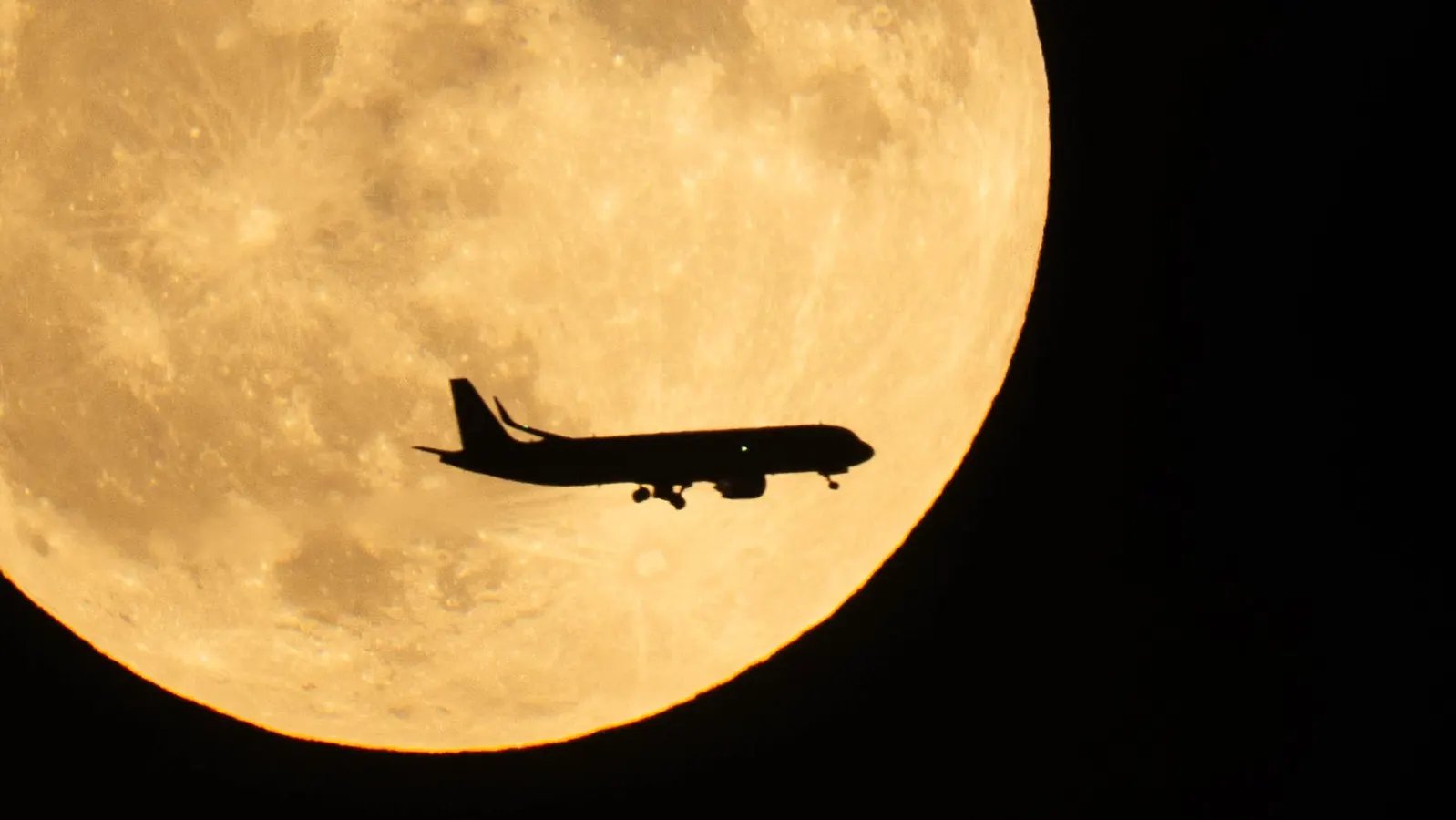
A plane retracts its landing gear in front of the full moon, also known as the Flower Moon, over north London. Picture date: Monday May 12, 2025. (Photo by James Manning/PA Images via Getty Images)
PA Images via Getty Images
Key Facts
The flower moon will turn full at 1:24 p.m. EDT on Friday, May 1, 2026. It will appear full the night before and the night after, but the best time to watch it rise in North America will be at moonrise during dusk on Friday, May 1, when it appears on the eastern horizon shortly after sunset.
According to the Old Farmer’s Almanac, May’s full moon is commonly known as the Flower Moon, reflecting spring blooms. Other names include the Budding Moon, Leaf Budding Moon, Planting Moon, Egg Laying Moon and Frog Moon.
The Flower Moon is not a supermoon in 2026. The moon’s orbit around Earth is slightly elliptical, meaning each month it reaches a closest point (perigee) and a farthest point (apogee). A supermoon occurs when a full moon coincides closely with perigee, making it appear slightly larger and brighter in the sky. Since it occurs close to apogee, the Flower Moon is the opposite — a micromoon.
A full moon always looks most impressive when it first appears above the eastern horizon during dusk. It’s at its most impactful when moonrise occurs shortly after sunset, which it does this month across North America and Europe.
Best Time To See The Full ‘flower Moon’ Rise
To see the flower moon at its best, find an elevated location, open countryside or an east-facing coastline with a clear view of the eastern horizon. To determine the exact time of moonrise from your location, check a moonrise calculator. Here are sample times:
- New York: sunset at 7:51 p.m. EDT, moonrise at 8:17 p.m. EDT on Friday, May 1.
- Los Angeles: sunset at 7:36 p.m. PDT, moonrise at 8:04 p.m. PDT on Friday, May 1.
- London: sunset at 8:22 p.m. BST, moonrise at 8:46 p.m. BST on Friday, May 1.
Why The Full Moon Looks So Large
Moonrise is the best time to experience the so-called “moon illusion,” when the moon appears dramatically larger near the horizon. This optical illusion is caused by the human brain comparing the moon to foreground objects such as trees, buildings and mountains. Although the moon’s physical size does not change, it can appear significantly larger when low in the sky. According to NASA, there is still no satisfying scientific explanation for why the illusion is so powerful.
The Full Flower Moon rises near Molfetta Cathedral in Molfetta, Italy, on May 12, 2025. (Photo by Davide Pischettola/NurPhoto via Getty Images).
NurPhoto via Getty Images
When Is The Next Full Moon?
The next full moon after the flower moon will be May 31’s blue moon, the second full moon in the same calendar month. However, the night to watch the moonrise will be on May 30, when the almost-full moon will rise shortly after sunset across North America and Europe.
Background
The flower moon is the fifth full moon of 2026. A solar year lasts about 365.24 days, while a lunar year — 12 full moon cycles — totals about 354 days, which is why some calendar years contain 13 full moons. The 13 full moons in 2026 have so far included a “blood moon” total lunar eclipse in March, and will include supermoons in November and December, the latter on Christmas Eve.
