

Updated April 28, 2026 08:20AM
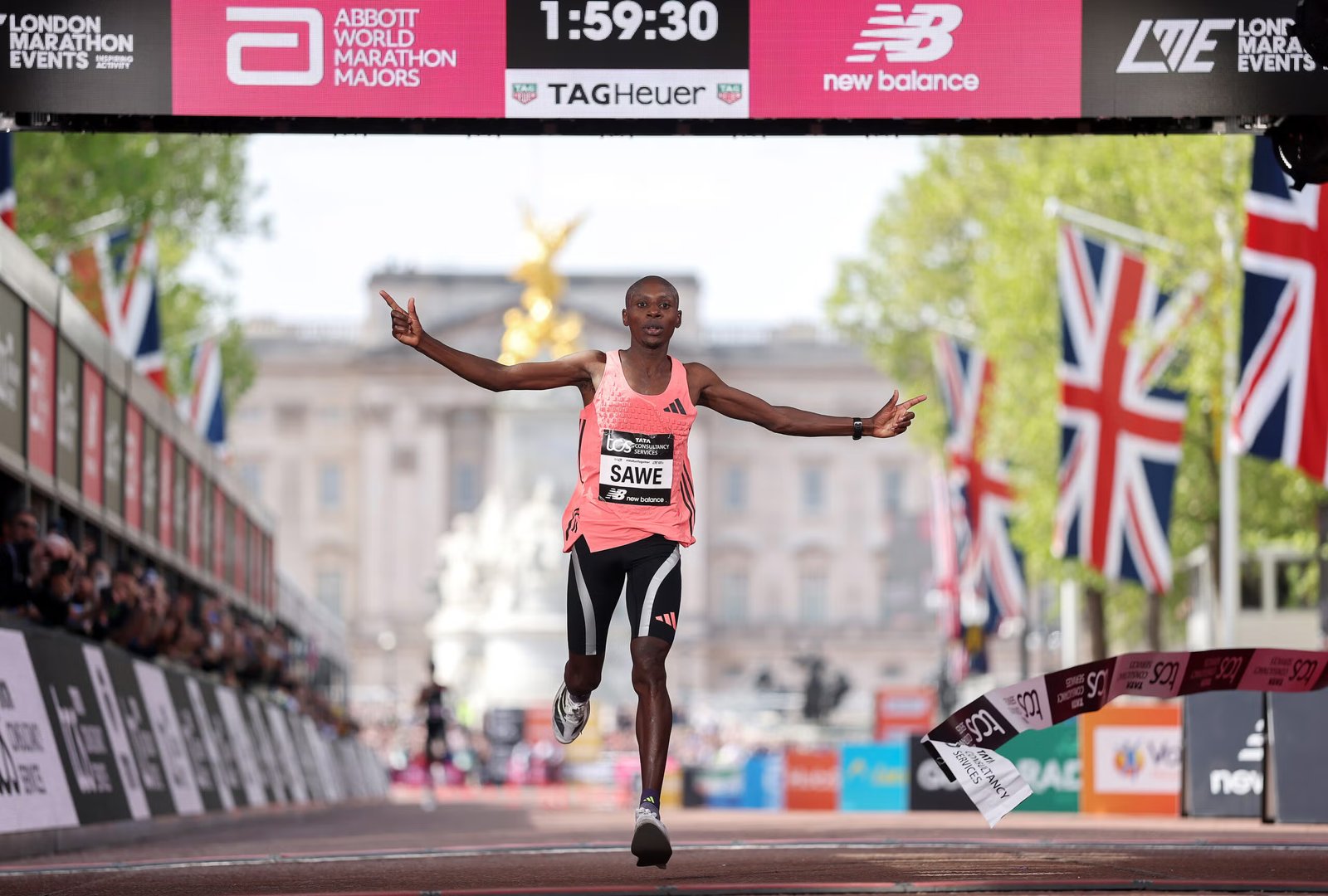
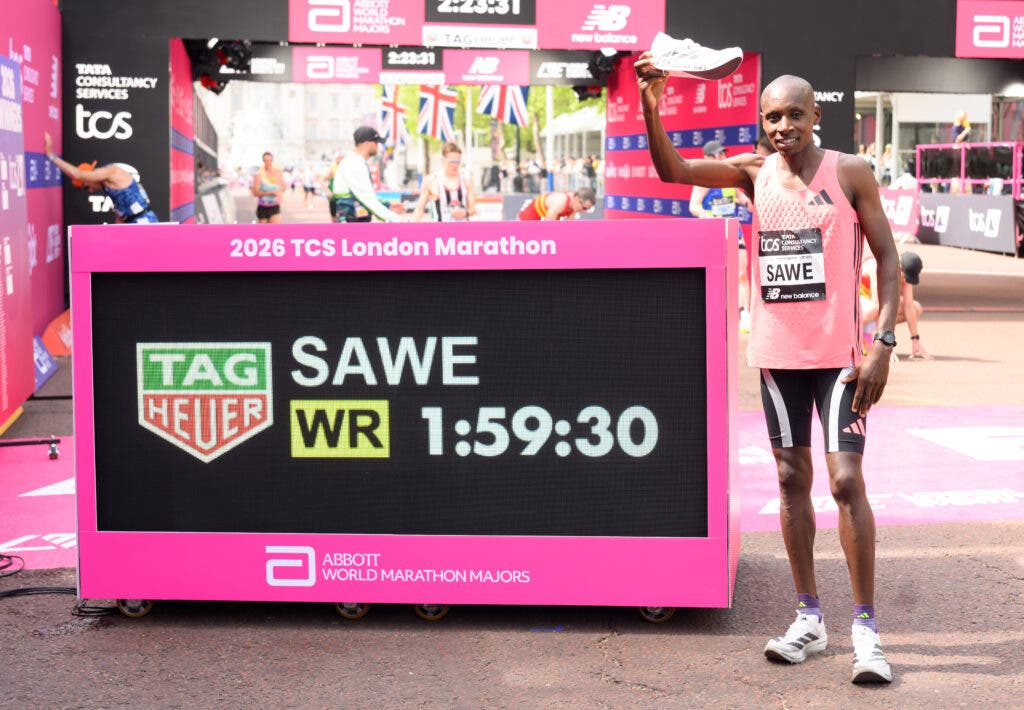
Sabastian Sawe broke the tape on The Mall on Sunday morning with both arms in the air and a look on his face that wasn’t quite belief yet. The clock said 1:59:30. Under two hours. In a real, sanctioned, record-eligible race—the thing the running world has been chasing for a decade and that, until that moment, no human had ever officially done.
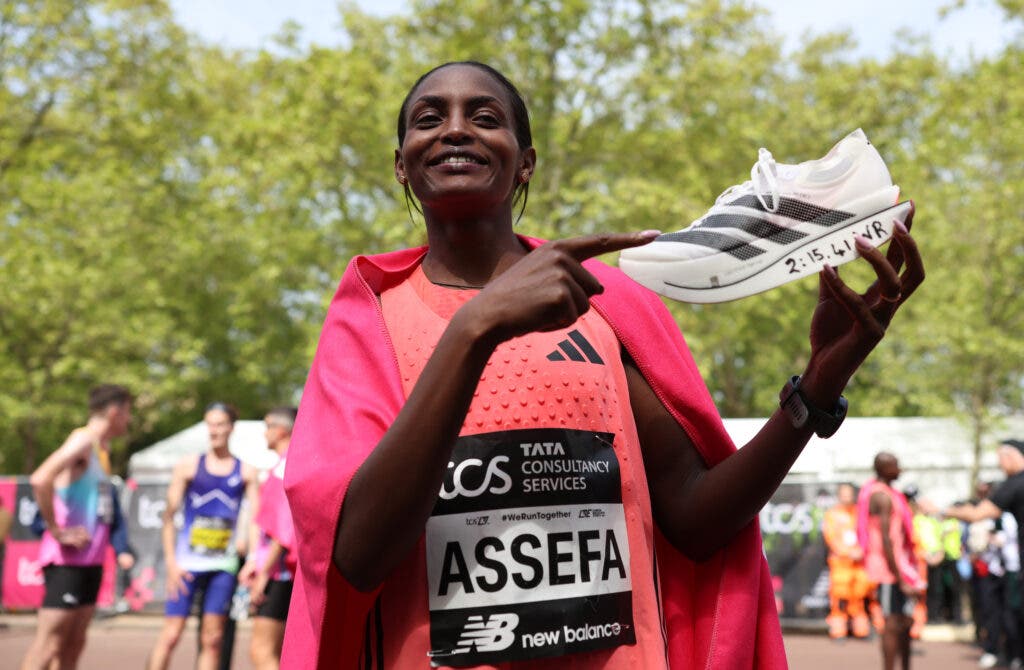
Eleven seconds later, Yomif Kejelcha came through in 1:59:41, in his marathon debut. Jacob Kiplimo went 2:00:28 for third—also under the previous world record. On the women’s side, Tigst Assefa lowered her own women’s record to 2:15:41. And just like that, the entire ceiling of the sport was lifted before most of us, waiting our turn in the foggy fields at Blackheath in Southeast London, had even applied our Body Glide.
Way back behind them, struggling through a warm-up before joining my corral, was me. New Balance had put the bib on me. I had a foot and a knee that, a month earlier, wouldn’t bear weight.
Every marathon writer eventually says this, and here I am saying it: the marathon is one of the only sports where you share a field with the best in the world on the same day, on the same course, in the same weather. I will never, in any meaningful sense, be on the same playing surface as LeBron. But on Sunday I ran the streets Sawe ran. He just got there a lot, lot, lot faster.
Nervously hopping as I was funneled toward the start line, foot and knee a question mark, I wasn’t thinking about Sawe. I was running through the line I’d been telling myself for the past few days:
If you’re running, you’re winning.
It’s the line I tell people just starting out, when doubt creeps in and they don’t feel as though they run enough or fast enough or look the part. It is not, traditionally, advice I take myself. I’m a middle-of-the-pack guy who’s run two marathons and was training for a third with PR ambitions. I’d transitioned more into a “hills pay the bills” guy than an “if you’re running, you’re winning” guy.
Then, week 12 of a 15-week block, I woke up with a swollen foot. Couldn’t walk. Crawled down the stairs of my apartment, hobbled into an Uber on crutches, got tested for every horrible thing it could be. Three days later, it went away, almost as suddenly as it had arrived.
Then the knee. I felt it on my last long run before taper, near the end—a sharp twinge on the outside of the joint. I limped home and didn’t run again for almost two weeks. The limp was still there a few days before I was supposed to fly to London. So I went back to the doctor. He cleared me to run but, without an MRI, couldn’t tell me what had actually happened. “It’s in God’s hands,” he said, which—OK, sure, man.
So the goal had to shift. From PR to start line. From start line to finish line. From finish line to: please, dear god, let me not have to take the Tube back in shame. I had to come back to the line I tell other people, because, well, a few weeks ago, I literally couldn’t walk. Getting to run a marathon at all was kind of cool.
I packed for London.
You arrive and immediately start trading war stories. A friend scraped her knee badly at mile 14 of her 22-miler—not fully healed, but she’s here. Another friend had a back issue; if it goes, if it goes, she’s pulling out at a medical tent, zero shame. People talk about gels, caffeine timing, pooping. (We don’t talk about pooping enough. A marathon is, in significant part, about not pooping your pants. This is the truth of the sport.) For one weekend, you have a chosen family. You eat together, stretch in the same hotel lobby, start together, suffer in parallel.
This was my first London Marathon. The energy is something else—a city-wide hum that’s not unlike NYC Marathon Sunday, which any New Yorker will tell you is one of the best days of the year, full stop. The course runs you through these short tunnels where the crowd noise drops out and suddenly it’s just your breath and the slap of hundreds of feet all around you. You come out the other side, and the wall of sound hits you again.
Around mile four, I ran past a church. Its bells were ringing the theme to Chariots of Fire.
I want to say I laughed. I didn’t, though. I think I made some kind of involuntary noise—a laugh trying to be a sob, or vice versa. My eyes went. I’d been so locked into damage control for the previous two weeks, so braced for the knee to lock up, that I hadn’t really let myself feel the fact that I was here.
That was the moment I stopped worrying about my time.
Mile 13 was when I made the decision that sealed it. I’d come through the half in a time that wasn’t my best but wasn’t a disaster either, and I knew, even as I clocked it, that if I tried to hold that pace for another 13 miles, I was going to either hurt myself or hate the rest of the race. Maybe both. So I decided, right there, to walk when I needed to walk and run when I could run. To choose happiness. To finish on my own terms.
And the city met me there. Around mile 16, a kid held up a sign that said: “GO RANDOM STRANGER GO.” I was a random stranger! He was cheering for me! I heard people shout “Kevin!” It was for other Kevins, but I still took it in. I was handed bananas by kind Londoners. Someone even complimented my hair.
I was now running a pace I would have been embarrassed about a month earlier. It didn’t matter. The shoes on my feet were New Balances, and the company’s “Run Your Way” posters were everywhere along the course, and on a day like this it rang true. You can be chasing 2:30 or 5:30 and the road treats you the same.
Which brings me back to Sawe.
The day after I finished—upright, foot and knee somehow intact—I went to St. JOHN, Fergus Henderson’s whitewashed dining room where the menu reads like a dare. I wanted to celebrate with something unhinged. I ordered a glass of crémant, the pigeon, and a side of Hairy Tatties (cod and mashed potatoes).
By Monday, the whole city was still working through what had happened. The cab driver that morning had wanted to know what I thought of Sawe’s splits. A woman at the next table had been talking about it when I sat down. You’d hear “one fifty-nine” drift past in conversation the way you might hear someone mention the weather.
My server clocked the medal around my neck and we got to talking. He had a sharp take: now that the two-hour barrier is broken, it’ll keep getting broken. It took someone to do it once. It was more mental than anything else.
Which is the same thing Kipchoge has been saying for years. “No human is limited” was the line he hung his Vienna run on back in 2019, when he went 1:59:40 in conditions that didn’t count for the record books but did count for pushing human potential. Sawe inherited that. He just made it count.
And maybe this is the throughline. The elite at the very tip of the sport and the dude struggling through a warm-up were, on the same morning, asking their bodies the same question. Sawe was asking his how fast a human can possibly go. I was asking mine if it would let me finish at all. We got different answers. We were asking the same thing.
Late in the race, I saw a woman in a wheelchair tip out a few meters from the finish. Other runners stopped to help her up. She crossed the line.
They all did. I crossed it too. The red pavement of The Mall, Buckingham Palace behind us.
If you’re running, you’re winning.
I didn’t PR. But I finished. I finished happy. And it turns out that was the whole point.
