

Topline
With the moon reaching its last quarter phase on Saturday, May 9, it begins to rise around midnight, then later each night. The effect is that the night sky as seen from mid-northern latitudes enters one of its final truly dark periods before summer’s short nights take over. It’s a gateway to spring’s deep-sky season, when galaxies dominate the night sky, but also the perfect time to see some of the night sky’s most famous constellations — even from light-polluted cities. Here are five things to see in the night sky this week.
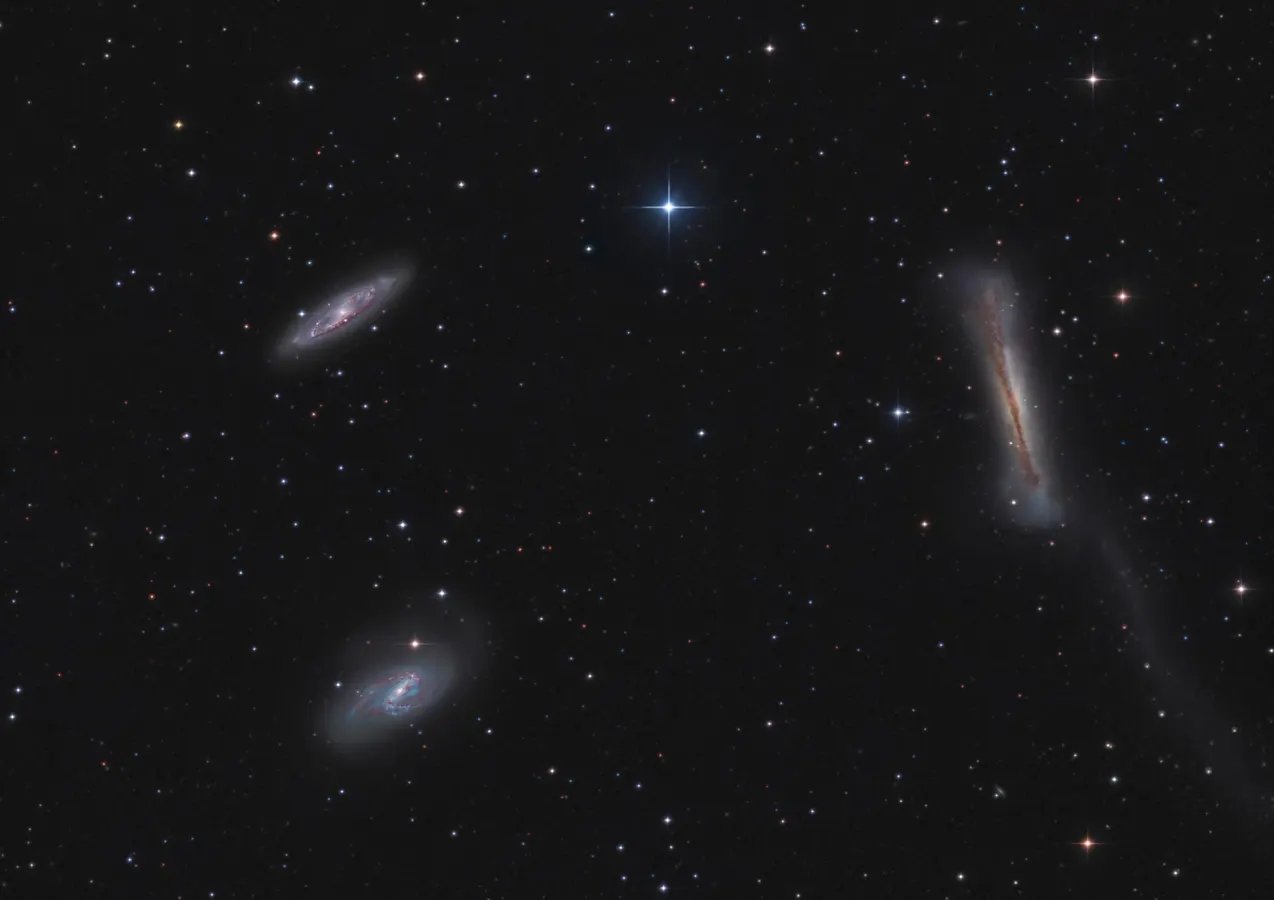
The Leo Triplet is a small group of galaxies about 35 million light-years away in the constellation Leo. This galaxy group consists of the spiral galaxies M65, M66, and NGC 3628.
getty
Key Facts
A last-quarter moon rises on Saturday, May 9. Half-lit as seen from Earth, it occurs week after May 1’s full Flower Moon. As it rises around midnight, the evening skies are dark, revealing far more stars than in recent weeks.
May is being dominated by two very bright points of light after dark. Look west 45 minutes after sunset to see Jupiter (highest) and Venus (lowest) in the western sky. They’re getting closer to each other as they approach a close conjunction on June 9.
This month is “galaxy season,” with constellations like Leo and Virgo to the south, a window on the universe beyond the Milky Way. Any telescope will reveal a plethora of galaxies.
Follow The Big Dipper
Look straight overhead, and you’ll find the Big Dipper at its highest point of the year. For stargazers, it’s an incredibly useful tool. The two stars at the end of its bowl point directly to Polaris, the North Star. Follow the curve of its handle, and you’ll “arc to Arcturus,” one of the brightest stars in the spring sky.
Find An ‘arc To Arcturus’ And Corona Borealis
Follow that curve from the Big Dipper, and you’ll land on Arcturus, glowing orange in the southeast. This is not just another bright star — it’s a red giant about 37 light-years away, nearing the later stages of its life. Its warm color is easy to detect with the naked eye, especially from darker locations. Just beneath is the crescent-shaped constellation of seven stars called Corona Borealis, meaning northern crown.
A sky chart indicating how to locate the constellation Corona Borealis between the bright stars Arcturus and Vega. The Big Dipper’s handle points in the direction of Corona Borealis.
NASA/JPL-Caltech
Glimpse The Leo Triplet
May is the perfect time to look beyond the Milky Way into the wider universe. High in the south, in the constellation Leo, lies one of the most rewarding galaxy groupings visible to amateur observers. The Leo Triplet (M65, M66 and NGC 3628) appears as three faint patches of light — each one a vast island of billions of stars. Under dark skies, binoculars can hint at them, while a small telescope reveals their elongated shapes.
What’s Next In The Night Sky
Over the next week, conditions improve even further. The moon continues to wane toward the new moon on May 17, creating a dark-sky window that’s one of the best opportunities of the entire spring for observing faint galaxies and star clusters. Later in the month, the cycle shifts. The Blue Moon — May’s second full moon — on May 31 will brighten the sky for about a week before. June will bring summer constellations, such as the famous stars of the Summer Triangle, with August delivering a total solar eclipse on Aug. 12, followed by the peak of the Perseid meteor shower under dark skies.
