

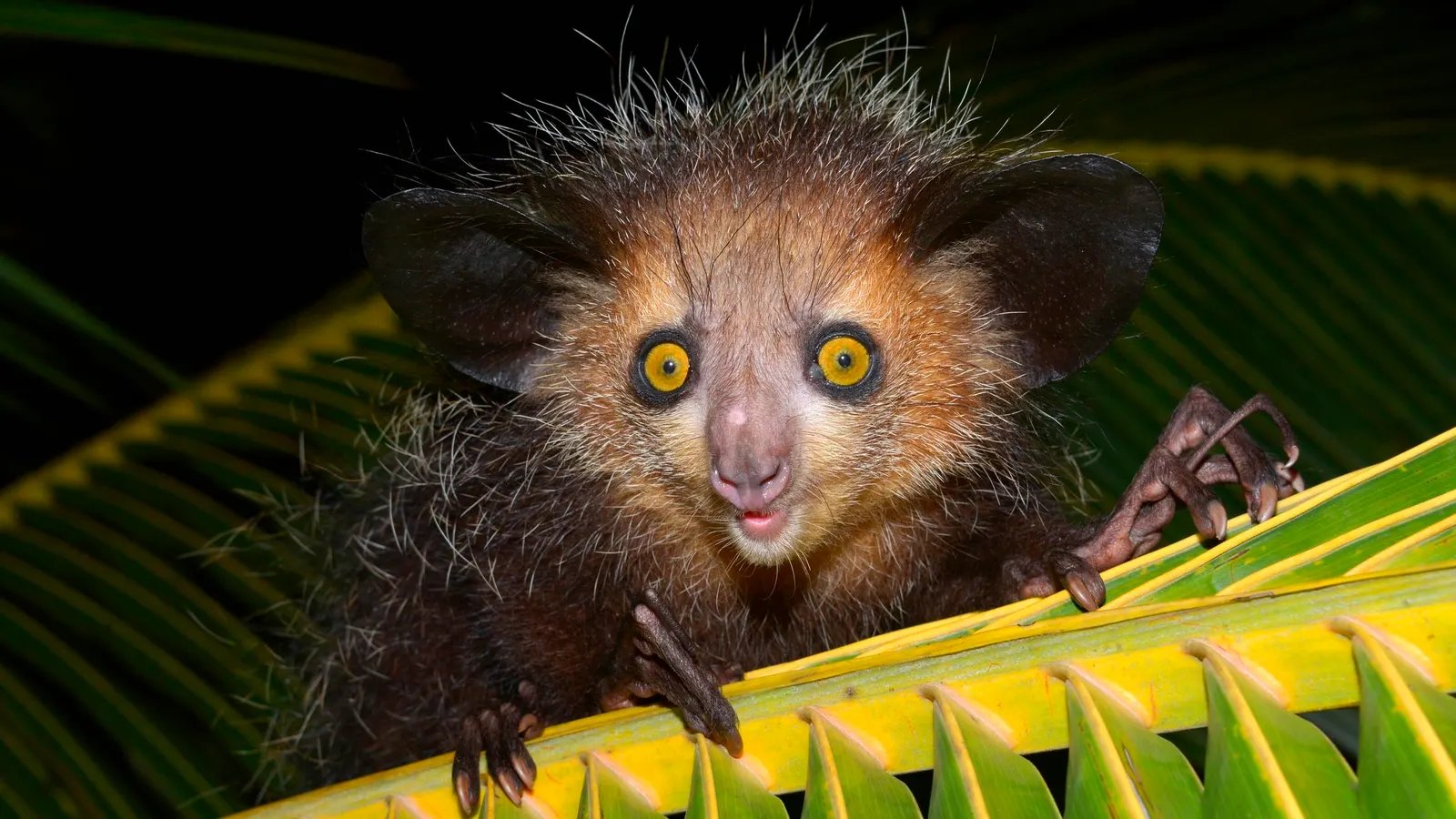
With rodent teeth, bat-like ears and a woodpecker-inspired hunting strategy, this primate may just be one of evolution’s strangest experiments.
getty
The aye-aye looks almost nothing like a primate. Most would describe it as a creature assembled from spare animal parts. It has oversized ears like a bat, teeth like a rodent and glowing eyes like an owl. But its most famously bizarre feature is its middle finger: impossibly long, unnervingly thin and jointed in a way that gives it an almost spider-like range of motion.
For centuries, scientists struggled to classify it. Early naturalists thought it might be a squirrel. Others compared it to a woodpecker. And, strangely, both were onto something.
This is because the aye-aye does something no other primate is known to do at such an extreme level: it hunts hidden insect larvae inside wood, using a technique remarkably similar to the way woodpeckers forage. And according to decades of research, nearly every strange feature of its anatomy appears to serve that one extraordinary lifestyle.
A Primate That Hunts By Tapping On Trees
The aye-aye (Daubentonia madagascariensis) is found exclusively in the forests of Madagascar. Its most famous behavior is what’s known as “percussive foraging,” described in detail in a seminal 1991 study published in Animal Behaviour, based on observations of two adult males, one adult female and her infant daughter.
The animal moves through the canopy, typically after dark, and it pauses every few seconds to drum rapidly on tree branches with its elongated middle finger. The taps are both fast and deliberate; it appears almost as though it’s “scanning” the wood, like a carpenter inspecting a wall for hollow spaces. Then, once it successfully detects something promising beneath the bark, the next stage begins.
Using its large, continuously growing incisors — which resemble those of rodents more than those of other primates — the aye-aye starts to gnaw its way through the wood. Then comes the step that has fascinated researchers for decades: it inserts its long middle finger into the hole and scoops out insect larvae hidden inside.
What caught biologists’ attention is how remarkably suited the finger itself is to this job. Unlike the thicker grasping fingers typical of primates, the aye-aye’s third digit is extraordinarily slender and highly flexible. This makes it possible to bend independently of the other fingers, allowing the aye-aye to actively maneuver the finger inside tunnels to extract prey, almost like a tiny wire tool designed for precision work.
The comparison to woodpeckers emerged naturally from these observations. Woodpeckers are well-known for their ability to locate insects concealed within wood by tapping and listening for changes in resonance. The aye-aye seemingly solved the same ecological problem with an entirely different anatomical toolkit: fingers instead of beaks, incisors instead of chiseling skulls.
This is an example of what evolutionary biologists call convergent evolution: when unrelated species independently evolve similar solutions by means of occupying similar ecological niches. The aye-aye, in essence, became a woodpecker by primate standards.
Scientists Still Aren’t Entirely Sure What This Primate Hears
After observing the aye-aye in situ, researchers’ next question was: What, exactly, is the aye-aye detecting when it taps on wood? And even today, researchers still don’t fully agree.
The original interpretation was relatively straightforward. It was thought that the aye-aye’s taps served to identify hollow chambers inside wood using acoustic feedback generated by tapping. In simpler terms, the animal was believed to be listening for echo-like sounds, which would effectively reveal where insect tunnels were hidden beneath the bark.
But a fascinating 1998 study published in the International Journal of Primatology complicated this explanation. In five separate experiments, the authors devised artificial foraging setups that contained cavities hidden beneath surfaces. Some cavities were intentionally left hollow, while others were filled with materials like gelatin or foam. The hypothesis was that if the aye-aye relied purely on hollow resonance, then the filling inside the cavities should have disrupted its ability to identify them.
Yet to the researchers’ surprise, the aye-ayes had no problem locating the target areas.
This upended all prior theories regarding cavity location; evidently, the aye-aye isn’t detecting “hollowness” in the way researchers originally imagined. Instead, it might be sensing much subtler mechanical differences in how vibrations travel through wood. The tapping may provide information about structural discontinuities, density changes or the presence of tunnels themselves, even when those tunnels are no longer empty.
This uncertainty is part of what makes the aye-aye such a fascinating species. The behavior is notoriously difficult to study in the wild. The sensory cues involved are probably extremely subtle, and the animal itself is nocturnal, elusive and endangered.
What is clear, however, is that the aye-aye’s comical assortment of features definitely isn’t incidental. Nearly every aspect of its anatomy appears tuned toward this strange style of hunting:
- Its oversized ears likely enhance sensitivity to fine acoustic differences
- Its skeletal finger acts as both a percussion instrument and an extraction tool
- Its exaggerated eyes help it navigate dense forest canopies at night while searching for suitable branches to inspect
The World’s Most Specialized Primate
Most primates survive by exploiting relatively familiar foods, such as fruit, leaves, flowers, seeds or visible insects. Yet as abundant as resources like these are, they’re also highly competitive. This is likely the reason why the aye-aye took a wildly different evolutionary route to its counterparts.
In a 2017 study published in Genome Biology and Evolution, researchers explored the unusual sensory adaptations that are associated with the species’ feeding behavior. They examined whether aye-ayes shared genetic signatures with echolocating mammals like bats and dolphins, since all three groups seem to rely heavily on acoustic information to locate food.
Ultimately, the findings didn’t provide strong evidence of the same molecular convergence seen in true echolocators. However, it reinforced something else that’s equally interesting: the aye-aye possesses an unusually specialized auditory system, linked to its highly distinctive foraging niche. And this niche likely emerged due to the incredibly unique ecological conditions of Madagascar itself.
Historically, the island lacked many of the competitors that can be found elsewhere in the world — and, notably, there were no woodpeckers occupying this particular feeding role. Hidden wood-boring larvae represented a rich but underexploited food source, which little to no other animals could access efficiently. Thus, the aye-aye evolved to fill that vacancy.
Over millennia, natural selection sculpted nearly every part of the aye-aye’s body around that strategy. Its incisors became permanently growing chisels for excavating wood. Its ears enlarged. Its finger elongated into a hyper-specialized probing tool. Its brain likely became increasingly adapted for processing fine auditory information.
The result is a primate so evolutionarily eccentric that it almost appears assembled from multiple unrelated species. And maybe that’s why many people find the aye-aye both fascinating and unsettling.
Humans are remarkably good at recognizing “typical” primate faces and bodies; we intuitively notice hands, expressions and social familiarity. The aye-aye disrupts that pattern. It retains just enough recognizable primate traits to feel familiar, while everything else seems pulled toward another ecological identity entirely.
A rodent’s teeth. A bat’s ears. A woodpecker’s feeding strategy. Yet despite how alien it appears, the aye-aye is not some evolutionary mistake or oddity drifting at the edges of biology. It is, in many ways, a masterpiece of specialization.
The aye-aye is one of evolution’s strangest primate examples of convergence, but it’s far from the only one. Test your knowledge with my fun Evolution IQ Test.
