

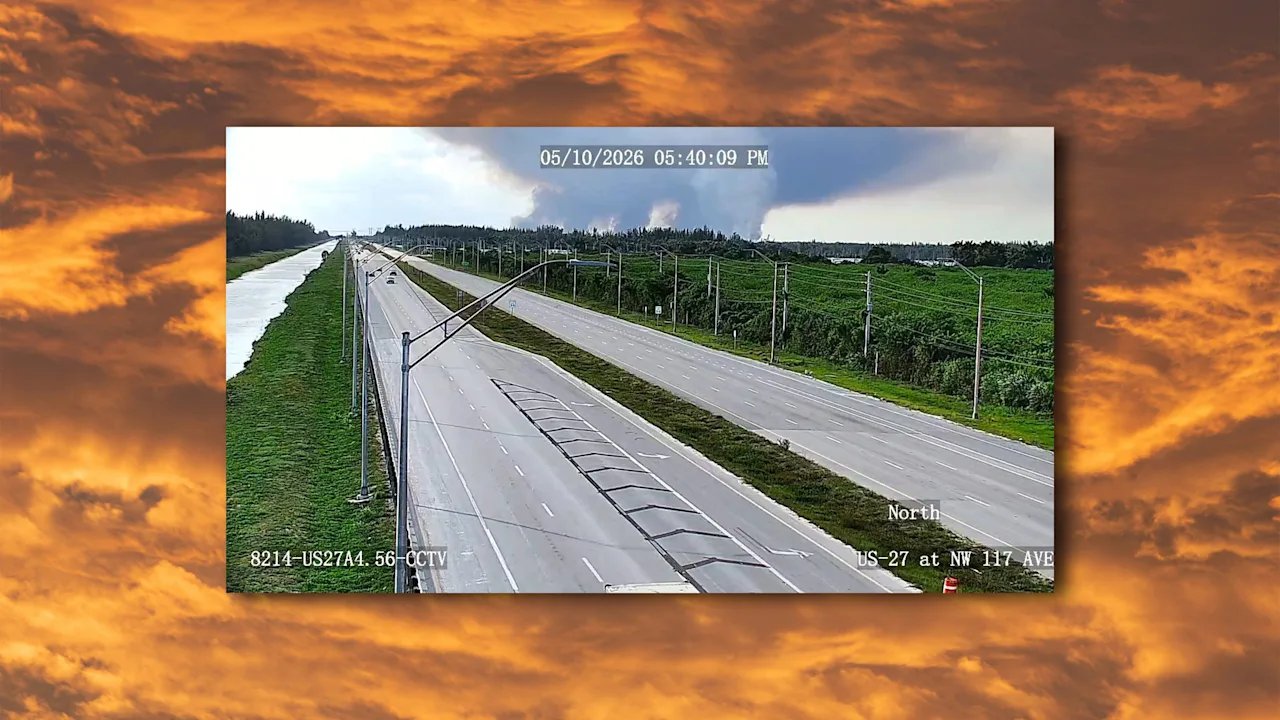
After weeks of extreme drought across Florida, a wildfire has broken out in the Everglades, burning more than 5,000 acres.
The fire, called the Max Road Miramar Fire, is located outside of Miami, and was first reported on Sunday.
By Monday around 11 a.m., it had burned at least 5,600 acres, according to the Florida Forest Service, and was only 30% contained.
In images and videos of the Max Road Miramar Fire, massive plumes of black smoke fill the sky; the smoke has caused low visibility on major roadways.
Interactive wildfire maps provided by Watch Duty and Esri’s Wildfire Aware are tracking the fire’s spread in real time.
Many may think of the Everglades as a swamp, and may wonder how such an environment can burn. Though Everglades National Park is a 1.5-million-acre wetlands preserve, it does experience a dry season from December to around mid-May.
This year has been exceptionally dry. Florida is experiencing its worst drought in about 15 years. Most of the state is experiencing “extreme” drought, while counties in the Panhandle are in an “exceptional” drought, according to the National Weather Service.
These dry conditions have already fueled multiple wildfires this year. Since January 1, there have been nearly 2,000 wildfires across the state, burning more than 86,000 acres. Typically, Florida sees some 2,400 fires in a whole year.
Wildfires have also been burning through Georgia, which is experiencing similar record drought; when adding in that state, fires have burned more than 120,000 acres this year—an area, Politico noted, that is four times larger than Disney World.
“Not natural”
This is not the first time the Everglades specifically have burned. Some regular burns are essential, experts have noted, helping to clear grass and fertilize the ground. But climate change, and the hotter, drier environment it creates, has also been a factor.
“It’s natural for the Everglades to dry down, but not dry out,” Steve Davis, the Everglades Foundation’s chief science officer, said in August 2025 when a wildfire burned 1,800 acres of the park. “It’s not natural for them to burn large areas.”
Because of the state’s extreme drought, the current fires could be even more detrimental to wildlife, who are already stressed from a lack of freshwater.
The rising temperatures driven by human-caused climate change are ramping up wildfire activity, in terms of both their frequency and severity.
Already across the country the wildfire season this year is “well above average,” and scientists expect it to worsen.
It’s not just the hot, dry conditions that could create a wildfire crisis. In April, the U.S. Forest Service announced that it would be closing three-quarters of its research facilities.
That reorganization has experts worried about both the number of scientists leaving the agency and the collection of crucial wildfire and climate change data, including information that helps states battle fires.
“There are a lot of tools and data that underlie what firefighters are using when they battle wildfires,” Julian Reyes, chief of staff at the Union of Concerned Scientists, told Fast Company at the time. “The dismantling of that [research and development] part of the Forest Service will affect firefighting capabilities.”
