

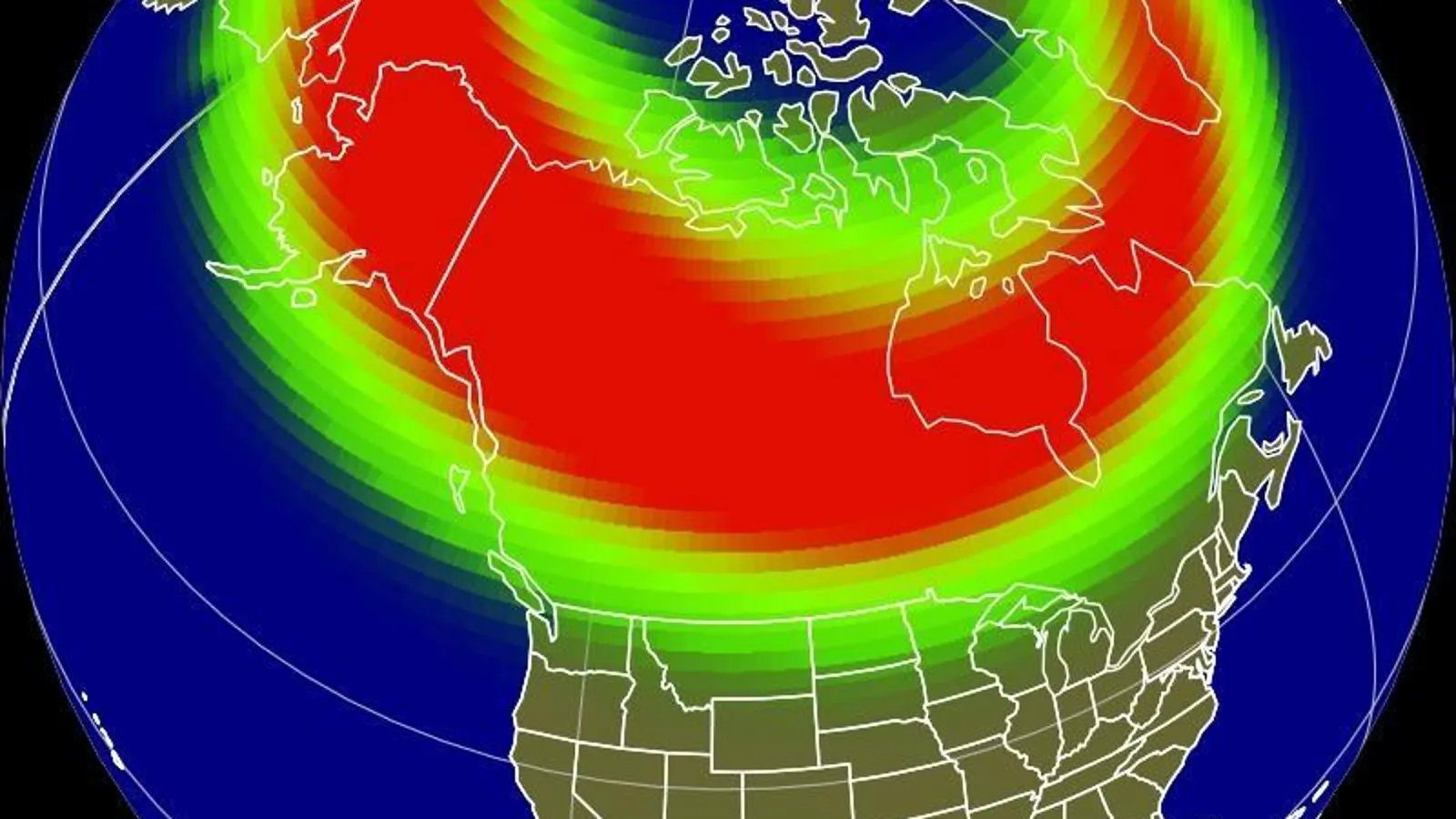
NOAA’s aurora viewline forecast for overnight on Friday-Saturday, May 15-16, 2026.
NOAA
In the wake of last night’s display, the northern lights may be visible this Friday night in northern U.S. states and Canada after forecasters at the National Oceanic and Atmospheric Administration predicted a G1 geomagnetic storm may strike overnight. With a new moon on Saturday, May 16, the sky will be free from moonlight, allowing faint aurora to be seen.
Northern Lights Alert: Coronal Hole
It comes in the wake of a coronal hole — a gap in the sun’s corona, its outer atmosphere — which is causing fast-moving solar wind to escape. That turbulence is directed toward Earth, which could spark a geomagnetic storm as charged particles interact with Earth’s magnetic field. They then accelerate down its magnetic field lines at the north and south poles to create ovals of green and red.
Northern Lights Alert: Where And When
A G1 geomagnetic storm may mean aurora seen from northern U.S. states overnight on Friday, May 15, through Saturday, May 16, likely on the northern horizon.
States with the potential to see northern lights include Alaska and (northerly parts of) Washington, Idaho, Montana, North Dakota, South Dakota, Minnesota, Wisconsin, Michigan and Maine.
If a G2-class geomagnetic storm erupts, aurora may be viewable from states farther south, such as Oregon, Wyoming, Nebraska, Iowa, Illinois, Indiana, Ohio, New York, Vermont and New Hampshire.
GOES 19’s view of the coronal hole on the sun on May 14, 2026.
NASA SDO
Northern Lights Alert: Solar Activity
Solar activity has been at low levels for some weeks, but on May 7, an M2-class solar flare heralded the arrival of an active sunspot. A solar flare — an eruption of electromagnetic radiation — is caused by twisted magnetic fields, typically above sunspots — cooler, darker regions of the sun’s surface that form when clumps of its magnetic field well up from deep within the sun. In the wake of the May 7 flare came several coronal mass ejections, clouds of charged particles that — if Earth-directed — can cause geomagnetic storms.
Northern Lights Alert: Forecasting Aurora
The sun’s roughly 27-day rotation is a critical factor for predicting Northern Lights, as it brings active, aurora-producing sunspot regions back into view from Earth.
“Active to G1 (Minor) storm levels are likely to prevail on 16 May due to lingering CH HSS influences,” reads a forecast from NOAA, referring to the coronal hole and a resulting high-speed solar stream. Active levels are also likely on 18 May, 23 May, and 27 May as active regions of the sun turn to face Earth.
However, calculating whether a CME is Earth-bound, and when it will arrive, can only be done accurately when the CME’s effect on the solar wind — the stream of charged particles released from the sun that travels in all directions in the solar system — is measured by NOAA’s DSCOVR satellite, which orbits the sun a million miles from Earth. DSCOVR measures the solar wind’s speed and magnetic intensity, which is critical in calculating how it is about to change. Only then can an aurora display be accurately forecast by NOAA’s Space Weather Prediction Center, but there’s not much warning — just 30 minutes.
Northern Lights Forecast: Latest Updates
Aurora-chasers frequently use the Kp index to predict the intensity of a geomagnetic storm, but for aurora displays, the interplanetary magnetic field’s Bz component is more important. Bz determines how easily solar energy enters Earth’s magnetosphere. When Bz points north, Earth’s field resists it; when Bz swings south, the two fields connect, allowing plasma to stream in. A sustained southward Bz of −5 nT or stronger usually signals an imminent display of aurora.
To check visibility in real time, use NOAA’s 30-minute aurora forecast or download apps such as Aurora Now, My Aurora Forecast or Glendale Aurora for up-to-the-minute alerts and live solar wind data.
Wishing you clear skies and wide eyes.
