

Opinions expressed by Entrepreneur contributors are their own.
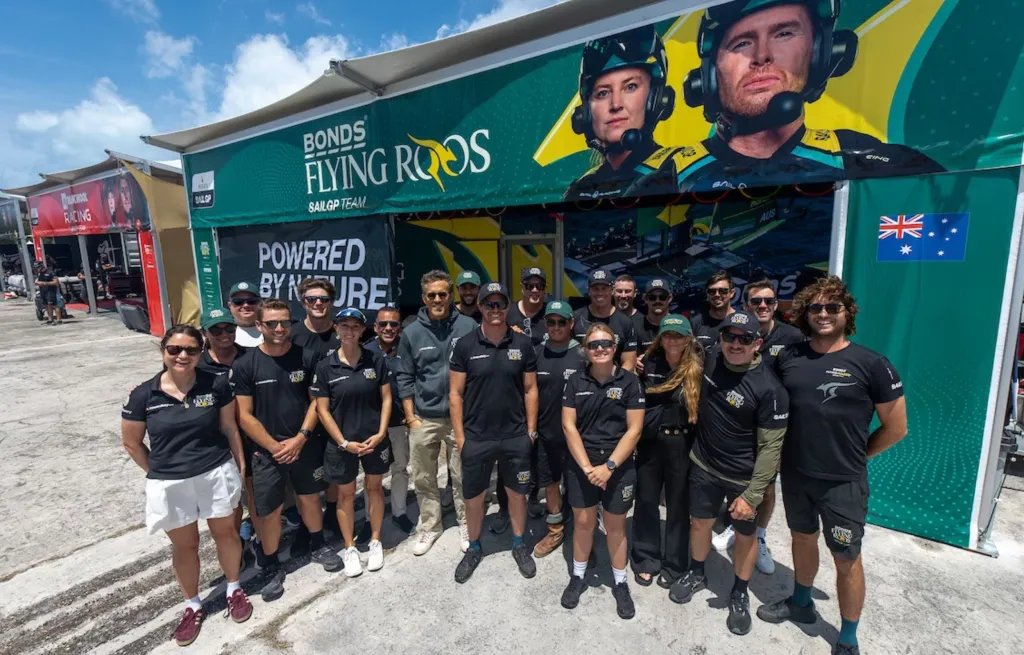
On May 9-10, SailGP completed its fourth race on the island of Bermuda, with the Australian Ryan Reynolds-owned Bonds Flying Roos taking home first place. But the event was already underway long before the F50 catamarans ever hit the water.
From global shipping and on-site construction to customs clearances and government coordination, SailGP undertakes a logistical odyssey before every race, moving around the world with enough cargo to outweigh seven blue whales.
Charting a course
The first step is choosing the right location.
“When we created SailGP, we wanted to be a traveling championship,” says COO Julien di Biase. “You really want the team and event in the same place, because then you get a super-engaged audience,” adds co-founder and sailing legend Russell Coutts. “Even if they don’t know any of the sailing athletes, that’s enough for a lot of folks.”
Unlike sports such as golf, where established courses already exist at nearly every major resort, finding a suitable venue for a sailing race is complicated. Organizers need the right sea conditions — strong winds, flat water — but also a location that can host large crowds and offers views close enough that fans don’t need a telescope to follow the action.
Then there’s the tech site, the command center where analysts huddle around screens tracking jibbing angles and knot speed, supporting their crews from shore.
“That’s the foundation on which we build all of our logistics,” Julien di Biase explains. “Where is the port for our vessels to arrive? Can we get to that venue based on the dates of the previous and next races? It’s crucial to make sure that once we announce a race in a specific city on a specific date, we can deliver.”
All hands on deck
Early on, SailGP had to beg cities to host events. Now, cities are often the ones making the pitch, with some even covering half the cost.
“There’s a big difference between how different cities support us financially, but on average, we’ve reached a stage now where it’s a true partnership,” di Biase says.
Those partnerships are critical because local governments play a major role in on-site logistics. Take Bermuda, for example, an island that operates almost entirely on imports. As di Biase explains it, goods arrive, taxes and duties are paid, and then those products are consumed on the island.
The challenge for SailGP came when it needed to move equipment back out. During the league’s first few visits, navigating those logistics proved difficult until the Bermudian government stepped in and worked with customs officials to streamline the process.
“Once we have that partnership with the city, we really lean on them and leverage their local connections to make sure the environment is right for us to operate there,” di Biase says.
Anchoring the event
Early on, each team required a huge operational base and a crew of more than 100 people to maintain the boat.
“When we announced the idea of SailGP and using the rebranded F50, most people who knew these boats thought we were crazy,” Julien di Biase says. “But we modified it so we could take it apart, really plug and play.”
Today, the F50 can be fully disassembled for shipping and reassembled on site before a race weekend. Each boat breaks down into four to five shipping containers that travel by vessel between events.
The setup includes separate containers for the wing, the hull, and the primary components, as well as a second hull container that doubles as the team’s on-site office. For each race, SailGP transports roughly 115 shipping containers carrying everything from F50 catamarans and chase boats to specialized broadcast equipment and other racing assets. Nearly everything else is sourced locally. According to di Biase, that approach serves three purposes.
First, it reduces the amount of equipment that needs to be transported around the world. Second, relying on local vendors, workers, and resources creates a greater economic impact within the host city. Finally, the model is more sustainable. While SailGP still transports a significant amount of highly specialized equipment from race to race, the league tries to leverage local resources as much as possible, creating what di Biase describes as a hybrid operational model.
Alongside its global logistics partner, DP World, the league has transported more than 100,000 individual parts worldwide in 2026 using ships, aircraft, trucks, and specialized logistics equipment. Altogether, that amounts to more than 1 million kilograms of cargo, roughly the equivalent weight of seven blue whales.
“The connections they have around the world with customs and port authorities are critical,” di Biase says of DP World. “There are always import backlogs, and we can’t afford to be at the back of the queue.”
Smooth seas don’t make skilled sailors
Just like on a sailboat, no matter how prepared the crew is, problems are inevitable, and success depends on adapting in the moment.
“We have issues all the time,” Julien di Biase says. “From a vessel arriving late because of bad weather to a customs strike at the Port of LA. You can’t really control those things.”
The biggest logistical headaches come when a race is postponed or canceled, as happened last year with SailGP’s planned event in Rio. After discovering a design flaw across the fleet, the league was forced to cancel the race just as cargo was being loaded for transport.
“We had to pause the cargo for a couple of days,” di Biase explains. “The vessels were basically hovering offshore while we figured out a solution.”
Complicating matters further were U.S. maritime regulations that prevented the foreign vessel from immediately returning to an American port without first stopping elsewhere. As a result, SailGP had to reroute and offload cargo in the Dominican Republic before continuing operations.
Wind in their sails
SailGP began with just five events on its calendar. Today, the league has expanded to 13 races, with founder Russell Coutts aiming to eventually reach 20 events and 20 teams. That growth, however, leaves even less time to move the league’s massive operation from one city to the next.
“We’re seeing a bit of a ceiling now,” di Biase says. “If we want to get to 20 events and 20 teams, we need to rethink our logistics. We need to come up with a new plan, because we need to be faster.”
According to di Biase, SailGP’s first five years largely served as a proof of concept, demonstrating that a global traveling sailing championship could work at scale. Now, as the league approaches financial sustainability and continues to grow internationally, its logistics operation has reached an inflection point.
“We’ve realized we’ve kind of plateaued with our logistics,” di Biase admits. “If we want to keep growing, we need to think outside the box, figure out how to break that ceiling, and keep rising.”
On May 9-10, SailGP completed its fourth race on the island of Bermuda, with the Australian Ryan Reynolds-owned Bonds Flying Roos taking home first place. But the event was already underway long before the F50 catamarans ever hit the water.
From global shipping and on-site construction to customs clearances and government coordination, SailGP undertakes a logistical odyssey before every race, moving around the world with enough cargo to outweigh seven blue whales.
Charting a course
The first step is choosing the right location.
