

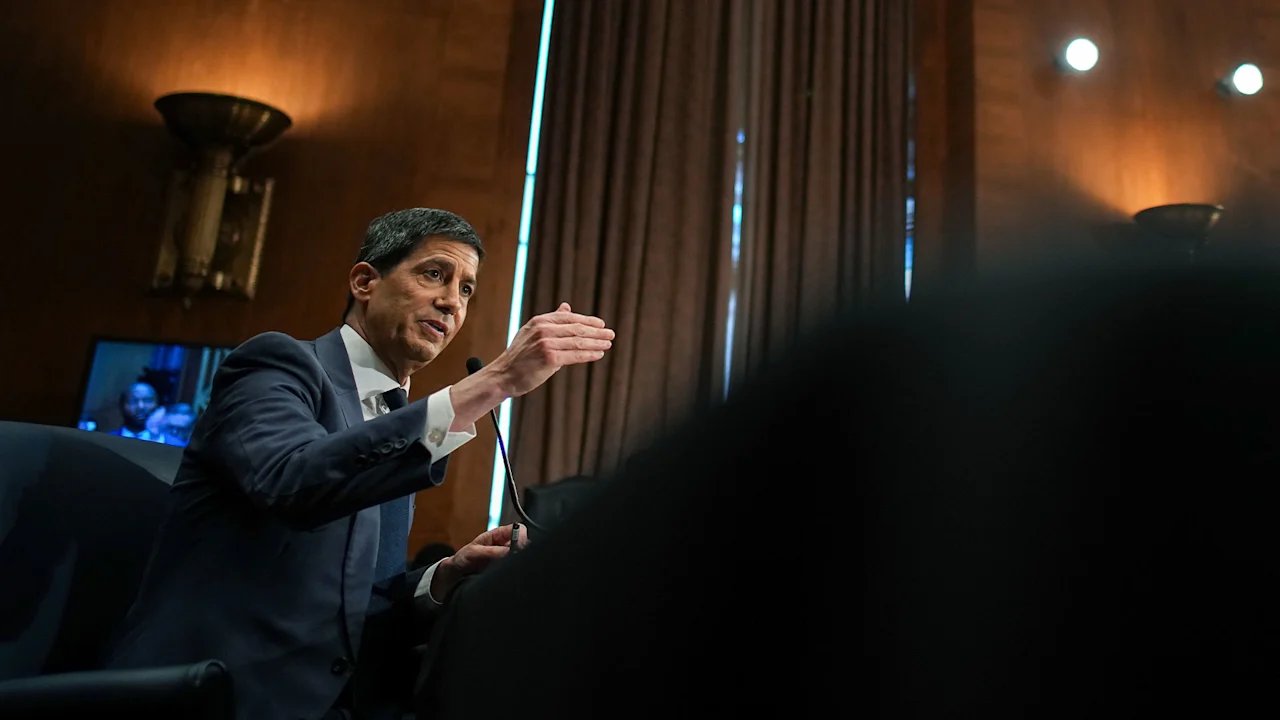
Kevin Warsh is now likely to secure Senate approval as the next Federal Reserve chair—and become arguably the most powerful central banker in the world. But when Warsh appeared before the Senate Banking Committee for his confirmation hearing in April, one punchy question underscored the dilemma that Warsh, lawmakers and the Fed all face:
“Are you going to be the president’s human sock puppet?” asked Republican Senator John Kennedy of Louisiana.
On one level, the question reflects President Donald Trump’s intense pressure on the central bank to cut rates, with current Chair Jerome Powell often the target of his ire. But it also points to Warsh’s own inconsistency on inflation.
Earlier in his career, he was a “hawk,” pushing for interest rate hikes to curb inflation and opposing the novel crisis management authorities that the Fed took on after the 2008 financial meltdown. Now, Warsh supports the interest rate cuts that Trump has exhorted as a way to juice growth.
Warsh has also come under fire for his deep ties to the financial sector, where he once worked. Lawmakers such as Democratic Senator Elizabeth Warren of Massachusetts have cited the potential conflict of interest posed by his undisclosed assets, even though in theory they’ll be divested as part of Warsh’s arrangements with the government’s ethics watchdogs if he becomes chair.
As scholars who study central banks and the politics of finance, we understand why concerns about Warsh’s credibility have persisted. But perhaps counterintuitively, we also believe that once he’s confirmed, his finance background could reinforce his prior hawkish leanings, leading to more independence from Trump on inflation and interest rates.
Is past prologue?
If confirmed as chair, as expected, Warsh and his colleagues on the Fed’s policy-setting committee would wield enormous power. Not only does the central bank set the benchmark rate that determines short-term lending, but the Fed also oversees a US$6.7 trillion balance sheet, mostly in government bonds, that partially affects longer-term borrowing costs. Guided by its mandate to control inflation, the Fed’s decisions impact everything from grocery prices to mortgage rates.
Along with Warsh’s prior stints in government and on the Fed’s policymaking board as a governor, he worked for the investment firm Morgan Stanley and the hedge fund Duquesne Capital. In those positions, Warsh advanced his career in an industry that has long preferred hawkish Fed policies, even at the cost of job growth: Wall Street is generally “conservative” in that it favors lower inflation and higher interest rates on grounds that those policies can support bigger bank profits and higher prices for bank shares, while reducing the risks brought by disinflation policies.
While serving as a Fed governor in the aftermath of the 2008 financial crisis, Warsh’s comments reflected this outlook. He talked extensively about inflation being a “choice”—that is, the result of poor policy decisions, rather than broader structural forces.
He also questioned the Fed’s massive bond purchases, which were meant to stimulate the economy and reduce high unemployment by pushing long-term borrowing rates lower. The Fed revived those bond buys during the pandemic recession, while waiting too long, in the eyes of many economists, to hike rates once inflation began rising in 2021.
More recently, Warsh has focused his criticism on the central bank’s “bloated” balance sheet as well as its inflation record. Those legacies, along with the stimulative government spending under President Joe Biden, prompted Warsh to warn in February 2022 that “extraordinary excesses in monetary and fiscal policy caused the inflation dragon to resurface after 40 years of dormancy.”
Which Warsh will show up?
Given that long record, many Fed watchers looked at his turnaround in the second Trump administration with some skepticism. When he was a finalist for the nomination to chair the central bank in summer 2025, he told CNBC that the Fed’s hesitancy to cut rates—which was already drawing Trump’s wrath—was “quite a mark against them.”
“The specter of the miss they made on inflation, it has stuck with them,” he added. “So one of the reasons why the president . . . is right to be pushing the Fed publicly is we need regime change in the conduct of policy.”
Warsh’s rhetorical shift has led many to ask whether he can reconcile his responsibilities with political pressure. But the worsening inflation outlook for both the U.S. and world, driven by spiking oil prices, may force his hand regardless.
The spike in oil prices from the Iran war, in particular, has economists raising their inflation forecasts for the U.S. At his last Fed meeting as chair, Powell indicated that the central bank could be a long way off from lowering rates given inflation concerns. The Bank of England and the European Central Banks are also bracing for possible rate hikes if inflation doesn’t ease.
Trump ramp ups the pressure
For his part, Trump has used unprecedented means to bend the Fed since returning to office.
Those tactics include trying to fire Fed Governor Lisa Cook and threatening to fire Powell—who just announced he will stay on as a governor on the Fed’s board after his chairmanship ends. Those kinds of pressure tactics—which effectively seek to restaff the Fed’s leadership with more members favoring interest rate cuts—are more often seen in countries like Turkey or Argentina.
So why do we believe that Warsh won’t be the “human sock puppet” some fear?
In our view, it’s his background in finance that leads us to think he’ll be able to resist political pressure once on the job. After all, when Powell was appointed by Trump during his first term, he had also worked in that sector—and he has demonstrated independence from both Trump and Biden.
This is not just a theory. Political scientist Chris Adolph has identified a pattern in which Wall Street is the “shadow principal” of the central bankers who shuffle in and out of the financial sector. Similarly, economist Adam Posen has described finance as the interest group with the most prominent lobbying role over monetary policy.
In practical terms, this means that Warsh has long been steeped in ideas about inflation that have traditionally held sway over the financial sector, and he may well be more open about these preferences once confirmed. Moreover, he’s likely to return to finance once his term at the Fed ends. Together, we believe these factors may give Warsh the intrinsic motivation and enough incentives to resist overt political pressure from the president.
Of course, being too beholden to Wall Street is also a risk, as pointed out by Warren and others. The Fed is meant to support Wall Street in times of crisis—and even more so since the 2010 Dodd-Frank reform. However, the Dodd-Frank Act also asked the Fed to monitor risks to the entire financial system by supervising and regulating financial institutions. That requirement requires the Fed to prevent crises, not just bail out Wall Street when a crisis hits.
As it happens, the Fed today is quietly but surely moving to water down the rules put in place after 2008—a deregulatory shift that Warsh strongly supports.
Fed independence from government, as a matter of law and of norms, is deeply important for the health of the U.S. economy. And Warsh’s rhetorical shifts on monetary policy raise serious questions about its fate under his chairmanship. Senators have been right to push him as a nominee on this matter. However, the Fed also faces pressure from the finance industry, often pulling policy in the opposite direction. As such, we believe that Warsh’s professional history in finance may bolster his autonomy from Trump on rates once he’s confirmed.
Cristina Bodea is a professor of political science at Michigan State University and Andrew Kerner is an assistant professor of political science at Michigan State University.
This article is republished from The Conversation under a Creative Commons license. Read the original article.
