


A new accountability tool shows exactly how every member of Congress voted on national parks, forests, and wilderness areas—stripping away the political noise. Here’s how to see whether your representatives are in support of public lands.
Grand Staircase-Escalante National Monument is the latest public land area to face a potential rollback of protections (Photo: The Good Brigade/Getty Images)
Published May 20, 2026 04:41PM
Over the last year, the Trump administration implemented sweeping changes to public lands, from stripping protections and opening areas to oil and gas drilling, to laying off thousands of federal government workers on the frontlines. Now, a new tool aims to hold Congress accountable for its voting record.
The Congressional Public Lands Score tracks how every U.S. representative or senator voted on issues impacting America’s national parks, forests, monuments, wilderness areas, and wildlife refuges. The free interactive map helps users track where their Congressional lawmakers stand on public lands issues.
Brothers Jim and Will Pattiz, founders of the public-lands-focused advocacy group More Than Just Parks, created the tool. They told Outside that their tracker went live on April 22 and has cataloged every vote in the 119th Congress, which convened on January 3, 2025. Voters can turn to the map ahead of the 2026 midterm elections, which begin in November.
“We decided we needed to take on a really active, aggressive advocacy role for our public lands,” Jim Pattiz told Outside.
The Congressional Public Lands Score Grades Congress
The program gives each elected official a letter grade from A to F based on their voting record, which is then visualized on a map. A specially designed program automatically tracks each congressperson’s vote, flagging it as either in support of or in opposition to a public lands issue. Users can then scroll through the map or search for their representative directly by name, state, or zip code.
In addition to logging each legislator’s voting record, the website also includes a legislative watch section that analyzes legislation that has been or will be voted on, explains the bill’s status, and outlines what could happen to public lands if it passes. States are also scored on how well their delegation is perceived to support public lands policies.
“The simple version is, does this vote affect whether lands stay public, protected, properly funded, and managed by competent agencies?” Jim Pattiz told Outside. “Votes that affect any of those four are going to be counted as a public lands vote.”
The brothers believe that weighted issues include bills, resolutions, and executive actions that shape public lands policy. According to the tool’s methodology, rankings are nonpartisan and assign equal value to each scored vote. A member’s score equals the percentage of scored votes cast in favor of public lands protection.
Users can also rank their elected officials by their support for public lands and filter for those up for reelection in 2026.
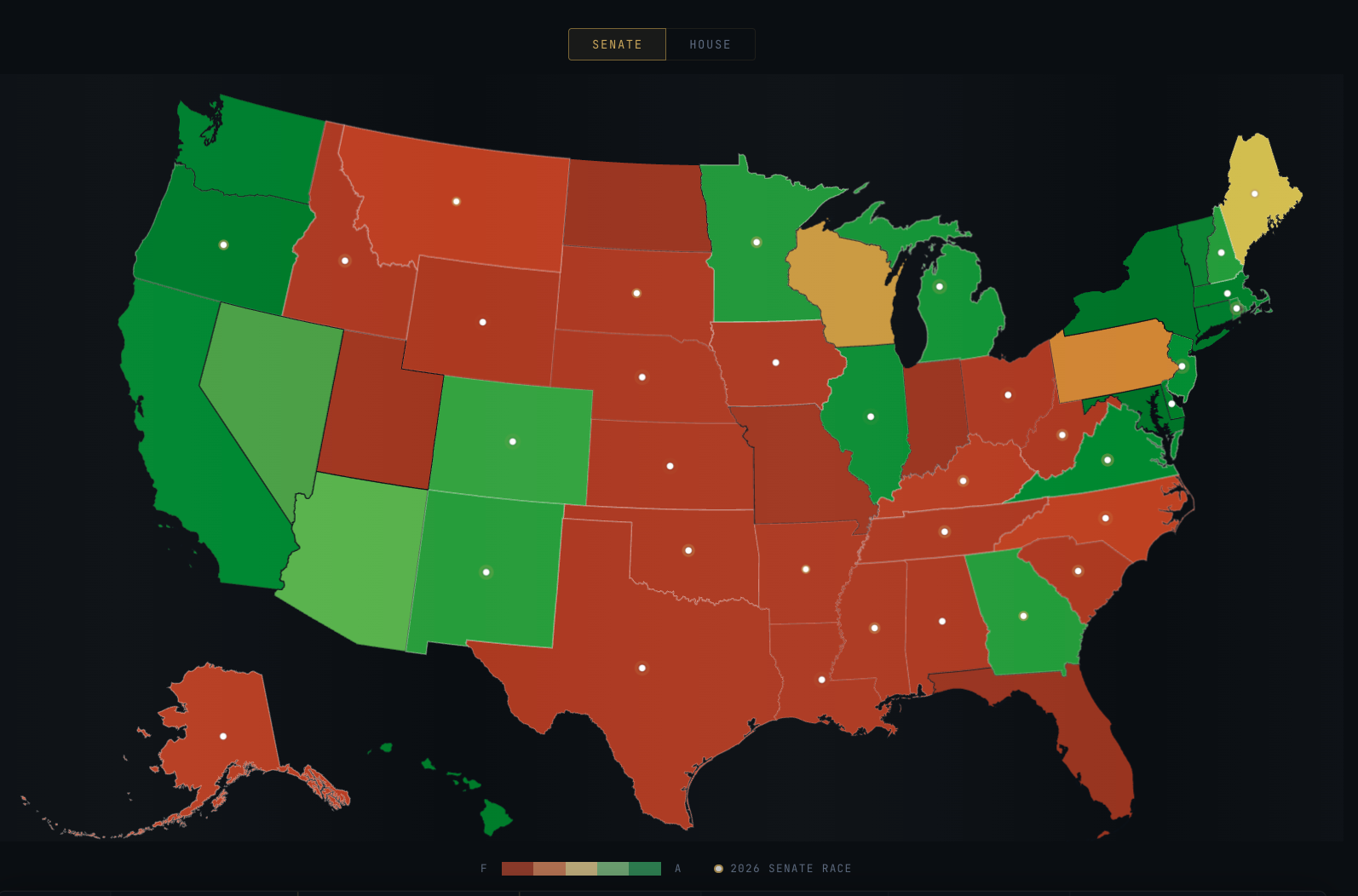
How Did Your Representative Vote?
Nine senators, all of whom are Democrats, currently hold an A+ rating for voting in support of public lands 100 percent of the time. In contrast, 54 senators have earned an F rating for voting against public lands most of the time. Every F-rated senator is a Republican.
The brothers say their tool is nonpartisan and reflects trends in how each party votes on policies that impact public lands protections.
“Yes, it’s largely Democrats on the one side and largely Republicans on the other, but that’s just the way it is,” Jim Pattiz said. “It might look like this is a partisan thing, but the facts are facts, and they’re there, and they’re well supported.”
The tool has also revealed surprising trends across the U.S. The Mountain West, for example, is largely conservative, but it is also a region with extensive public lands, and conservative voters there tend to support their protection.
“For Mountain West voters, public lands are one of the top issues, unlike most of the rest of the country,” Will Pattiz said. “That is one region where this tool is going to be extremely useful. It lets voters see, ‘Hey, wait a minute, I voted for you because you were carrying a gun and you were walking in the woods, but what the hell is this vote?’”
Tracking Public Lands Issues
It’s hardly the first map or interactive tool designed to document changes in the public lands arena. In March, Outside reported on an interactive map tracking all the national park signs slated for removal. The More Than Just Parks website hosts another interactive map of threatened public lands, and other groups, like the League of Conservation Voters, offer broader environmental voting scorecards, but this new tool is the first to specifically look at voting records on public lands.
The Pattiz brothers told Outside they hope that the tool will empower outdoor recreationists to hold politicians accountable at the ballot box.
“I encourage folks to go look in there and see for themselves and see if they find anything that surprises them,” Will Pattiz said. If the tool works as intended, the brothers hope those surprises won’t just spark frustration, but a voting bloc dedicated to keeping the nation’s wild spaces intact for the next generation.
Key Findings from the Congressional Public Lands Score Analysis
- Eight Congressional Review Act resolutions targeting public lands protections were signed into law in a single session, with a ninth pending.
- 11 senators voted against public lands on every single scored vote.
- 20 F-rated senators are up for reelection in 2026.
- 18 votes were scored in the Senate and 17 in the House across CRA resolutions, bills, amendments, and confirmations.
- Every score traces to an official roll call record on senate.gov or clerk.house.gov.
