

Published May 27, 2026 03:46AM
Last fall, I tethered a 2013 Fiat 500e (55 miles of range, a California compliance car that wants nothing to do with distance) to a 2024 Cybertruck that could feed it a full charge from its bed outlet, and I drove them both across the Navajo Nation. The setup was intentionally ridiculous. We weren’t trying to prove EVs are ready for tribal land. We were tracing the outlines of absence, where infrastructure stops and improvisation begins. In Tuba City, Arizona, a hotel manager who’d sat on a state advisory council helped us coax a battered Tesla charger back to life, angling the connector, resetting the pedestal. Out here, that’s the real network. Not the federal one.
I have relatives who live without running water or electricity—not as a historical anecdote, as a daily fact. So when I see a National Electric Vehicle Infrastructure map with I-40 lit up like a runway and the lines dimming at the reservation boundary, I don’t need anyone to explain the pattern. “At a later date,” in infrastructure parlance, can also mean never.
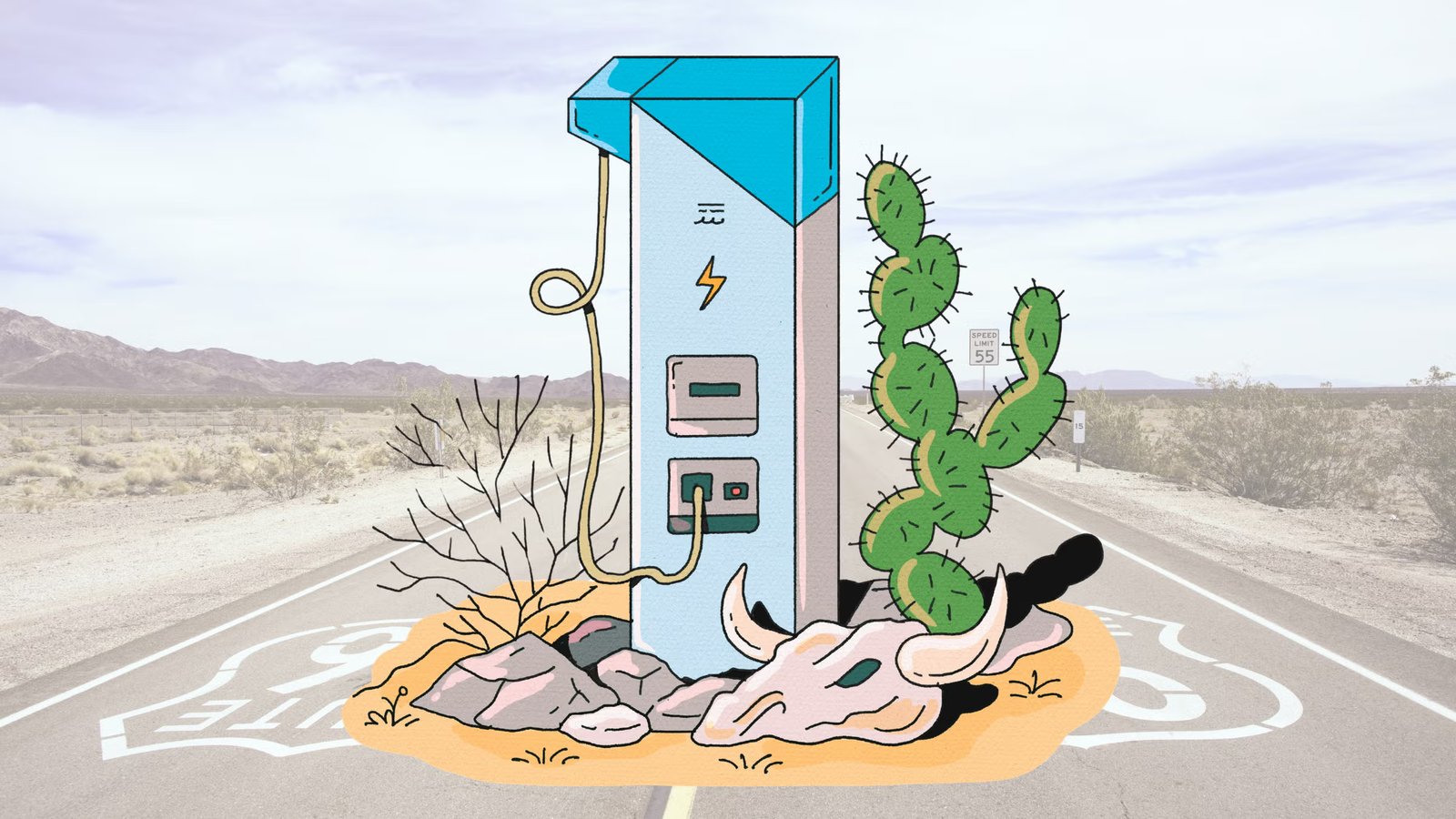
Route 66 tells this story at continental scale. The Mother Road runs from Potawatomi land in Illinois through Muscogee, Cheyenne, and Arapaho nations in Oklahoma, to Navajo and Hualapai lands in Arizona—more tribal jurisdictions than most travelers realize. The diners sold the imagery and the curio shops moved the kitsch, while the communities got bypassed.
An initiative called Electric Nation, led by Native Sun Community Power Development, is doing what federal programs mostly haven’t: building through Indian Country instead of around it. They’re installing EV chargers across 23 tribal nations, with more than 75 percent of planned Level 2 chargers already in and 16 EVs deployed for tribal use. It amounts to a modern, electric Route 66, a clean corridor where the power is tribal-controlled. Not a pilot—a network.
I’ve been chasing this question since I left the Department of Energy. I built the first map of EV chargers on tribal lands, then mapped a route from Tucson to Plymouth Rock using only tribal infrastructure. It can be done. In Oklahoma, the route threads some of the most diverse tribal jurisdictions in the country. In Kingman, Arizona, the Route 66 Museum already pairs an EV museum with Native trade route history. At the Hubbell Trading Post on the Navajo Nation, the story isn’t about nostalgia. It’s about continuity.
The old Mother Road sold a fantasy of open road freedom while routing around the people who were already here. Electric Nation is what it looks like when they build the road themselves.
I know this because I’ve watched the question land in real time. We were parked in the Burger King lot in Chinle, Arizona, when a young family walked up, the way people do when curiosity defeats hesitation. The parents were polite, almost apologetic. Their little boy had been watching Cybertruck videos for months, and he had that quiet, contained electricity kids get when something they’ve only seen on a screen suddenly stands in front of them like a landed spacecraft. I opened the door and he climbed in with the familiarity of someone who’d memorized the interior from clips. The planar dash, the cold geometry, a machine from an adjacent timeline.
For many, the Cybertruck is theater and provocation, a symbol onto which a thousand arguments get projected. Here, in a Burger King lot on the Navajo Nation, the symbolism drained out of the stainless steel. What remained was practical: could something like this work for people who live with distance as a daily condition rather than a weekend inconvenience?
Between the two cars stretched 12 years of EV evolution. Between the towns we aimed to cross lay 12 decades of American infrastructure that habitually pauses at reservation borders. We planned with spreadsheets, PlugShare, a range test in Tucson. When the Fiat inevitably showed its low power mode turtle of death, the truck would feed it from its 220V outlet. If we executed right, the days would remain a schedule rather than a rescue. The Fiat had other opinions about this, but we don’t need to get into that.
As of last October, the chargers on Navajo and Hopi lands were a tally so short you could memorize it over coffee: a DC fast charger in Kayenta, a Level 2 unit at Sage Memorial Hospital in Ganado, a tired charger at the Moenkopi Lodge in Tuba City whose cable looks like it has absorbed more weather than maintenance. That’s it. Everything else is left to improvisation.
The Inflation Reduction Act made huge sums available, but departments of transportation (DOTs) decide siting—and priorities consolidate around the urban centers that already have everything else. Phoenix and Tucson first, later for the rest. You can probably guess how that’s been going.
What I keep coming back to is the gap between the formal systems, planning documents that nod to tribal inclusion, and the informal labor from local people who keep the real network alive out of necessity. The hotel manager in Tuba City understood where the lines went and why. He also did the work in front of him. The line between those two worlds is not theoretical. It is the gap into which time and money and confidence leak.
Electric Nation closes that gap by refusing to reproduce it. The chargers aren’t placed by a state DOT working from a highway model. They’re placed by tribes, for tribes. And the EVs deployed for tribal use aren’t demonstration vehicles sitting in a fleet lot. They’re working. It answers the question that kid in Chinle was too young to articulate but old enough to feel: does the future include us, or does it just pass through?
This article is from the Summer 2026 issue of Outside magazine. To receive the print magazine, become an Outside+ member here.
