

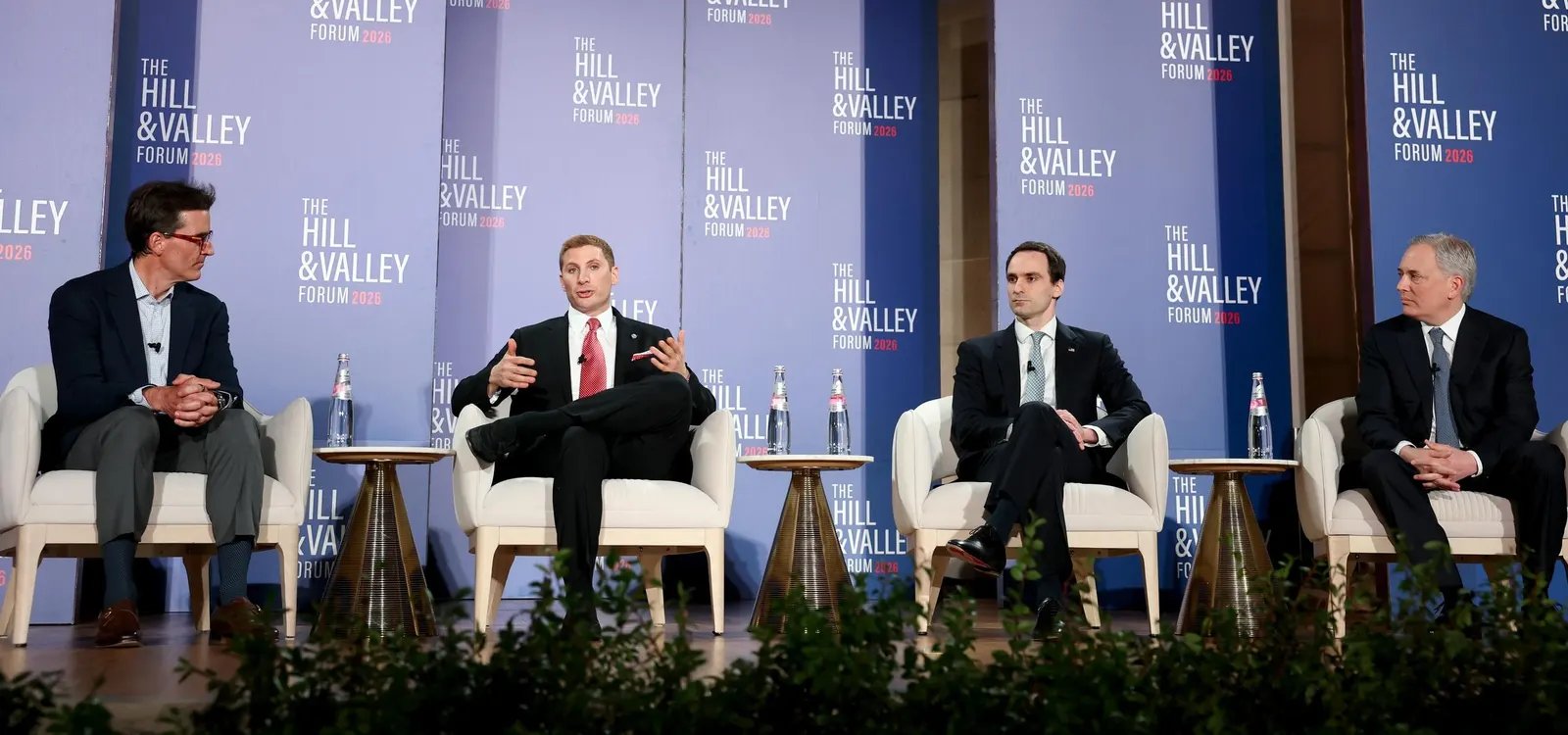
WASHINGTON, DC – MARCH 24: (L-R) Thomas Laffont, Jacob Helberg, Michael Kratsios and David Sacks participate in the Winning the AI Race: From Strategy to Execution panel during The Hill & Valley Forum 2026 at Andrew W. Mellon Auditorium on March 24, 2026 in Washington, DC. (Photo by Tasos Katopodis/Getty Images for The Hill & Valley Forum)
Getty Images for The Hill & Valley Forum
David Sacks, a venture capitalist and former White House AI and crypto adviser to President Donald Trump, used the Memorial Day weekend to emphasize what he sees as the greater risk to U.S. technological leadership: excessive regulation rather than unchecked AI development. Sacks, who stepped down from his formal role earlier in 2026 but remains an influential voice, argued that even light-touch government oversight could hand an advantage to China in the global AI race.
The discussion centered on a near-miss executive order last week that would have established a voluntary framework for federal agencies to review frontier AI models before release. As reported by Politico, Sacks intervened with a last-minute call to Trump, warning that the “voluntary” process risked evolving into de facto mandatory delays that could slow American innovation.
Trump ultimately postponed the signing. Sacks wrote in an X post, using language that critics say overstates the competitive framing of U.S.–China AI dynamics, “Winning the AI race means not only beating China but also clearing bureaucratic hurdles thrown up by state legislatures and woke politicians in DC.”
Why Sacks Says Productivity Is Rising
Sacks extended his commentary beyond policy to labor-market dynamics. In a widely circulated post on X over the holiday weekend, he noted, “Coding has been AI’s breakout use case this year. The fact that it’s increased demand for software engineers — rather than decreased it — should call into question the entire ‘AI will cause mass job loss’ narrative.”
Sacks alluded to numbers shared by GitHub COO Kyle Dangle in April. “There were 1 billion commits in 2025. Now, it’s 275 million per week, on pace for 14 billion this year if growth remains linear (spoiler: it won’t.),” Dangle said in an X post. He continued, “…we’re pushing incredibly hard on more CPUs, scaling services, and strengthening GitHub’s core features.”
Sacks argues that more software means more demand for software engineers, and less regulation means more innovation.
Where Critics Push Back
While Sacks’s data-driven optimism has resonated with tech optimists, critics have pushed back. In a blog post published by The London School of Economics and Political Science, Mohammad Hosseini and Laura Caroli dispute the “winning the AI race” rhetoric: “The race mentality promoted in the U.S. omits the fact that China is not developing its AI strategy under a ‘race’ framing. Indeed, the race narrative has been rejected by Chinese politicians and business leaders, who seem more interested in the adoption and concrete applications of AI than in a ‘race’ against the U.S.”
Broader analyses of the U.S.-China AI competition, such as those from Brookings Institution, assert that while the U.S. retains a lead in frontier models and compute scale, China is advancing rapidly in areas like open-source models, efficiency improvements, and real-world application and deployment. The outcome of the “race,” these reports suggest, will depend not only on speed but on effective translation of AI into economic gains across society.
Regarding Sacks, potential conflicts of interest have come into question. In November 2025, a New York Times report, “Silicon Valley’s Man in the White House Is Benefiting Himself and His Friends,” revealed Sacks’ venture capital firm has significant investments in AI-related companies. Sacks has maintained that his views stem from a commitment to U.S. technological leadership.
What It Means For Investors And Policy
Sacks’ messaging highlights a bullish outlook for AI infrastructure, compute, data centers and enabling technologies, particularly under a light-touch regulatory environment that could sustain long-term capital flows and innovation momentum. At the same time, the episode illustrates ongoing tensions in Washington over the appropriate balance between accelerating development and mitigating risks.
For investors, this debate matters alongside corporate earnings and technological breakthroughs. Light regulation may support near-term growth in AI adoption and productivity gains, as evidenced by expanding software ecosystems. However, insufficient attention to safety or geopolitical realities could invite setbacks and short-term volatility, whether through public backlash, security incidents or accelerated foreign competition.
The month’s developments signal that the U.S. approach to AI remains firmly oriented toward rapid progress, even as the conversation around responsible development continues. Investors tracking Nvidia, broader AI infrastructure plays or emerging applications would do well to monitor this evolving policy debate closely.
