

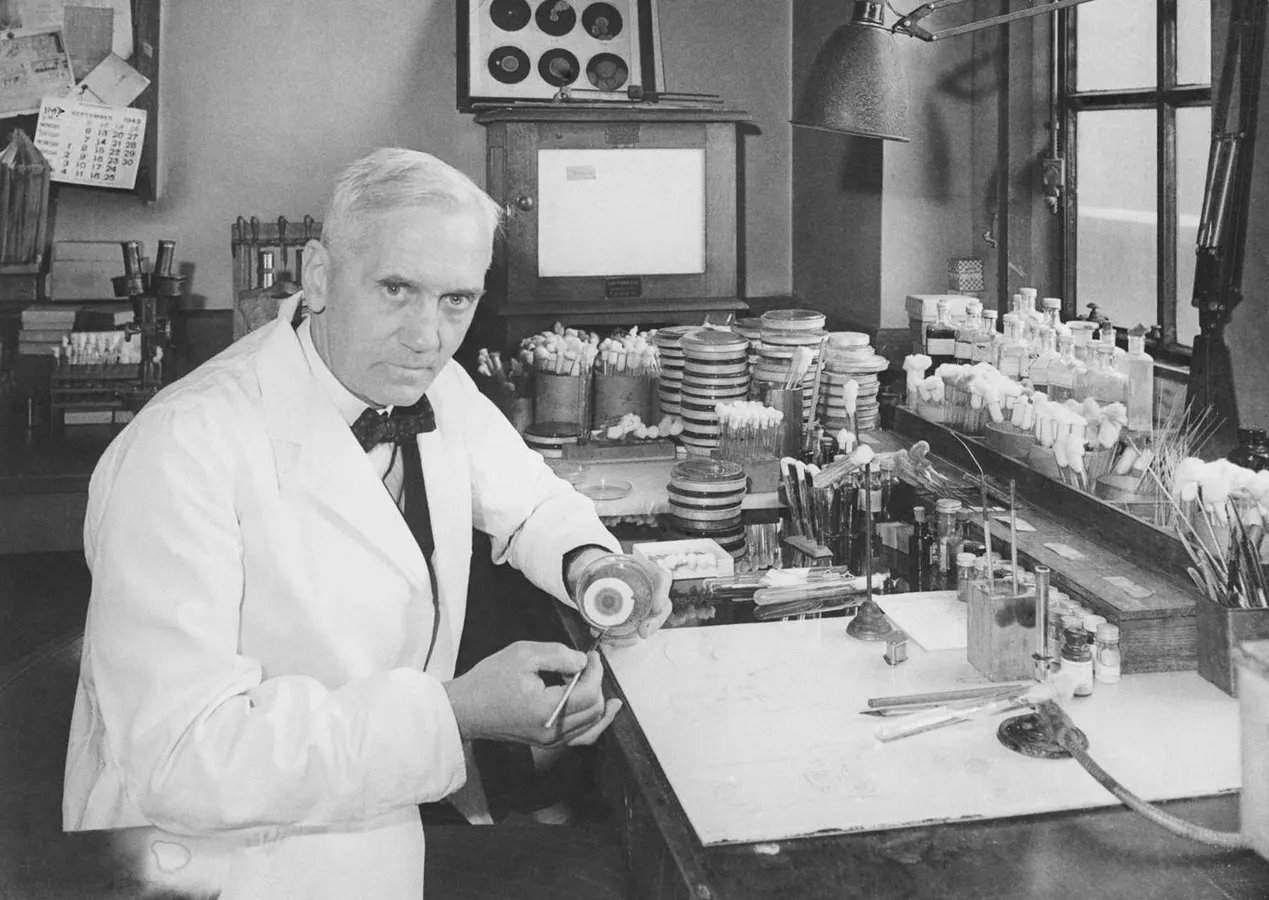
Dr. Alexander Fleming discovered penicillin.
Bettmann Archive
For most of the last century, drug discovery was a slow, physical process. You started with a theory about how a disease worked, designed hundreds or thousands of molecules to test your theory, watched them fail, adjusted, and tried again. Progress came unevenly and often at great cost.
AI is changing that. Today, before a scientist ever picks up a pipette, much of the early work can happen with the help of computers.
Some people have started calling this shift a “search engine for biology.” Instead of probing biology blindly, researchers can now navigate it and query it, using models trained on large datasets of human biology.
Finding the Target
The first problem in drug development has always been the hardest: figuring out what, exactly, a drug should target in the complex biology of the human body, whether genes, proteins, or other factors that drive disease.
Biology is not a tidy system. It’s a dense network of pathways, feedback loops, and compensatory mechanisms. A protein that may be important in one context, may turn out to be irrelevant in another. A promising signal in laboratory research may disappears when tested in clinical trials. Entire drug discovery programs sometimes collapse because the original hypothesis was just slightly off.
With AI, however, researchers are no longer shooting in the dark.
Models trained on genomic sequences, protein structures, and gene expression data are beginning to surface patterns across that complexity. They don’t “understand” disease in any human sense, but they can flag relationships that would be hard to spot otherwise: correlations between genes, protein and disease, potential biomarkers — weak signals which are often buried in large and noisy datasets.
Starting in 2020, DeepMind’s AlphaFold system predicted the structures of over 200 million proteins. That work would have taken centuries with trial-and-error experimentation. It didn’t solve disease biology, but it gave researchers a much clearer map of the terrain.
TEDDY, built by Merck, is a family of AI models designed to better understand disease biology at the level of individual cells. By analyzing data from more than 100 million cells, it provides a more precise view of how diseases develop and helps researchers design more targeted and effective drugs while potentially reducing research and development costs.
That narrows the guesswork dramatically.
And yet, talk to people running programs inside pharmaceutical companies, and they’ll tell you the success rate hasn’t suddenly doubled. Biology still surprises. But gradually, we are learning more about new areas of biology, and the pace of innovation is increasing.
Designing the Molecule
If identifying the target is uncertain, designing a drug to hit it begins to resemble a combinatorial explosion.
A viable molecule has to do many things at once. It must bind to the correct target in the right way. It must survive long enough in the body to have an effect but not be toxic. It has to be absorbed, distributed, metabolized, and excreted in ways that are all “just right.”
Medicinal chemists have always worked within these constraints. What’s new is the scale at which they can now explore them.
Generative AI systems, in particular, are beginning to “speak the language of chemistry,” learning the underlying patterns of molecular structure in much the same way large language models learn syntax and semantics in text. Instead of simply screening existing compounds, these systems can propose entirely new molecules, optimized across multiple parameters from the outset.
AI-designed drugs can be more specific, more selective, and are beginning to exhibit higher success rates in clinical trials. The result is not just more combinations tried, but often better ones, improving the odds of successful drug discovery.
Where Speed Stops
There is a tendency, especially in early-stage biotech, to talk about timelines collapsing: years shaved off discovery, pipelines accelerating, iteration cycles tightening.
Some of that is true. But biology does not move at the speed of software.
Once a candidate leaves the computer, it enters a world that is stubbornly resistant to acceleration. Cells respond when they respond, and toxicity emerges, or doesn’t, over biological timescales. Long-term safety cannot be compressed.
But AI can help prioritize which molecules to test. It can reduce the number of obvious dead ends. It cannot make a chronic toxicity study run in weeks instead of months. AI can improve the odds, but it doesn’t change the entire game.
Improving the Odds of the Trial
Clinical development itself is beginning to change in meaningful ways. Simulations and digital twins of clinical trials make it possible to model outcomes before patients are enrolled, refining trial design and improving the chances of success. At the same time, generative AI is dramatically accelerating the creation of clinical trial documentation, a process that has traditionally been slow, manual, and costly.
Together, these advances are not just speeding up trials, but making them more precise and better designed from the start.
Instead of broadly acting drugs for broad populations, we are moving toward treatments that target specific pathways and even specific patients. The unit of discovery is shifting from the average patient to the individual biology underneath.
AI is what makes that shift possible. It connects the layers from genes to proteins to cells, tissues and organs, to clinical outcomes. As those connections become clearer, the boundary between discovering a drug and delivering the right treatment begins to narrow.
For decades, drug discovery has been defined by trial and error. That is beginning to change. Not because biology has become simpler, but because our ability to search, model, and design within it has fundamentally improved.
That is the real breakthrough: not just faster drug discovery, but better drug discovery, where stronger hypotheses lead to better molecules, and better molecules lead to better outcomes.
(With the support of Chris Meier, managing director and Senior Partner at BCG X, core member of BCG’s Health Care practice focusing on pharmaceutical R&D and medical and commercial topics)
