

Topline
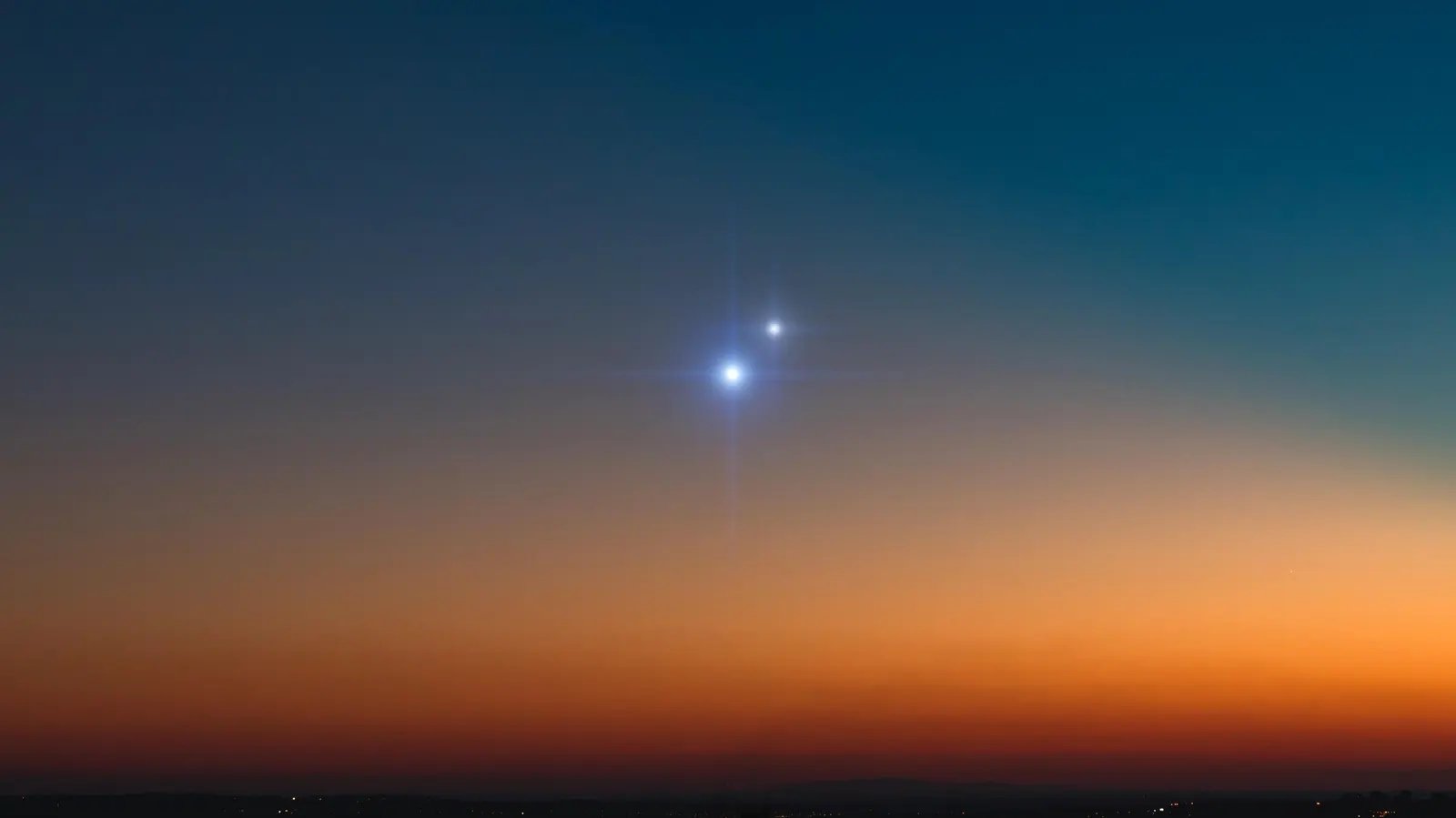
Skywatchers should clear their diary for dusk tonight as the two brightest planets in the night sky — blazing Venus and giant Jupiter — get to within 1.6 degrees of each other just after sunset. However, the sight will be visible for only a couple of hours after the sun has set. The prize for anyone looking west about 45 minutes after sunset will be the rare sight of two bright planets no farther apart than the width of a thumb held at arm’s length, according to Sky & Telescope. Here’s what you need to know to see 2-26’s best planetary conjunction with the naked eye tonight.
On Tuesday, June 9, Venus and Jupiter will come together in one of the most striking naked-eye events of the year, forming a brilliant pairing low in the twilight sky, with Mercury close by.
getty
Key Facts
Venus will be around 1.6 degrees from Jupiter, to its upper right. Mercury will be below right, closer to the horizon.
Despite being much smaller, Venus will be seven times brighter than Jupiter, largely because it’s getting closer to Earth at the moment, but also because it’s covered in a layer of reflective clouds.
If you miss the conjunction due to bad weather or fail to find the trio, return any night this week for another attempt — the two will be within five degrees of each other all week.
On Tuesday, June 16, a crescent moon will appear close to the three planets. In the weeks after the conjunction, Jupiter will sink toward the horizon while Venus will climb higher in the western sky. It will dominate the post-sunset sky all summer.
Look for the planetary duo in the western sky about 45 minutes after sunset.
Sky & Telescope
A beautiful illusion
Although Venus and Jupiter will appear to be very close in the evening sky, they are physically nowhere near each other in space. Venus is currently about 110 million miles (180 million kilometers) from Earth, while Jupiter lies roughly 560 million miles (900 million kilometers) away. Their apparent meeting is a trick of perspective caused by the alignment of Earth, Venus and Jupiter along our line of sight. Such events, known as conjunctions, occur because the planets orbit the sun in nearly the same plane, occasionally appearing to cluster together when viewed from Earth. In reality, Jupiter is about five times farther from Earth than Venus.
The next planetary conjunction also includes Jupiter. Around midnight on Nov. 14, Jupiter and Mars rise in the east just a degree from each other.
A sky chart indicating how to locate the constellation Corona Borealis between the bright stars Arcturus and Vega. The Big Dipper’s handle points in the direction of Corona Borealis.
NASA/JPL-Caltech
The next great sky event: the ‘Blaze Star’
One of the sky’s rarest naked-eye events is set to occur sometime in 2026 — the eruption of T Coronae Borealis, known as the “Blaze Star.” Located about 3,000 light-years away in the constellation Corona Borealis, the recurrent nova ( a “mini supernova” that repeats predictably) brightens dramatically roughly every 80 years, with previous eruptions recorded in 1866 and 1946. Researchers have identified June 25, 2026, as the statistically most likely date for its next outburst, although if that does not happen, then another likely window opens on February 8, 2027. The prediction follows unusual dimming episodes observed in 2023 and 2024 that closely resembled behavior seen before the 1946 eruption.
T Coronae Borealis is a binary star system consisting of a red giant and a white dwarf. Material from the red giant accumulates on the white dwarf until a thermonuclear reaction ignites on its surface, causing a nova explosion. Unlike a supernova, the stars survive the event. When the eruption occurs, the system is expected to brighten from its normal 10th magnitude to about magnitude +2 or +3, making it visible to the naked eye. Although it will not rival the brightest stars, its sudden appearance in a seemingly empty part of the sky will make it one of the most remarkable astronomical sights of the decade.
