

Published June 9, 2026 03:18AM
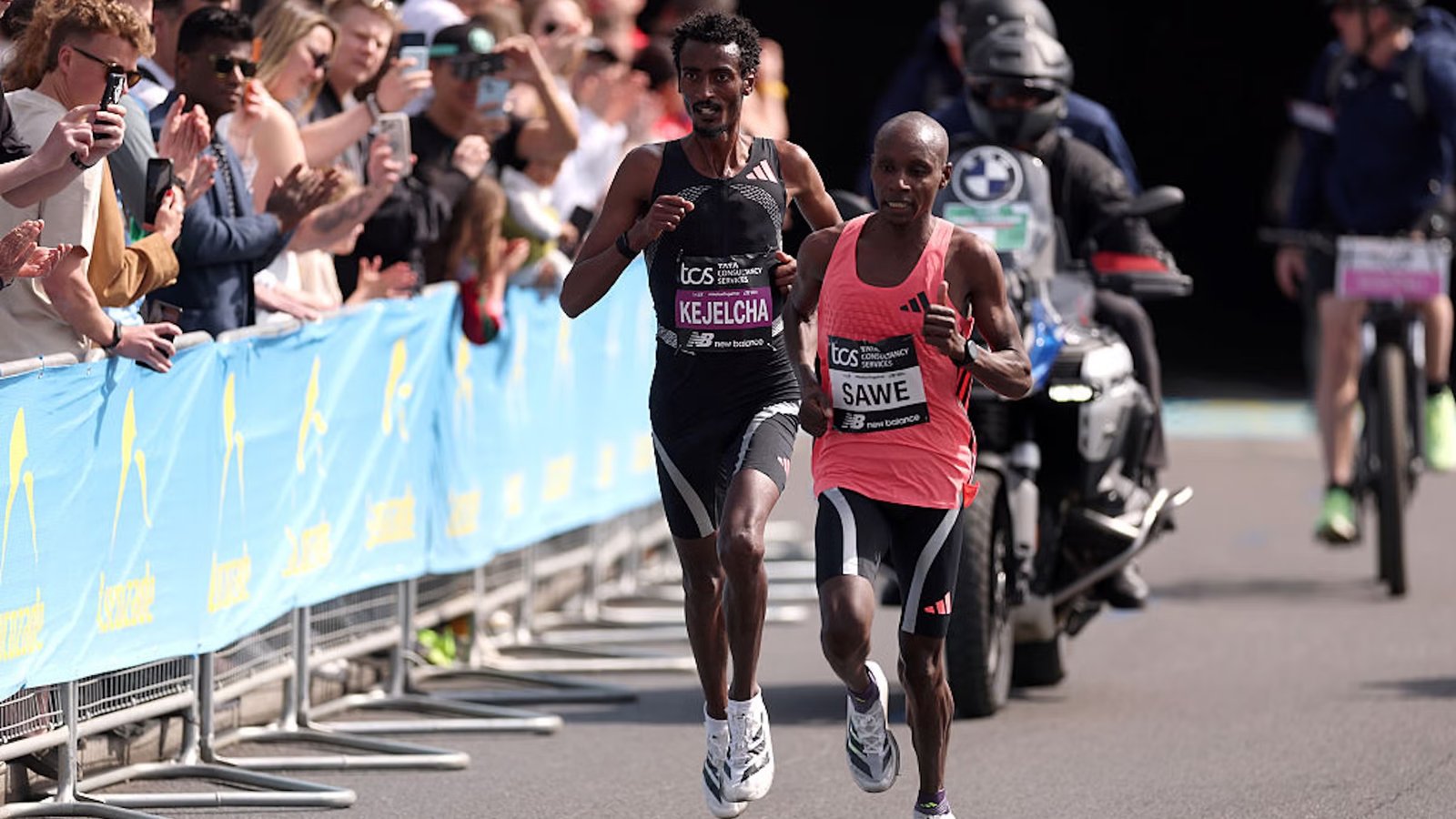
Sabastian Sawe, the first person to run an official marathon in less than two hours, took baking soda before his race. What’s most remarkable about this fact is not that he did it, but that most people didn’t think it was a big deal. Of course he did. Everyone is doing now, right?
I’m exaggerating, but not by much. When I first wrote about the Swedish company Maurten’s new easy-on-the-stomach formulation of baking soda back in 2023, it was mostly seen as a performance boost for short events lasting between about one and ten minutes. Baking soda—sodium bicarbonate, as scientists refer to it, or simply bicarb—is a base, so it counteracts the acidity associated with intense exercise and high lactate levels. But there was little evidence that it would be helpful in longer endurance and ultraendurance contests.
These days, though, things have changed. “Bicarb in the marathon is certainly something that is getting more and more traction recently,” says Michael Arishita, the founder of Flagstaff-based Blank’s Sports Nutrition, which makes its own stomach-friendly version of baking soda. “A lot of athletes are using bicarb in the marathon and staying quiet about it.” Among the marathoners using Arishita’s product is Rory Linkletter, who ran 2:06:04 at this year’s Boston Marathon. (For the record, Olympic 5,000-meter runner Graham Blanks is another customer… but the name is just a coincidence.)
The original rationale for long-distance athletes using baking soda was that it might help during short, intense bursts during the race: surges, hills, finishing sprints. But a 2024 study using Maurten’s baking soda found performance benefits even during an evenly paced 40K cycling time trial, suggesting that there’s something else going on. Endurance athletes—not just Sawe, but even ultra-endurance stars like Kilian Jornet—have latched onto the idea.
“A lot of the top marathoners are using it,” says Mark Coogan, a marathoner on the 1996 Olympic team and now coach of Team New Balance Boston. “At meets now, you see so many people using bicarb, it looks like it’s a mandatory part of your pre-game meal.”
So what’s the actual benefit for marathoners? Nobody’s entirely sure, but the scientists I asked suggested a few different possibilities:
Longer Lasting
The reason scientists have long dismissed the idea that baking soda would help in longer events was that they tested it numerous times, and it didn’t work. But old-school baking soda from your kitchen doesn’t stay in your system for very long, peaking 60 to 90 minutes after ingestion. The new hydrogel-based formulations, in contrast, seem to keep internal bicarbonate levels elevated for many hours. Maybe it’s as simple as that.
Higher “Steady-State” Lactate
The magic of baking soda in shorter events is complex and multifactorial, but the key point is that it helps you tolerate spikes of super-high lactate levels—to keep pushing when your legs feel like cement in the final straightaway of an 800-meter race, say. In a well-paced marathon, you’ll never have spikes of super-high lactate, because you’ll keep your effort slightly below threshold. This allows you to stay in a sustainable “steady state” where the amount of lactate you’re producing is balanced by the amount you’re reusing as fuel.
Still, your lactate levels will be a little higher than they would be at rest. Typically, you’d expect to sustain levels of between 2 and 3 mmol/L during a marathon. With baking soda buffering the associated fatigue, you should be able to sustain a slightly higher level without sending your lactate levels into a death spiral. “If an athlete would normally steady-state around 2 mmol/L,” Arishita says, “they might have the same perceptions at 2.5 to 3 mmol/L.” That should translate into a slightly faster marathon pace.
Less Pain Perception
Leaving all the biochemistry aside, there’s a simpler reason that marathoners might go faster on baking soda: it hurts less. “There is likely to be an interaction between bicarb and the stimulation of pain receptors,” says Andy Sparks, a researcher who has published numerous studies on the effects of baking soda in athletes and now works in Maurten’s R&D department.
The burning sensation in exhausted muscles is triggered (at least in part) by hydrogen ions; baking soda buffers those ions. “This is likely the mechanism by which bicarb reduces pain perception and therefore reduces RPE [rating of perceived exertion],” Sparks explains, “so in self-paced exercise that will lead to higher power outputs and faster speeds.”
Greater Efficiency
There’s a minor mystery in some of Maurten’s long-distance bicarb studies. Cyclists on bicarb tend to have the same cadence, the same heart rate, the same VO2 (a proxy for energy consumption), and the same perceived effort as they do on the placebo…but they go faster. That suggests the cyclists are managing to get more out of each calorie they burn.
One possible explanation for this improved efficiency, Sparks says, is that levels of acidity within the muscle are also reduced by the presence of bicarb in the bloodstream. The enzymes that control the metabolic reactions fueling muscle contractions work better in this lower-acidity environment, which translates to more power.
Carb-Bicarb Interactions
The two elephants in the sports nutrition room these days are super-high carbohydrate intakes and baking soda. Could they be connected? There’s a long history of research suggesting that baking soda speeds the transfer of food from the stomach to the intestines for absorption. A 1940 study found that a teaspoon of baking soda decreased stomach emptying time by 16.3 percent; a 2014 study in rats found that baking soda reversed the delay in stomach emptying caused by hard exercise.
The problem with this theory is that it depends on baking soda acting in the stomach itself. The whole point of new baking soda formulations like Maurten’s, Sparks points out, is to avoid releasing it in the stomach, keeping it encapsulated until it reaches the intestine.
Still, there may be other interactions. Maurten has tried some in-house studies using carbon-13 isotope tracers to test whether top athletes are able to burn more supplemental carbs when they’re taking baking soda. So far they haven’t seen any signs that this is happening, Sparks says, but the data is very preliminary for now. Arishita suggests another possibility: that high carb intake slows down bicarb absorption, enabling it to last longer in the body. One way or another, he says, “there is certainly some interaction between bicarb and high carb intake.”
The overall conclusion, then, is that no one is really sure why, or even if, baking soda is useful over long distances like the marathon. It’s risky to leap to conclusions based only on the fact that some very fast runners, like Sabastian Sawe, use it. And it’s really difficult to run good randomized trials of super long efforts like a marathon (who’s volunteering to run all-out marathons on three back-to-back weekends?), so it may be a while before we get definitive answers. But in the meantime, if I were running a marathon…
For more Sweat Science, sign up for the email newsletter and check out my new book The Explorer’s Gene: Why We Seek Big Challenges, New Flavors, and the Blank Spots on the Map.
