

Published June 24, 2026 06:00AM
When Outside first got featured the Slate earlier this year—wrapping it in sun-bleached orange, shooting it against the kind of high desert backdrop outside Palm Springs—the question everyone kept asking wasn’t what is this thing? It was will this thing actually happen? EV startups have a way of, well, not starting. The Slate felt different, but feeling different and being different are two separate animals.
Now things get real. It comes with a price tag, a delivery date, and enough spec improvements to quiet a lot of the noise.
The $24,950 Slate Truck—already the most affordable electric vehicle in America and the most affordable new truck of any kind—just got meaningfully better. Range is up 37 percent over what was initially announced to an estimated 205 miles. Payload has climbed to 1,550 pounds. Tow rating hits 2,000 pounds, enough to haul a pair of jet skis. First deliveries are expected in Q4 2026. You can preorder it now at Slate.auto for $300. If you already dropped $50 on a reservation, it’s only $250 more to convert. More than 180,000 people are ahead of you in line.
The Case for Simple
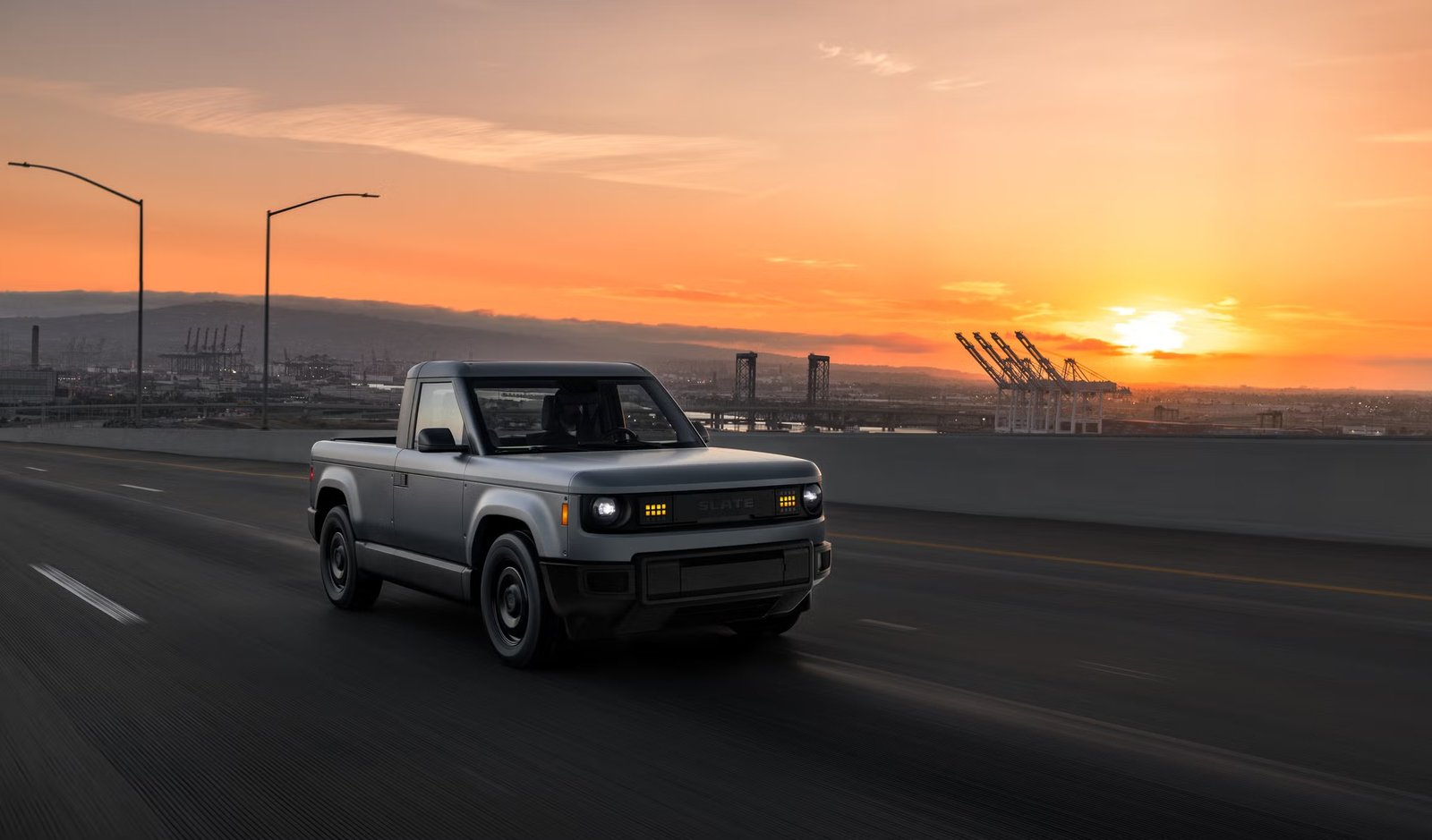
Let me restate what makes the Slate unusual, because it remains genuinely unusual. There is no touchscreen. There are good, satisfying old-school knobs for the AC, plus a column shifter, crank windows (more on those in a minute), and a button to pop the trunk. A mounting spot for your phone (comes standard) or a tablet (an option) handles navigation. The exterior comes from the factory in one color: grey. Everything else is up to you.
The philosophy behind all of it came through clearly during a walkthrough of the engineering station at Slate’s HQ in Southern California. An engineer described the question to me that drove every design decision: “For every single component in this truck, does it need to be there?” The crank windows, he said, were a direct result of that question. “Do I need power windows driving down the street? No. And the crank window is more durable and more affordable.” The same logic applied to noise, vibration, and harshness (NVH) treatment, which started as an outright non-starter. NVH “was gonna have to fight its way in,” the engineer told me. It wasn’t the first priority. Safety was. Crashworthiness was. Everything else earned its place.
What they ended up with is a vehicle that feels stripped down in a way that is, unexpectedly, kind of refreshing. Raw plastic interior. Steel wheels. Crank windows that deploy muscles that haven’t been activated since 1994. The whole thing has the energy of something utilitarian and purposeful, before the industry convinced everyone that cameras and screens were a reasonable substitute for just, you know, turning your head.
On the exterior, the body panels are a custom polypropylene-and-talc composite developed specifically for the vehicle—chosen because when a shopping cart hits it, it bounces back rather than cracks. Dings, in Slate’s view, are patina. This truck is meant to be used and roughed up. And if it really bothers you? Get a new wrap.
What It’s Like to Ride In
No journalist has driven the Slate yet—media drives are still to come ahead of deliveries. But I did get to ride shotgun today while a Slate rep put it through its paces, including a few moments of flooring it, and the impressions are worth noting.
Zippy. More than you’d expect. At 174.6 inches long, the Slate sits shorter than a Ford Maverick, and its rear-wheel drive with 135 kW and 264 Nm of torque pushes what is ultimately a pretty light vehicle. Zero to sixty in eight seconds doesn’t sound like a headline, but the experience feels faster than that—partly because of the size, partly because EVs do that thing where the torque is just there, and partly because you’re in something that looks like an old Chevy S10.
The interior feels bigger than the outside suggests, mainly because there’s no transmission tunnel or engine intruding into the cabin. I was told they designed the occupant package around colleagues who were six feet four inches and five feet twin inches and you can feel the intentionality. The sight lines feel open, and the belt line is high enough that the cab reads as spacious despite the footprint.
Road noise and vibration were better than anticipated, especially given the engineering philosophy described above. What they landed on: obsessive attention to sealing—door seals, window seals, the bulkhead—plus liquid-applied sound deadening under the carpet floor. It’s not a Volvo. But it doesn’t rattle you around.
The crank windows are, again, a delight and also a mild workout. The frunk turns out to have a drain and cup-holder slots built in. That’s your cooler and your camp kitchen. That detail, small as it is, captures something about how Slate is thinking: not about features, but about functions.
What the Specs Actually Mean
The 37 percent range increase is the headline of this update, and it came from a single cascading decision. Slate originally used Nickel Manganese Cobalt (NMC) battery chemistry—high energy density, but it blocked a more efficient cell-to-pack architecture. They switched to LFP: lithium iron phosphate. Heavier, yes, but it unlocked the ability to push usable energy to 63 kWh from a 65 kWh pack, and it allowed them to further optimize the thermal management system, running cooling pumps less aggressively to wring out additional efficiency. The result is 205 estimated miles from a single pack. No more standard-and-extended-range choice.
The bonus: LFP chemistry means you can charge to 100 percent without degrading the battery. If you’ve been trained—as most EV owners have—to cap charging at 80, unlearn that habit for the Slate. Charge it full. Level 3 DC fast charging hits 20 to 80 percent in about 30 minutes via NACS. Level 2 at home goes 20 to 100 in four hours. Plug it in at night and wake up full.
The accessory marketplace launches alongside preorders, with over 175 items—more than 80 of them under $500. Partners include Yakima, Thule, and Camo, which makes tailgate pads for mountain bikes. There’s a $250 speaker system tuned specifically to the Slate’s cabin geometry that, on my listen, punches well above its price. Flated—the inflatable gear company—is making a truck topper out of paddleboard material that straps over the bed, hard enough to stand on, compact enough to pack down flat.
On the SUV front: more than half of the people configuring their Slates in pre-production have been opting for the SUV body styles—which is interesting, given that the whole marketing premise is an affordable pickup. The Squareback and Fastback start at $29,950 and convert after purchase, arriving flat-packed and bolting together in roughly an hour with a second set of hands. (Yes, you can do it yourself or hire someone.) The SUV kit panels are foam-filled composite, which adds acoustic benefit alongside structure, and the vehicle’s proximity sensor detects when the conversion is underway and reconfigures the airbag system automatically. More sophisticated than the IKEA-furniture comparisons suggest.
The Off-Road Question
I asked a Slate engineer directly: How off-road can you actually take this thing?
“I wouldn’t say this is an off-road vehicle,” he said. “Rear-wheel drive, open differential—so I joke that that’s the same as one-wheel drive off-road.” Then he paused. “But I am going to take it through the Manistee National Forest this summer, with the all-terrain tires and the two-inch lift. I think it’s fair to say that people do OK.” The two-inch suspension lift, combined with tires two inches larger in diameter, raises the vehicle a total of three inches. His goal was for the lifted configuration to ride and feel as close as possible to base trim—no degradation in dynamics, just extra clearance.
So the Slate is not a trail rig. But capable enough to get you to the trailhead on the kind of roads that actually require something.
The Bottom Line
As I wrote in our Spring issue, the Slate was a proposition, not a finished product. That was accurate at the time. No one had driven it, the range was shorter, and the delivery timeline was theoretical.
Now the preorder window is open and the factory in Warsaw, Indiana, is up and running; Q4 deliveries are the plan. None of that means it’s a sure thing. But $24,950 is a hard number to argue with, and 180,000 reservations suggest a lot of people aren’t waiting around for the verdict.
The rest of us will find out in a few months.
