

Published June 25, 2026 01:18PM
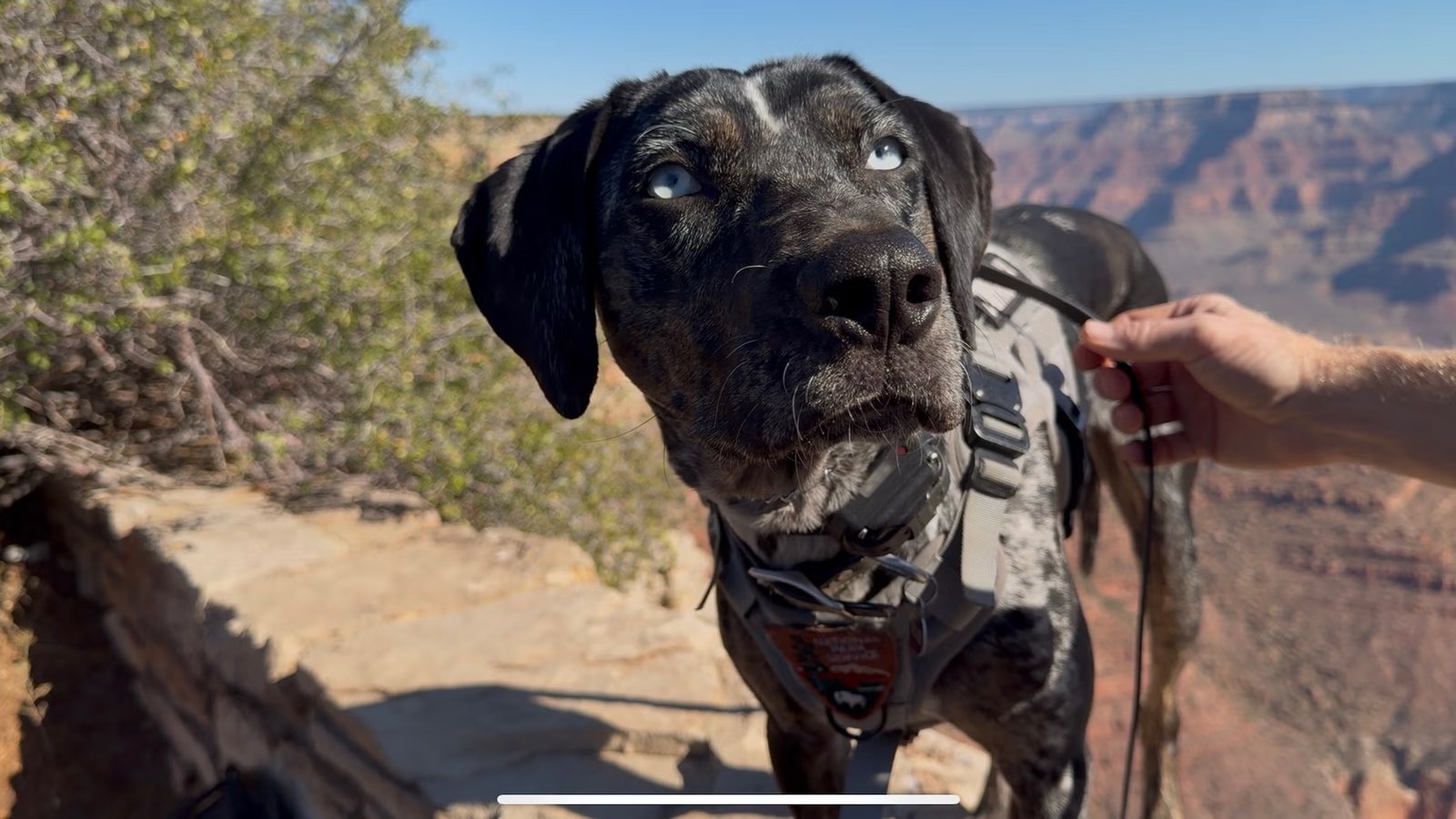
I’m standing at Mathers Campground in the Grand Canyon at one of more than 300 sites, staring straight into the eyes of a 700-pound elk. Next to me is Brady Dunne, a wildlife biologist with the National Park Service (NPS), and his partner, Blue. She’s not your usual park ranger—Blue is a Catahoula Leopard Hound, specially tasked with training the park’s wild ungulates to stay away from areas where people frequent.
And she takes her job very seriously.
“Grand Canyon has a what I would call a chronic elk problem,” Dunne told me. “Just like in Yellowstone, elk from outside the park have been coming in for 20, 25 years, and over that time have gotten what we call habituated. We have not been able to find a solution for that as of yet.”
On Patrol with Blue
It’s the morning of June 15, and I got up especially early to beat the Arizona heat. After meeting Dunne and Blue at the historic El Tovar Hotel, we hop in our trucks and go on patrol, driving through the park in search of human-habituated elk. Dunne’s radio clicks on—his wildlife rangers have spotted a large female hanging out at Mather Campground, one of five key places NPS staff have deemed high visitor use areas and an elk movement hotspot. (Other locations include El Tovar Hotel, Grand Canyon Visitor Center, Maswik Lodge, and Grand Canyon School.)
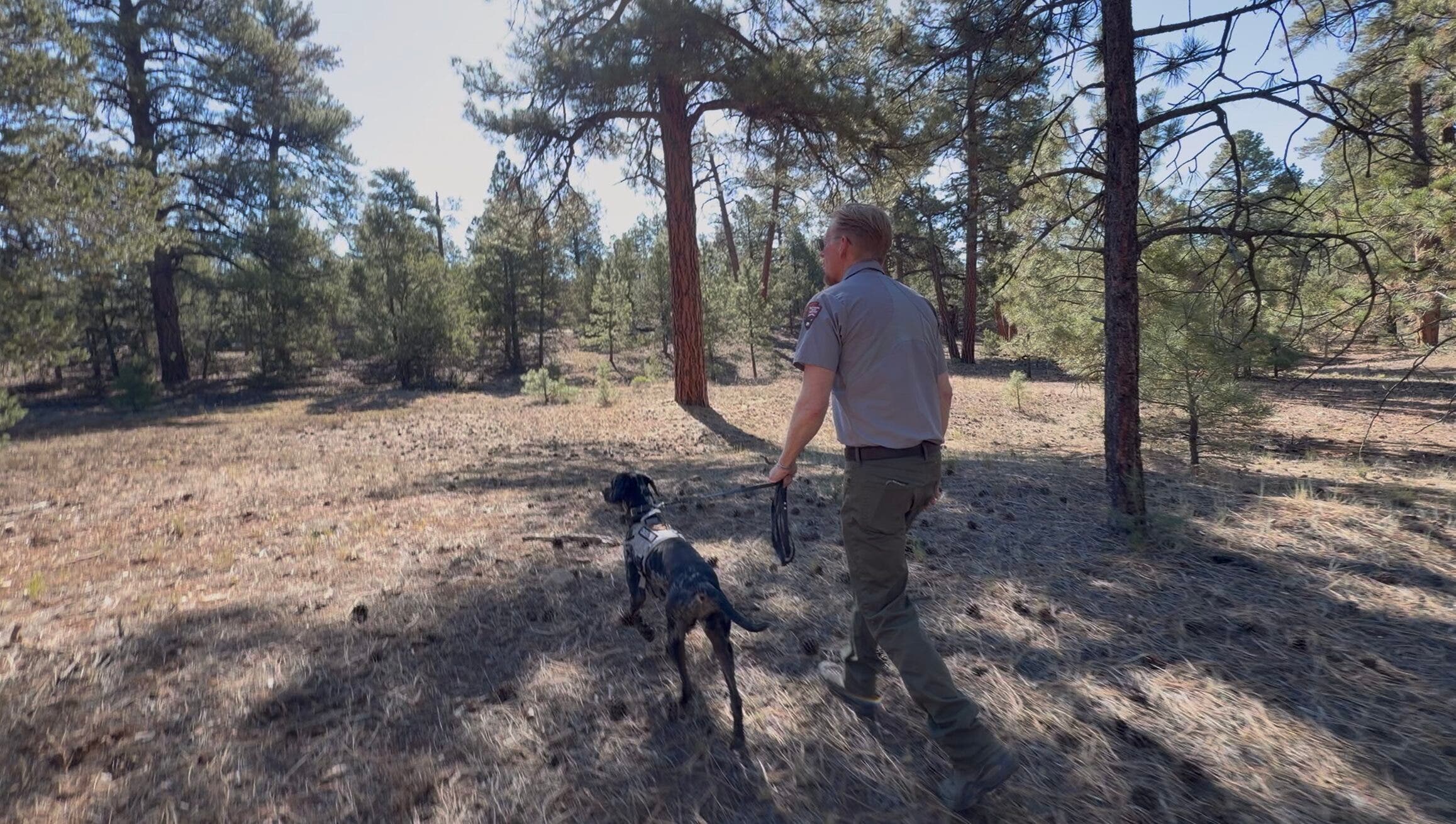
We park our vehicles along a narrow road bookended by Ponderosa pine, Pinyon, and Juniper trees. Dunne opens the hatch of his SUV and carefully leashes Blue. We walk, side-by-side, calmly and quietly, crunching over pine cones. Once within 20 feet, Dunne commands Blue to bark, activating her herding instincts to ward off the elk. Within seconds, the elk is up, running off into the distance.
I’d first learned of Blue in May, when she started patrolling parts of the South Rim. She’s not the first four-legged ranger to take on such a task. In July 2016, Glacier National Park employed Gracie, a border collie professionally trained to move bighorn sheep and mountain goats out of popular areas. Further south in California, a Karelian Bear Dog named Yoshi is currently warding off bears in Yosemite.
“It opens a lot of doors for a lot more conservation work using this new tool,” Alex Mueller, biological science technician at Grand Canyon National Park, told me.
A Pilot Program to Fuel a Long-Term Investment
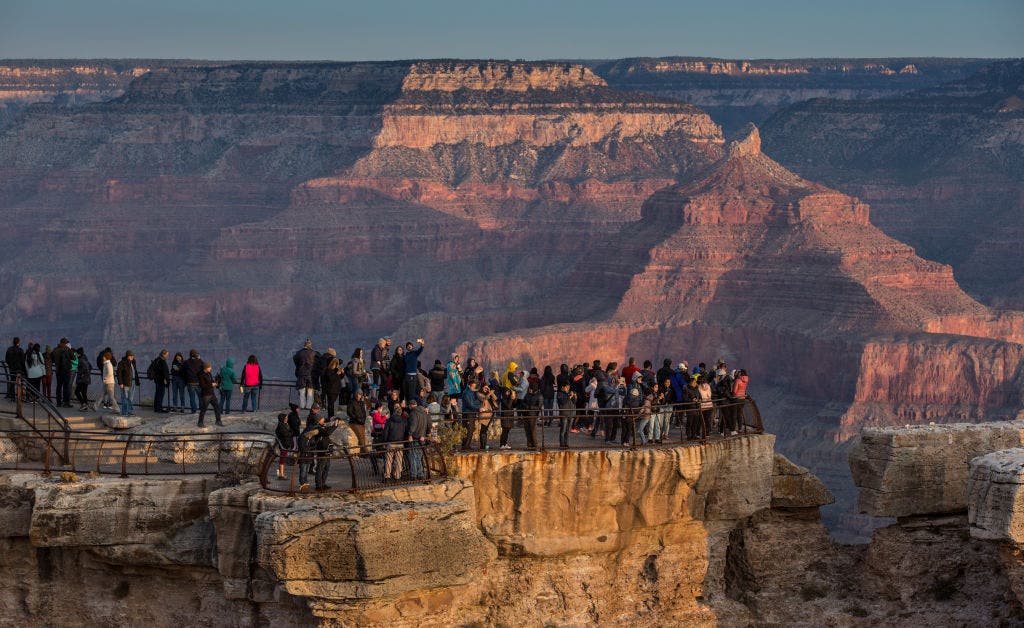
At 18 months, Blue is the first participant in a three-year initiative funded by the Grand Canyon Conservancy to condition habituated wildlife. Some elk and bighorn sheep have become more comfortable around people and in developed areas, using these locations to stay safe from predators like cougars and coyotes. The program, Dunne hopes, will reduce encounters, emergencies, and lethal management actions. It comes at a time when park visitation is at an all-time high.
“This park alone gets about five million and has had up to six million people visiting per year,” Dunn said. “On top of that, which is where the problem resides, is that we also have the highest elk population we’ve ever had, and the largest majority of that population has ever been habituated.”
As animals get habituated, they also become bolder and more aggressive. They can block roadways, walk along paths, and use the park as a natural buffer against predators because there are fewer cougars and coyotes within the park boundaries.
Blue acts as a “spotted wolf,” says Dunn, filling in that predator gap and spurring an innate fear response in elk. It’s a natural predator cue that supports long-lasting behavioral change. Blue is always on a leash and under Dunne’s full control. She never bites; instead, she uses barking and herding pressure to move animals out of the area.
“Blue starts barking. We walk towards the elk, and we guide the animal away. We do it over and over because that’s what you call aversive conditioning. They’re going to associate every time they go to ‘that one spot,’ that spotted wolf comes out with her owner and barks,” Dunne said. “All we do is shift them out of the area and let them be.”
NPS staff monitor elk and bighorn sheep movements using radio collars. This allows them to determine where the animal moved and how long they stayed away from the area, whether it’s 45 minutes or two weeks.
“We’re making it scientific on top of being innovative,” Dunne said.
A Furry Known Face Around Grand Canyon Village
Blue has become somewhat of a mascot around the Grand Canyon Village, the primary hub along the South Rim. My friend has lived in the area for five years and has two sons, Wyatt and Walker. When I told them I got to hang out with Blue for the day, their eyes lit up—she’d come to their school and show off her skillset in real time.
And if you think Blue is a character, well, you haven’t met Dunne. He’s a self-proclaimed old head, and a philosophical one at that. He told me he was expecting an uptight reporter, but my dirty Carhartts, Chaco-tanned feet, and beat-up Tacoma suggested otherwise.
“You seem cool, let’s do this,” he said. Dunne has decades of experience, having studied wolverines in Glacier, grizzlies in Yellowstone, captured cougars in Colorado, and tracked bobcats and Canada lynx across the Rocky Mountains. He’s also collected over 60,000 hours of field data.
“Thanks for reminding me how much fun I had,” he told me after describing his experience. He loves his work, you can tell. And his work is now Blue.
If the project is successful, Dunne hopes to expand his work to other parks and animals.
What to Do If You Come Across Wildlife
Sophie Mirotznik, a biological science technician, works with Blue and helps to control crowds or traffic. If you come across wildlife while visiting the park, be cognizant of where the elk are currently and where they are moving.
“To be a good steward, especially related to elk, staying 100 feet away is ideal. If it’s not possible, don’t close the gap between where you are and where the elk is,” Mirotznik said. “The animals are dangerous, and it’s better to listen to us than to get hurt.”
Listen to park staff, be patient with their process, and stay aware of your surroundings. Don’t feed the animals, and be sure to turn off the water stations after using them. If you find yourself face-to-face with the animal, she said to calmly walk away.
