

Published July 2, 2026 03:48AM
Let me paint you a nightmare scenario: You go to the office every day, knowing that at any moment, you could be told to pack up and leave on a spur-of-the-moment, 18-day business trip. When you arrive, you’ll be left in an unknown location with no transportation, no way out, and no promise of rescue. Oh, and did I mention that your destination is 1,100 degrees Fahrenheit and actively on fire?
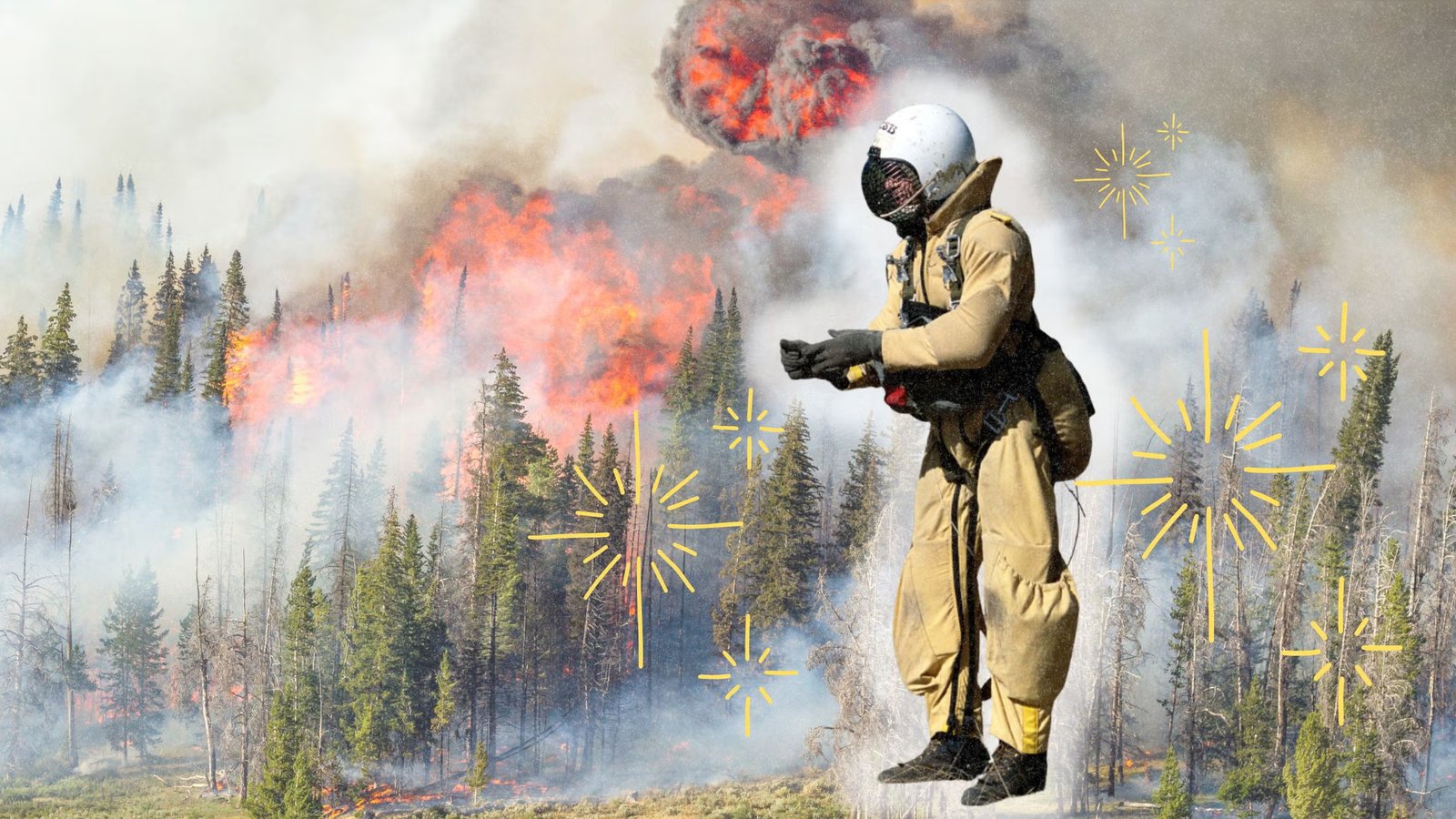
That’s smokejumping for you. When federal agencies get a call about a remote wildfire, they break out the maps. If there are roads nearby, they send in a ground-based hotshot crew. If there are no roads, no easy way in, and no easy way out—that’s when they send in the smokejumpers.
Jump crews are the nation’s first line of defense against destructive wildland fire. Most operate out of a handful of smokejumper bases scattered throughout the American West, ready to speed to a disaster site at a moment’s notice. And speed they do. Within two minutes of a call, they’re suited up. Within ten minutes, they’re on a plane. The crew—an elite group of six to eight firefighters—get dropped off in the middle of nowhere without any trucks or heavy equipment. Their job: stop the flames by hand. Only then do they start thinking about finding a way out.
In terms of work-life balance (nonexistent) and physical ordeals (grueling), it’s one of the toughest jobs on the planet. Jumpers regularly carry 120-pound packs through steep, off-trail terrain. The work is seasonal, and the pay is bad. Folks often live out of their vehicles, work restaurant jobs on the side, or decamp to Latin America in the off-season to stretch their savings further.
The work is also dangerous. Just last week, three wildland firefighters on a Colorado helitack crew died fighting a blaze in the western part of the state. Two more were injured. Smokejumpers have to battle all those same risks, plus the hazard of leaping out of a plane—often in a parachute they’ve made and rigged themselves—into rocky, treed territory without any clear landings. Sprains, sprains, and shattered ankles aren’t uncommon.
On top of that, federal funding cuts earlier this year slashed about a quarter of Forest Service employees, gutting fire services at a time when climate change is lengthening fire seasons and making existing fires more destructive than ever before. Understaffing could make fires worse—and the work even more dangerous.
And yet, the people who do it say they couldn’t imagine doing anything else. Here’s why.
The Gig at a Glance
Job: Smokejumper
Age: Early 30s
Years in the Business: 9
Salary: $30,000 to $100,000 depending on fire activity
There Are So Many Safer Jobs Out There. Why Do This?
I grew up in an area out West where big fire incidents are common. Sometimes in the summers, they’d shut down the fairgrounds because they needed the space for an incident command post, and then we wouldn’t have a state fair. Fire was part of life for me.
That said, I never thought of it as a job. I was a small-time athlete, playing football and riding bulls. I put myself through college rodeoing, but I was spending more money than I was making. Between the pay and the sense of purpose, wildland fire started to look pretty attractive. A few years later, I put in at jump programs across the nation. My first year jumping, I was 23.
How Competitive Is It to Become a Smokejumper?
It’s super competitive. As a prospective jumper, you apply to bases all over the country, and if you’re lucky, you get accepted into a rookie training program. Training is only six weeks long, but it’s intense. My base gets several hundred applicants each year, and we usually take just 10 to 20. Then they have to make it through the next six weeks. I’ve never seen a class where all rookie candidates have made it through training successfully. The attrition rate is usually 50 percent.
What Happens During Training?
We keep that to ourselves. It’s our culture not to share what happens during those weeks. The mystery adds to the stress of the program. We want to see how rookies operate when they’re put into a situation where they don’t know what to expect, because when they’re on the ground fighting fire, that’s exactly what they’ll be doing.
What Was Your First Jump Like?
My first jump was in Alaska. It was a slow year in the Lower 48, so they sent us up there to help out. I remember flying over the upper Yukon and looking down into the forest. There were zero roads, zero structures—just wilderness. As soon as we got close, we saw other aircraft dropping into the fire. We were next.
The thing about training is that it drills into you what to do and how to react without thinking. Muscle memory just takes over. I remember leaving the aircraft, and then standing on the ground.
Then I stood there for a minute, looking around, waiting to be told what to do. But as a smokejumper, no one gives you orders; you’re expected to work independently. I was watching everybody opening up paracargo boxes and doing their jobs, and I was like, “OK. No one’s going to tell me what to do anymore—I just need to grab a tool and get to work.”
How’s the Pay?
Awful. After my first season of jumping, I was considering going back to a hotshot crew. Base pay is only $16 per hour when you’re starting out, and you don’t make real money until you’re on an active fire and getting hazard pay. My first season was so slow, I only did two jumps, and I made about half of what I had been making as a hotshot. But it did get better. I now make much more than I did on a hotshot crew.
Part of the trouble is that we don’t get hazard pay for practice jumps. You’d think jumping out of an airplane 3,000 feet above the ground into a timbered jump spot you haven’t ever seen before would count as hazardous. But unless there’s an uncontrolled fire, we don’t get paid any extra for that work.
Do You Just Sit Around the Station When You’re Not Jumping?
There’s always plenty to do. We’re pubic servants, so if planes are staffed and there are no incidents at hand, we send individuals out on assignments to surrounding fire services to fill in as necessary. We send people out ot do controlled burns in Florida, Georgia, Virginia, and across the West. We also spend a lot of time building and repairing gear.
You Make All Your Own Parachutes and Gear in-House?
We do. We build our own harnesses and risers—the components that attach the suspension line system to the parachute. We have a whole office downstairs filled with sewing machines. After rookies graduate training, we send them into the loft to learn how to rig parachutes. They have to rig ten before they’re allowed to go out on fires. Once they rig 20, we have them jump their 21st parachute themselves.
How Do You Maintain Work-Life Balance with Such an Unpredictable Schedule?
I live my life on the road or in the sky six months out of the year. During the season, your work becomes your life, and your life becomes your work. I don’t think that’s always a bad thing.
Most of our significant others know that we do what we do because we love it. The caveat is that I don’t have children yet, and if that changes, things could get harder. I’ve seen people have to spend less time on the road becuase they’ve got their first kid, and that’s a bummer because it means they make less money.
What’s the Closest Call You’ve had?
I was working on a hotshot crew a few years back, and we were on our second roll—which means we’d already done a two-week stint in the field, had two days off, and were back for another two weeks. It was day 13 of that roll, and we had single-digit relative humidity. It was dry, and hot, and the wind was coming in 20- to 30-mph gusts.
It was 12 or 1 P.M.—not quite the witching hour, but approaching the heat of the day. We were working on a piece of dozer line, and the fire had burned through the understory. The ground was black, and we were told that if the fire went big, we could retreat here.
But then, in the heat, the unburned material in the ground started to smolder and built up a head of steam, and before we knew it we had a crown fire running up the hill toward us—and a half-mile of ground to cover before we could get to safety.
I was trying to yell to my crew, but the fire was loud as a freight train, and I couldn’t hear the sound of my own voice. I remember waving my arms and shouting, but no one could hear me. Eventually the crew looked around, saw the fire, and started running.
Most people made it out on foot just in time, but a few were still out there, and we had to send a vehicle. I watched the truck bust through a wall of flames at the dozer line. Luckily, everybody made it. I remember the immense relief, and the adrenaline—but there are few things I do these days that don’t involve at least a little adrenaline.
Have You Ever Lost a Teammate in the Line of Duty?
A few years ago, there was a fatality on my team. I was fairly young, and the fatality was a seasoned jumper. I was the last person who looked at his equipment. I gave him his final checkoff before he made the last jump of his life.
The thing that got him wasn’t an equipment failure, so I know it wasn’t my fault, but still. I was stuck on it for days. In the back of my mind, I kept thinking: Did I miss something? Could I have prevented it?
It was eye-opening. I started to wonder if I was in the right business—was this what I wanted to do for the rest of my life?
Did that Death Make You Think About Quitting?
I’ve never truly wanted to quit. When something like that happens, you have all these conversations with the people you work with. They’ve all been through it, and they get it. These people aren’t just coworkers—they’re your best friends. That helps you get through the lows quicker than you might think.
Why Do You Keep Coming Back? What Makes the Risk Worth It?
There are so many unknowns in life, and all you can do is keep doing work that you love and trying to serve your community. I’m a blue-collar boy. I don’t come from a trust-fund family. I’m going to work the rest of my life, and I know that. But this is a government job, and I obviously don’t do this for the money—it’s the people. It’s the service we provide. I’ve had other jobs, and I can’t see myself finding another job I enjoy this much or individuals I not only work well with but really admire. They’re my family.
If you look at the American workforce, how many people wake up in the morning and are excited to go to work? I bet you couldn’t find a whole bunch. For me, winter is the hardest. I miss the busy season. I miss the buzz around the base that happens during the summertime—there’s lots of high fives and energy and the stoke is high. That’s the feeling. That’s what keeps me coming back.
Quotes have been edited for length and clarity, as well as to preserve the source’s anonymity.
