

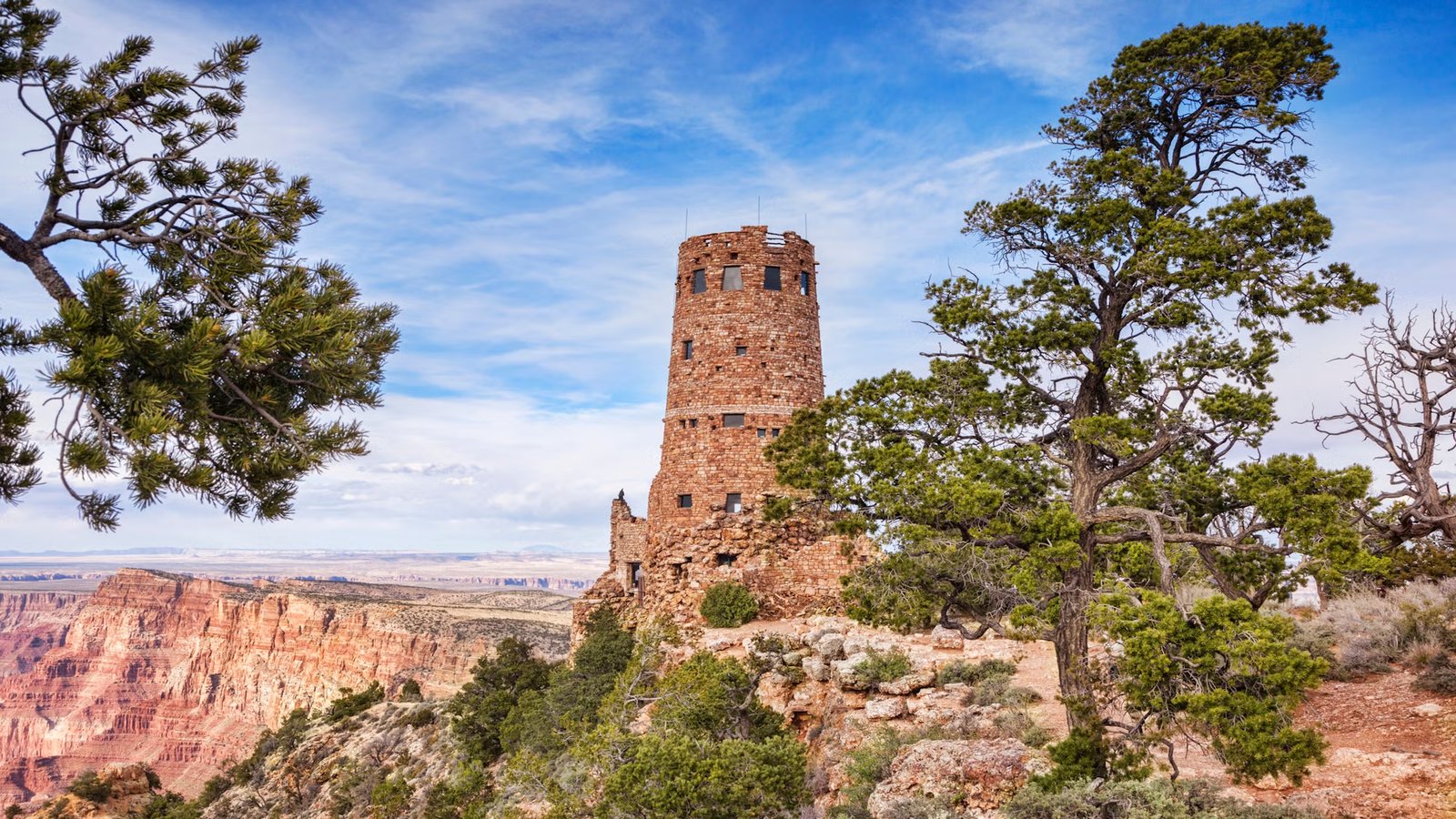
Law enforcement is asking the public for assistance in identifying an older male visitor who climbed on historic furniture for a photo, destroying a sacred piece of Hopi artwork inside the Desert View Watchtower. An expert explains why the destroyed artwork is an irreplaceable piece of Grand Canyon history.
The headpiece was on dislpay at the Desert View Watchtower at South rim of the Grand Canyon (Photo: Linda McKie/Getty Images)
Published July 2, 2026 04:07PM
National Park Service (NPS) rangers at the Grand Canyon are searching for a tourist who they say damaged a priceless Indigenous artifact at the national park’s Desert View Watchtower on June 17.
According to a NPS release, an unidentified man was attempting to snap a photograph when he climbed onto a handcrafted, historic chair, only to fall off and knock over a Hopi headpiece. The man then fled the scene. Rangers are asking the public to help identify the person.
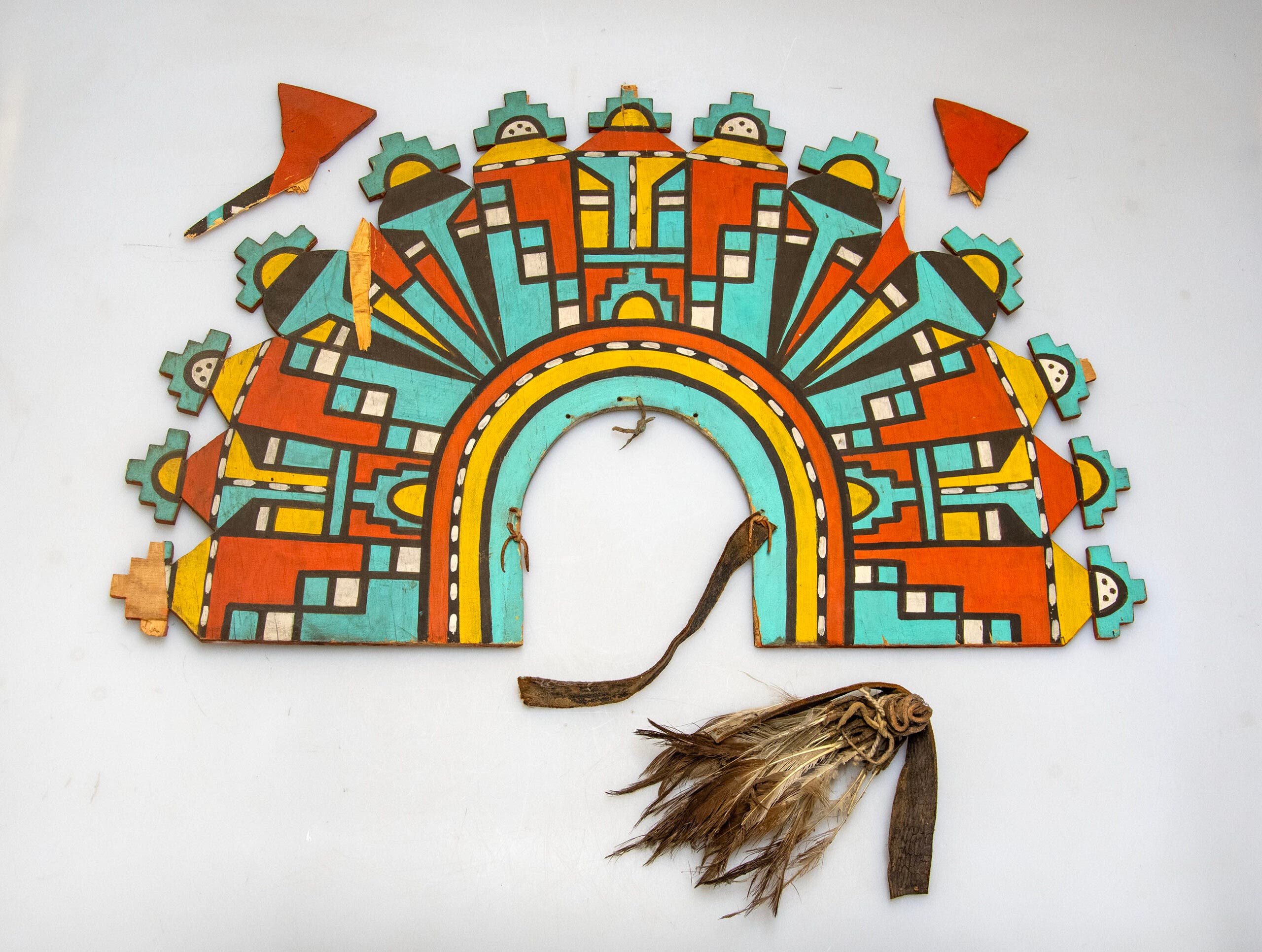
Experts tell Outside that the damaged headpiece, created by the legendary Hopi artist Fred Kabotie in the early 20th century, is a priceless piece of cultural heritage.
“This is beyond art,” Tony Chavarria told Outside. “This is an element of a living culture.”
Chavarria is the curator of ethnology at the Museum of Indian Arts and Culture in Santa Fe, New Mexico, and a member of the Santa Clara Pueblo tribe. He has spent more than 30 years collaborating with tribes in the curation and preservation of Native American culture.
“A headpiece like this is not just an item made for display and appreciation; it has another value,” Chavarria said. “It would be used in a ceremonial dance, as a key part of the culture of cyclical renewal that happens in many of our Southwest communities.”
How Did the Headpiece Get Destroyed?
According to the National Park Service (NPS) press release, the incident occurred when a white male tourist in his sixties or seventies was inside the Desert View Watchtower, a historic, nearly-100-year-old stone tower on the Grand Canyon’s South Rim.
Authorities said that after the man bumped into the headpiece, the artifact broke in two places and sustained damage in three others.
Rangers say that park staff treated the visitor with a basic first-aid kit. He then reportedly left with an adult woman believed to be his daughter. By the time law enforcement rangers were notified of the wreckage, the pair were gone.
Outside contacted NPS for comment but did not receive one in time for publication.
Chavarria said he hopes the individual will return to own up to his mistake, but that the incident should also serve as a reminder to the national park.
“These are true exhibits, meant to be viewed and appreciated from a distance,” Chavarria said. “Ideally this will lead to a change in how things are exhibited at the park.”
What’s Next for the Hopi Headpiece?
Two pieces broke off from the main headpiece, the leather straps attaching it tore, and there are other scuffs, scrapes, and gouges in the wood.
Because Kabotie—one of the foundational Native American artists of the 20th century—passed away in 1986, he cannot repair the work himself. But Chavarria said that a proper restoration is also more complex and nuanced than just patching the headpiece back together to look like it once did.
“How this piece should be restored, and if it even should be, that’s up to a Hopi person who creates this type of work,” he said. “It’s not as simple as gluing it back together, and that’s something I hope the park service is cognizant of as they approach this.”
When Photo Culture Leads to Destruction
In the era of social media, the pursuit of an image routinely proves dangerous. Last year, a trio of hikers in Glacier National Park fell into a deep gorge while climbing out onto a precipice to capture a photo. Two members of the group nearly drowned, but were saved by bystanders performing CPR.
Chavarria said that the allure of social media likes can often lead people to behave foolishly, particularly when it comes to art and cultural artifacts in outdoor locations, such as petroglyphs and pictographs.
“People don’t realize the significance of what they’re seeing, and the focus is on getting something they can post. It’s more about getting clicks than appreciating what they’re looking at,” he said.
“It’s not just an issue with Indigenous art, but geographic formations, too,” he said. “There’s a real lack of awareness.”
Can You Help Find the Suspects?
Park investigators are asking anyone who visited the Desert View Watchtower on June 17 between 11 A.M. and 4 P.M. to review their photos and recall any details that could assist the manhunt.
The Male Suspect: A Caucasian-American man in his 60s or 70s, approximately 6 feet tall, with a slender build, clean-shaven face, and white or gray hair. He was last seen wearing cargo shorts.
The Female Companion: A Caucasian-American woman in her late 30s or 40s, approximately 5 feet 5 inches tall, with an average build and dark hair falling below her shoulders. Authorities believe this woman was the suspect’s daughter.
If you recognize either individual or witnessed the incident, the NPS explicitly requests that you do not post names or rumors publicly on social media. Instead, send verified tips directly to investigators.
