

Published July 15, 2026 01:51PM
Thursday, July 9, was a perfect day in northern Minnesota: temps in the high 70s Fahrenheit, a slight breeze, and a bluebird sky. I checked the forecast—hot, sunny, and dry—before turning off my phone and tucking it into my pack for the duration of our four-day trip into the Boundary Waters Canoe Area Wilderness. If I had any concern, it was the one I texted to my sister and trip partner Jen a day earlier: “FYI…there’s a small fire south of Lac La Croix.”
“Oy…will have to keep our eyes on that,” she responded. “How close?”
“Not close,” I texted back. “It’s on the other side of the lake.”
Jen and I paddle into the Boundary Waters every summer. We grew up in northern Minnesota, have a family cabin on a lake that borders the wilderness, and we both guided canoe trips out of a camp at the end of the Gunflint Trail. These woods and waters are an extension of our lives. Every familiar lake and campsite brings a memory. Some have lingered for more than half a century.
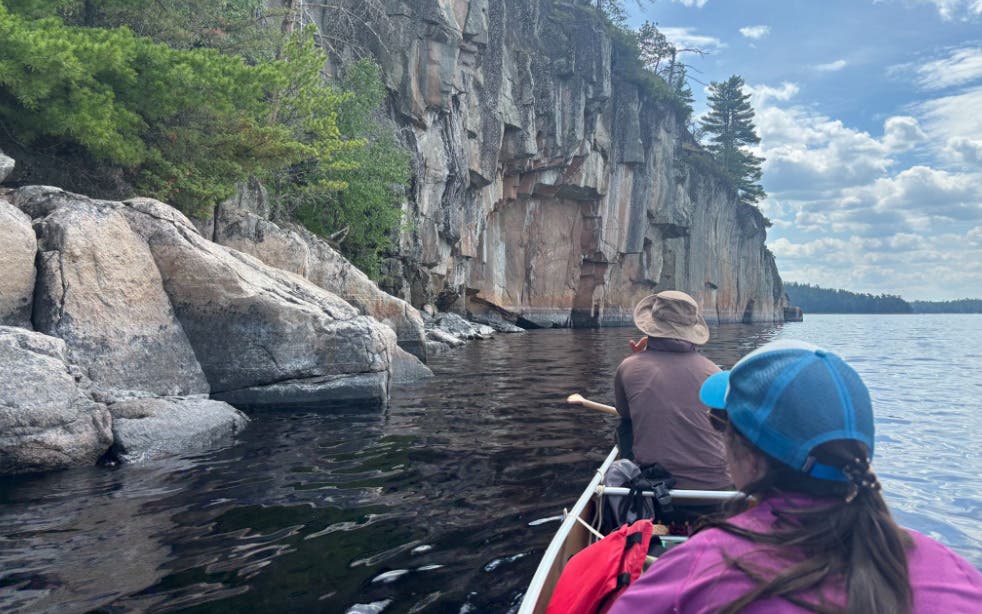
This year, Jen’s daughter Ellie joined us. In 1999, on Ellie’s first trip to the Boundary Waters, Jen breastfed her under mosquito netting at a campsite on Pine, a lake we can paddle and portage into from our cabin. This trip, our destination was Lac La Croix. It’s a long push down a beaver-dam choked river, across two big lakes, and over at least seven portages to reach this spectacular lake in one day, but it’s worth the shoulder pain. Lac La Croix sprawls across the border into Canada and is lined by high cliffs and mountainous ridges.
It has campsites shaded by white pines and slabs of granite that gently slope into the water. At the base of a cliff, rising straight out of the water, are vivid ochre pictographs of moose and other mysterious symbols, painted by the Indigenous Ojibwe or their Anishinaabe ancestors. These paintings could be 1,000 years old. No one knows. But they make the region’s original inhabitants feel omnipresent.
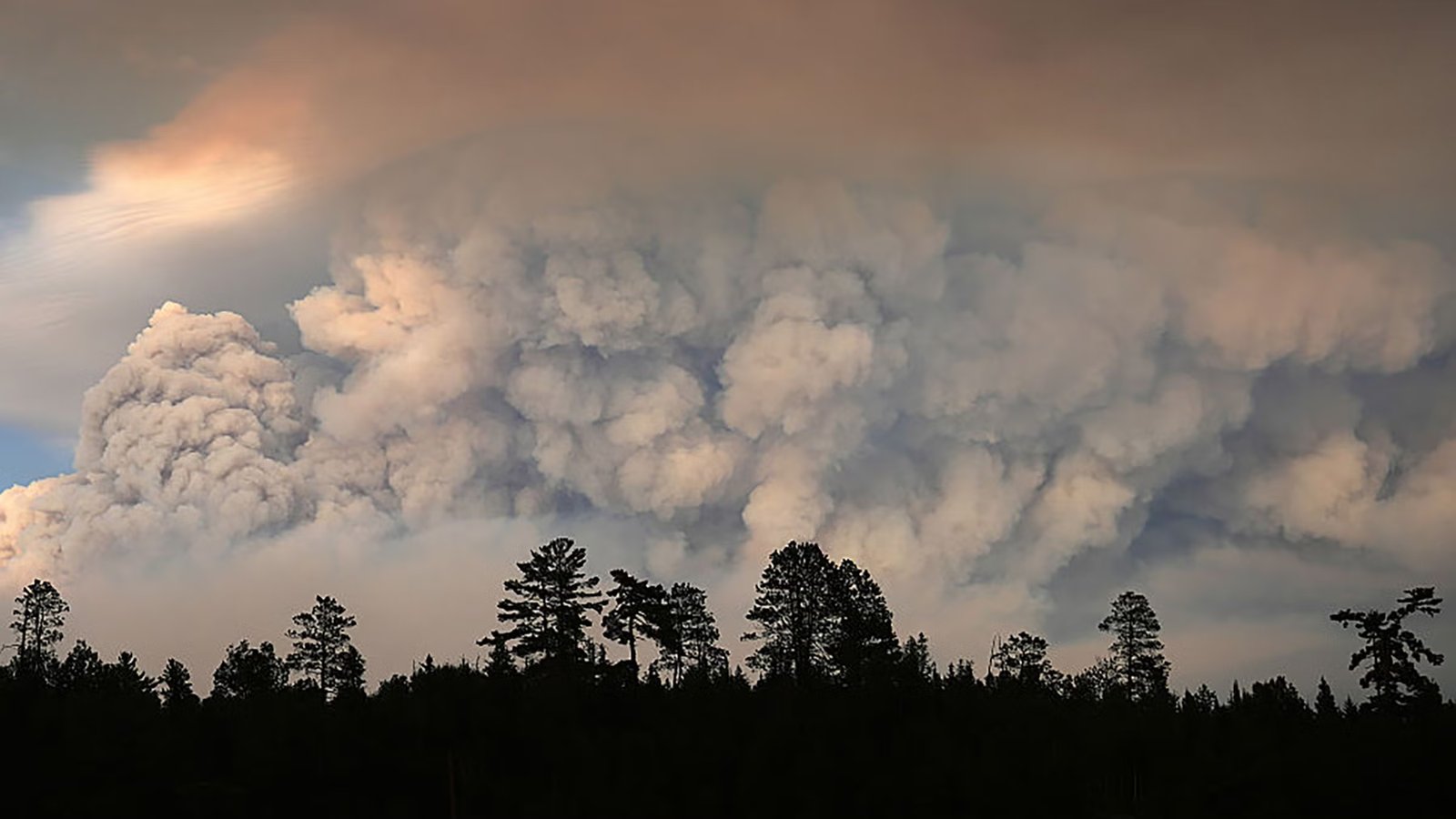
We arrived at Lac La Croix late Thursday afternoon, set up camp, took a swim, and fired up the JetBoil to heat water for chicken curry. Our campsite edged a secluded bay. There was a patch of ripe blueberries on the path to the latrine and an expansive western sunset view. Mixed into the fiery drama of the dropping orb was a smoky plume. It looked fueled by a fire much larger than the one-acre Thumb Fire that I texted to my sister a day ago.
Morning brought with it a smoky haze. It lifted and we paddled across the lake to climb to the summit of Warrior Hill, a high ridgeline that gave us a view to the south and east, where we spotted another dark plume lazily spiraling toward the sky. I turned on my phone in the rare chance that I had enough coverage to check Watch Duty, the app I use for tracking wildfires. Surprisingly, I had service and the app showed that the Thumb Fire had grown to 143 acres. The new Bear Trap Fire to the east was quickly growing, and smaller fires had sprouted up west of the Moose River, our only route back to the car; and near the Echo Trail, our only road home.
The fires were still too far away to panic, but I felt the intensity of the 90-degree heat and, with it, a crippling wave of grief. I understand that fire is necessary to regenerate a forest, but these towering, centuries-old white and red pines aren’t going to grow back in my lifetime, I thought.
Then I wondered what would happen to the blue heron, bald eagles, white-throated sparrows, and warblers we had seen today, plus all the beasts we hadn’t set eyes on—wolf, moose, lynx, and bear.
There’s a name for this grief. It’s called solastalgia, the emotional or existential distress caused by negatively perceived environmental change. In other words, it’s “the homesickness you have when you are still at home,” per Glen Albrecht, the philosopher who coined the term in 2023.
Saturday morning the lake was calm and the sky was blue, but the constant hum of a plane flying overhead through the night had unnerved me. Airplanes are not allowed to fly lower than 4,000 feet or land in the Boundary Waters unless there’s an emergency. We decided to break camp and start paddling south. We would figure out where to camp when we arrived at the portage to Ramshead Lake. At that point we could expand the loop farther west or camp on Nina Moose Lake and return the same way we arrived.
We paddled, watching a pair of bald eagles soar; passed snapping turtles sunning on rocks; and portaged into Agnes, a lake normally populated with campers. There was no one in sight. Overhead a white cloud to the west was growing.
It was impossible to estimate how fast the fire was moving. In the hour or so it took to paddle and portage into Nina Moose, the thick white cloud had turned to a thunderous, smoking plume, and a new smaller plume had developed south of it. We were hot, dehydrated, and paddling into a fierce headwind. As we circled the lake looking for a shady campsite, I turned on my phone, hoping to check Watch Duty.
Instead, I found a text from my partner, Brian: “Babe, not sure if you’ll get this, but the U.S. Forest Service is closing a big area of entries this evening due to fires, including where you are. Be careful. Love you.” That’s when full panic set in and I realized how quickly a summer day could turn from glorious to surreal to claustrophobic and dangerous.
Before we could paddle out, we needed to stop at a campsite to filter water and cool our minds and bodies with a swim. We also wanted to relay the message of the closure to the only other group of campers we had seen all day. Turns out, they had already been alerted by a ranger who stopped at their campsite on Lac La Croix. We had been out paddling most of the day and the ranger had missed us.
Hydrated and hellbent on getting out of the woods, we silently paddled south, accompanied by the song of a white-throated sparrow that followed us up the river. This wilderness has been my lifelong refuge, a place to regroup when the world feels too fast and humanity is going off the rails. If these woods go up in flames, I thought, I’ve lost my backyard escape hatch to peace and sanity.
We made it out in time to buy dinner in Ely. Two days later, the U.S. Forest Service would close the entire million-acre Boundary Waters. Three days later, the Thumb Fire would grow to 14,500 acres; the Bear Trap Fire would grow to 13,500 acres; and at least ten other fires would tear through the wilderness. The Echo Trail, our only road out, would be evacuated, and Ely residents could only watch as the fires crept closer.
And that perfect campsite on Lac La Croix? It has likely been reduced to a memory.
Stephanie Pearson is a contributing editor to Outside, a 2023 National Geographic Explorer, and the author of 100 Great American Parks, published by National Geographic. Three of her Outside stories have been anthologized in The Best American Travel Writing, and she’s won numerous Lowell Thomas Awards from the Society of American Travel Writers Foundation. She’s also a former travel editor at Outside.
