

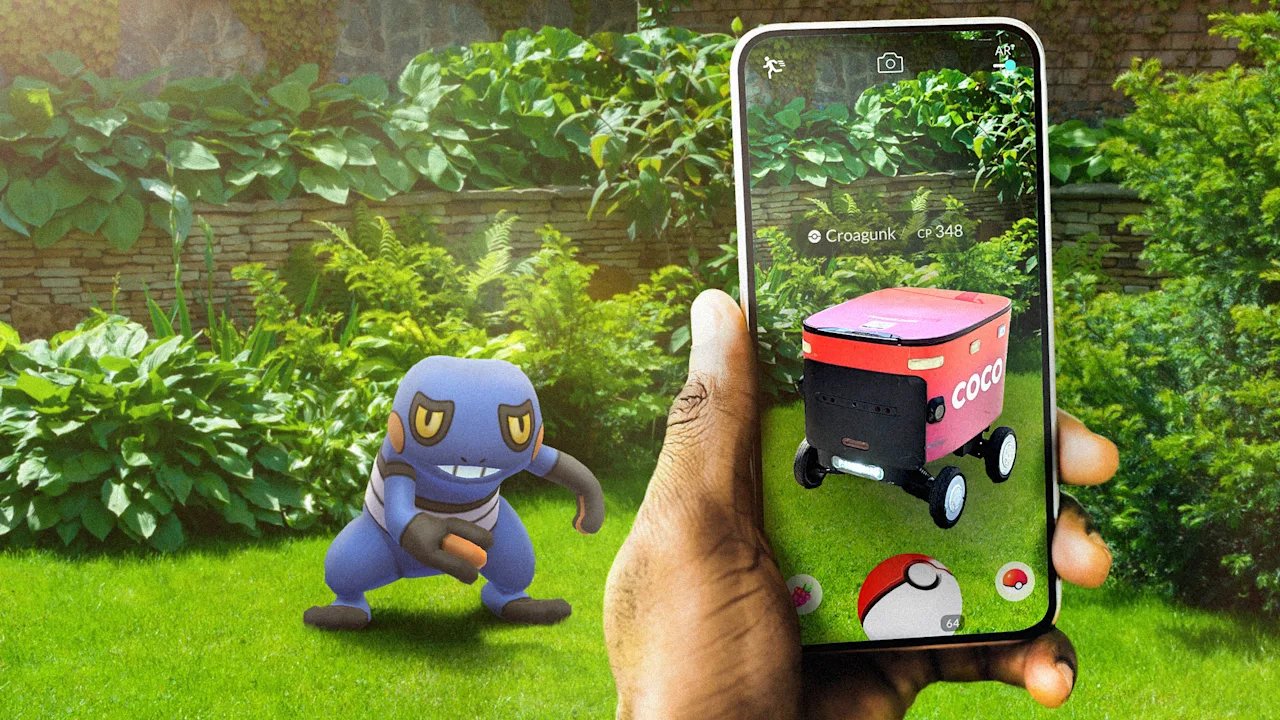
Walking down the street to scavenge for creatures like Snorlax and Squirtle was a regular activity in 2016, as the world was introduced to augmented reality (AR) games, thanks to Pokémon Go.
But now, 10 years later, images captured by players looking to “catch them all” are helping Niantic Spatial—a spinout of Niantic, the San Francisco–based company behind the game—teach robots to navigate the world more effectively by building a highly accurate visual positioning system.
“It turns out that getting Pikachu to realistically run around and getting Coco’s robot to safely and accurately move through the world is actually the same problem,” John Hanke, CEO of Niantic Spatial, told MIT Technology Review.
According to MIT Technology Review’s recent report, Niantic Spatial partnered with Coco Robotics, whose flight‑case‑size delivery robots can often be spotted on the sidewalks of Los Angeles, Chicago, Jersey City, Miami, and Helsinki. But the success of the robots depends on them reaching their destination on time—meaning not getting lost.
That’s where Pokémon comes in.
When searching for highly coveted Pokémon, players flocked to hot spots, taking multiple scans of the surrounding urban environments and capturing many angles of a single location.
These scans—as well as those captured by players of Ingress, another Niantic phone‑based AR game—became some of the 30 billion images used to train Niantic’s current visual positioning model.
“We had a million‑plus locations around the world where we can locate you precisely,” Brian McClendon, CTO at Niantic Spatial, told MIT Technology Review.
Gathering enough data to create one of the world’s largest image data sets required an enormous manpower—relying on players of a popular game to help. Just in its first week, Pokémon Go was downloaded by over 500 million people, still drawing in millions of users almost a decade later.
However, not all data is used for the mapping efforts, with players having to opt in to scan their surroundings. For instance, the data used to train the model received scans from the 2020 feature called “Field Search,” which gave players in-game rewards in exchange for scanning landmarks.
“We’ve been transparent about this”
While many players may have opted in without understanding the implications, Niantic’s terms of service is transparent about the company using user content to produce new services.
“Players have to choose to scan a specific public place—it’s not passive, and regular gameplay doesn’t train any AI,” a Niantic spokesperson told Fast Company when reached for comment. “We’ve been transparent about this since 2019 in our privacy policy and public announcements.”
But while helping robots bring warm pizza to college students seems like a noble pursuit, not everyone is happy—or surprised.
“500 million people played Pokémon Go; scanned every street, building, and corner on earth; thought they were catching Pikachu. Niantic was building a 30 billion image AI map of the world now powering delivery robots that don’t need GPS,” a user shared to X. “You were the product the whole time.”
At the same time, many users claim to have seen it coming.
“Anyone who thought the AR task was there for anything other than collecting real-world data is oblivious to the real world. I fully expected it,” one user shared on Reddit.
Another added: “No shit, did you think we were scanning pokestops for shits and giggles?”
And others are taking the news with humor.
“Have you seen some of these poor bots trying to navigate,” one Redditor says. “We didn’t do a good job.”
This story has been updated with Niantic’s response to our inquiry.
