

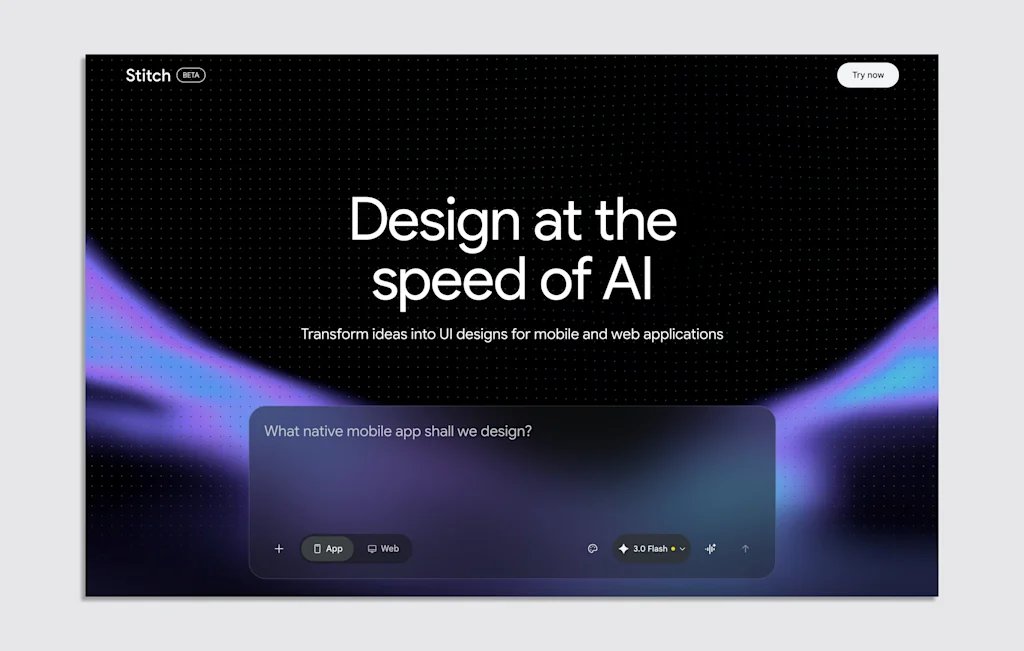
This week, Google announced new features for its AI-powered interface tool Stitch—in the process, it signaled that it’s going all-in on “vibe design.”
“We are evolving Stitch into an AI-native software design canvas,” Rustin Banks, product manager at Google Labs, wrote on company’s blog, Keynote. “With it, anyone can create, iterate and collaborate to turn natural language into high-fidelity UI designs.”
Launched last March during the Google I/O annual developer conference, Stitch sets out to give people an accessible tool for creating front end UI designs for projects like websites or mobile apps. While late to a market already occupied by competitors like Figma and Cursor, Stitch’s new features are catching the industry’s attention and posing a threat to incumbent platforms that are scrambling to keep up with the relentless pace of AI design software updates.
What’s new in Stitch
The announcement outlined five major AI-powered updates to the platform including integrations with other AI platforms, voice capabilities, design agents. Among the major updates is a complete redesign of Stitch’s UI: an infinite canvas similar to Figma’s which allows for all project iterations to be in one space. The canvas also allows text, images, or code to be added to the canvas as context.
Google also introduced AI agents with a design agent tailored for design reasoning, as well as an agent manager to keep organized when working on multiple ideas at once.
Stitch expanded its existing design system toolkit, which allows users to import or export design rules and use, and can now be used with DESIGN.md, an agent-friendly markdown file.
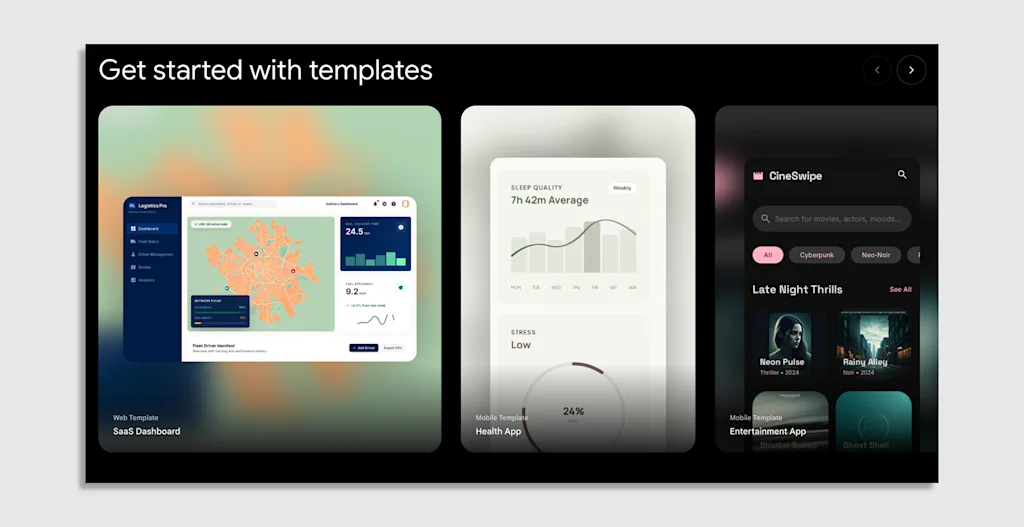
“This lets you, for instance, apply your designs to a different Stitch project so you don’t have to reinvent the wheel every time you start,” writes Banks.
The platform also offers an instant prototype feature which turns the existing project into an interactive preview of an app. One of the most exciting new features is Stitch’s new voice capabilities, which allows users to speak their ideas and transform them into prototypes or act as a sounding board and critic.
“The agent can give you real-time design critiques, design a new landing page by interviewing you, and make real-time updates—like “give me three different menu options,” or “show me this screen in different color palettes”—as you speak,” Banks explained.
Is Stitch the Figma killer?
Following Google’s announcement on March 18, Figma’s stock dipped and is currently down by 4% at the time of publishing. Some are calling Stitch an existential threat to Figma, whose Figma Make tool is a direct competitor to the free-to-use Stitch. (Figma declined to comment for this story.)
“Figma tanked 8% today on this news, Now down 80% from IPO in Aug 2025,” John Wang, head of crypto at Kalshi, said on X in reply to Google’s announcement.
It’s worth noting that stocks for software-as-a-service companies are notoriously reactionary. In the last quarter, IBM’s stock plummeted 20% over three months, with experts attributing the dip to Anthropic’s announcement of Claude Code modernizing COBOL systems.
For that reason and more, calling Stitch a “Figma killer” might be premature. Figma still corners the market for the professional design workflow. And the reality is that designers—both novices and pros—will use these tools at different moments in the design process. A tool like Stitch is able to help people turn an idea into a prototype; but that’s only the beginning of the product design story.
