

Fire officials and pro-density urbanists are often at loggerheads. This is especially evident in notoriously car-centric Los Angeles, where a firefighters’ union spent six figures opposing active mobility measures. The two camps can have different ideas of acceptable risks and priorities.
But Matthew Flaherty, a firefighter who has lived in L.A. his whole life, bridges the two worlds. He’s an advocate for affordable, transit-friendly housing. His struggle to find an apartment in a walkable neighborhood led him to become a member of the Livable Communities Initiative, a nonprofit group advocating for more walkable neighborhoods in L.A.
“Cities shouldn’t be designed around the fire department,” Flaherty argues. “The fire department should be designed to deal with the infrastructure as it is. If you have a plumber design a house, the whole house is going to be a toilet.”
One area of tension for fire safety advocates and density advocates is the requirement that most new apartment buildings have more than one stairway to facilitate resident evacuation and emergency responders’ access. In nearly all American cities, unlike in other parts of the world, developers are required to build double staircases into four- to six-story residential buildings. (Though definitions vary, these are often considered mid-rise buildings.)
This extra staircase takes up about 7% of floor space and drives up costs by 6% to 13%, according to the Pew Charitable Trusts. That extra cost could be enough to kill a project to build housing, says Stephen Smith, the executive director of the Center for Building in North America, a nonprofit organization focused on building code reform.
Largely due to advocates like Smith and Flaherty, a movement is sweeping across North America, from Texas to Toronto, to relax restrictions on residential stairways. Over 30 locations have now considered such measures. The possibility of relatively rapid changes to local building codes, outside the national three-year cycle, is raising urgent conversations about density and safety as cities grapple with housing shortages.
Seattle’s influence
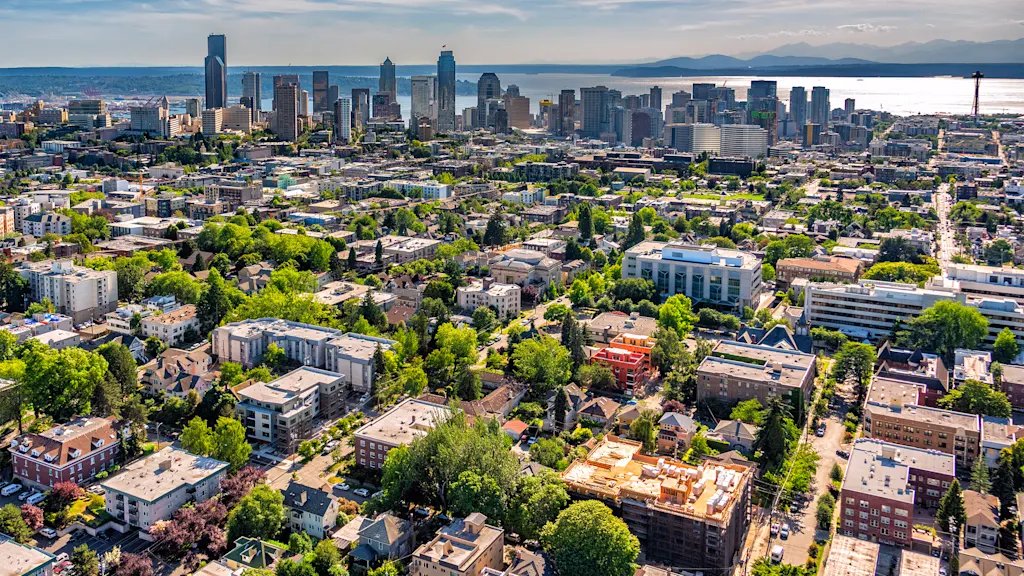
Single-stair apartment buildings (sometimes called point access blocks) are sprinkled throughout Seattle. Rents can start at around $1,500/month for studio apartments in such buildings. Walking around these apartments is a good way to get a feel for Seattle’s distinct neighborhoods.
