

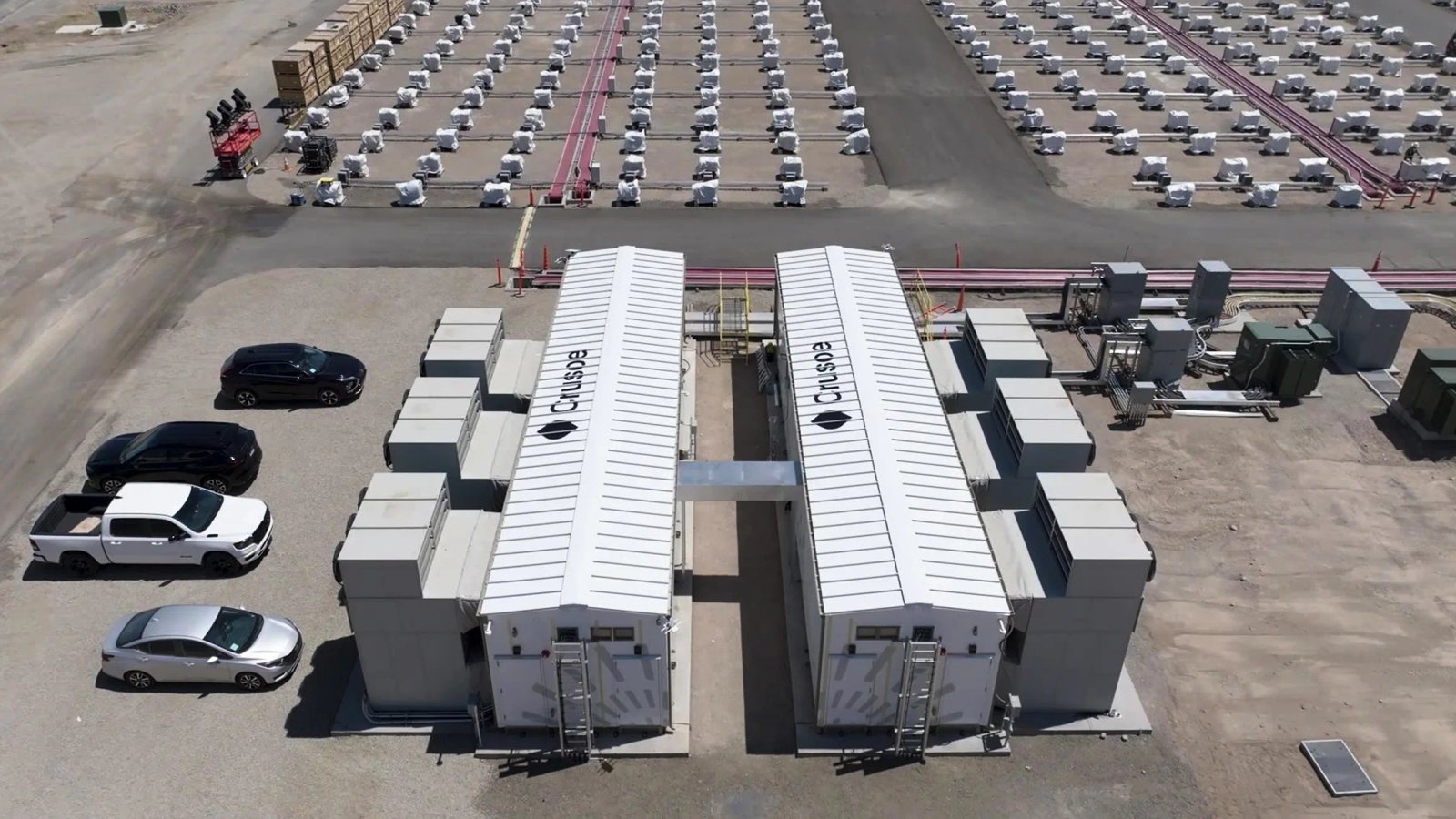
Now they have data showing it works—and they’re scaling up. Over the months that the solar microgrid has been in use, it’s run 99.2% of the time, outperforming the companies’ targets. And unlike other data centers that rely on fossil fuels, this one uses only clean power.
It’s very different from the standard way to build a data center. “The normal approach would be to get in line with a utility, wait for any number of years, and hopefully one day get an approval and join the grid,” says Cully Cavness, cofounder, president, and chief strategy officer at Crusoe. “This is a pretty innovative approach that bypasses a lot of that timeline and lets us take our outcome into our own hands by really going off-grid with renewables in a very fast timeline.”
Solar power was already cheap to deploy. But Redwood Materials, the country’s largest recycler of EV batteries, recognized that reusing those batteries could help dramatically drop the cost of energy storage for solar or other power sources. “Storing [solar] overnight and making that into a base load resource that can be dispatched 24/7 historically has been very, very expensive,” Cavness says. “What Redwood has done is they’ve made a 24/7 battery solution with renewables economic and scalable.”
When Redwood receives used EV batteries to recycle, most of them still have enough power for a second life. The company tests each battery, and also developed technology to monitor and manage the batteries in a microgrid. Crusoe developed modular data centers, each the size of a shipping trailer, that can be built in a factory and then shipped to a site to be quickly connected, unlike larger construction projects that take much more time.

The first site sits at Redwood’s campus in Nevada, where the company built out a small solar field and a network of hundreds of used EV batteries over a few months last year. Initially Crusoe connected four of its modular units, called Spark data centers, to the microgrid. Now, at a new Colorado factory, it plans to build another 20, boosting compute power nearly sevenfold. (Because Redwood intentionally built a large amount of solar power, it likely won’t need to add more; the new units will just ensure that 100% of the solar is used.)
Because so many more EV batteries exist than batteries for the electric grid, there’s an ample supply. “It’s still a very small percentage of EVs that are coming off the road, but it only takes a very small percentage to start to be a big number that’s relevant to the stationary market,” says JB Straubel, founder and CEO of Redwood Materials.
