

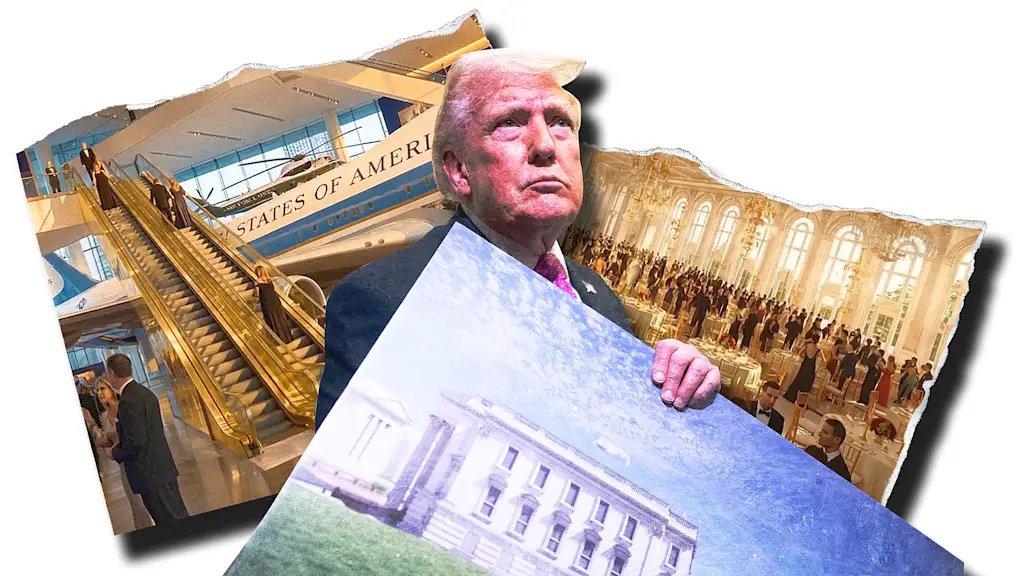
The Trump Organization just revealed that its next construction project will be the Donald J. Trump Presidential Library: a towering, gold-encrusted skyscraper, branded with Trump’s name, that will sit just south of Miami’s Freedom Tower. Inside, it will contain a re-creation of Trump’s proposed White House ballroom.
News of the development was shared via multiple March 30 social media posts from President Trump himself and his son Eric Trump, who serves as the executive vice president of the Trump Organization, Trump’s conglomerate of real estate developments, investments, and business ventures that has been operated by his children since 2017. The Trump Organization is spearheading the creation of Trump’s presidential library in collaboration with the architecture firm Bermello Ajamil, which already commands a major design presence in downtown Miami.
Trump’s so-called “library” will be the 17th official presidential library. Whereas nearly all other presidential libraries have taken their design cues from traditional libraries or museums, renderings of Trump’s library show a building that looks strikingly familiar to the Trump Organization’s existing portfolio of luxury residential properties.
Digital images of the development show a massive skyscraper featuring golden escalators, a golden statue of Trump, a giant presidential jet in the atrium, and a recreation of the White House ballroom. In a statement to Fast Company, Willy Bermello, a partner at Bermello Ajamil, implied that the library’s ballroom will match the scale of the 90,000-square-foot space planned at the White House.
It’s a bombastic design that seems purpose-built to literally dwarf all other presidential libraries in both scale and scope—and it enshrines the bigger-is-better design philosophy that’s come to define Trump’s second term in a gaudy show of glass and steel.
The history of the Presidential Library
The concept of a Presidential Library first emerged in 1939, when President Franklin Roosevelt donated his personal presidential papers to the federal government, as well as part of his Hyde Park estate, to establish an official record of his time in office for the public to visit.
Since then, more than a dozen other presidents—including Herbert Hoover, John F. Kennedy, and George W. Bush—have followed suit, establishing their own libraries to act as part-museum of their presidencies and part-archival collections of their own writings and relevant literature. Each library is overseen by the National Archives and Records Administration (NARA), which did not respond to Fast Company’s request for comment on whether it officially approved Trump’s upcoming library.
