

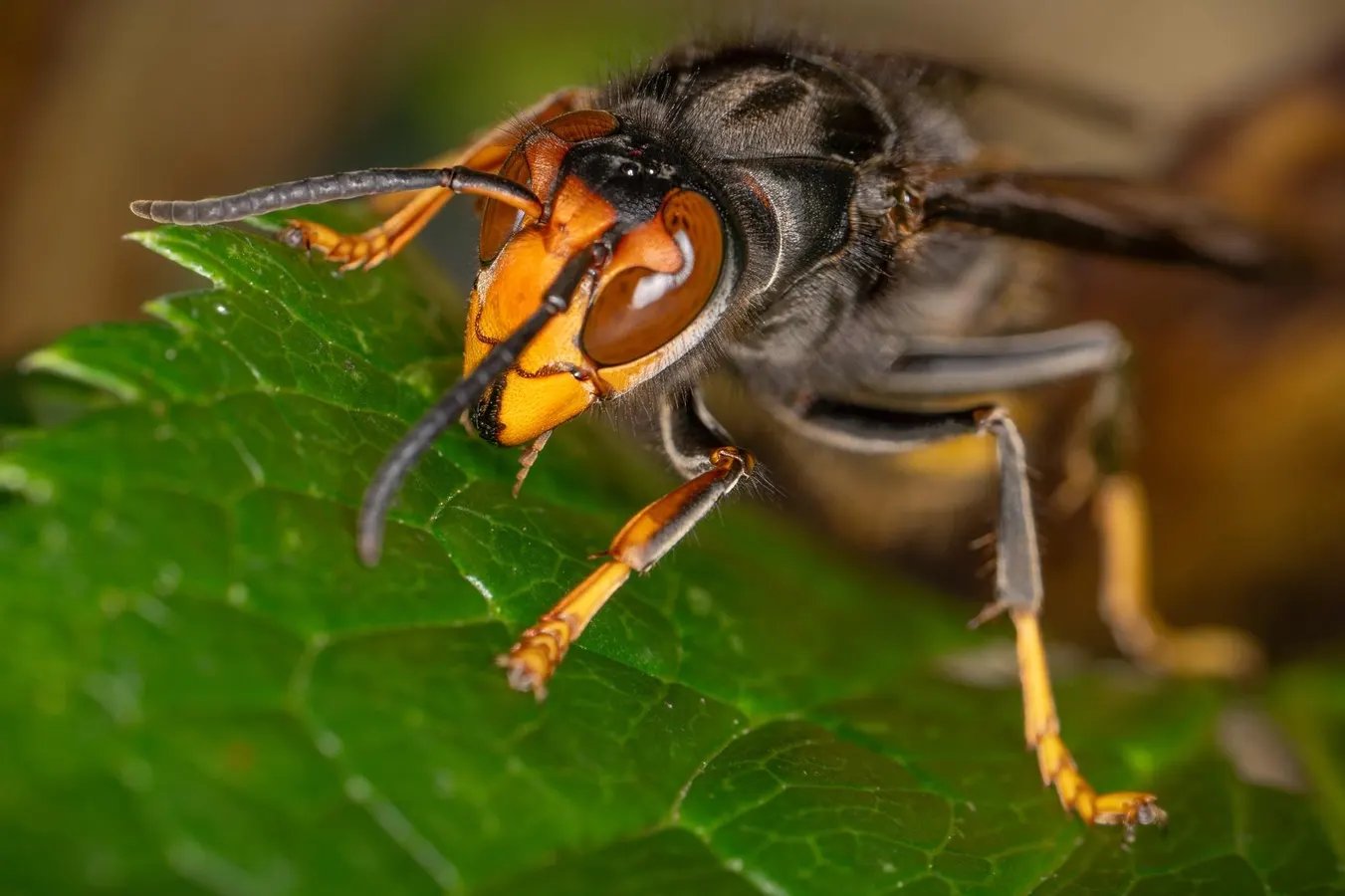
A yellow-legged hornet (also called the Asian hornet) targets bees and is causing alarm after becoming an invasive species in three Southern states.
NurPhoto via Getty Images
Residents of three Southern states are urged watch for aggressive non-native, yellow-legged hornets that prey on defenseless honeybees and decimate colonies in hours.
Alabama, South Carolina and Georgia are trying to contain and eradicate this destructive invasive species.
From Southeast Asia, the yellow-legged hornets (Vespa velutina) have caused alarm in the U.S. since they were discovered three years ago in Savannah. The insects are thought to have entered the U.S. from a ship.
Alabama Placing Traps at Port of Mobile
Alabama has been placing traps at the Port of Mobile to catch yellow-legged hornets in case they are brought into the state on a vessel.
The Alabama Department of Agriculture & Industries has established a special web page with public guidance about how to identify yellow-legged hornets and what to do if seen.
These hornets “can sting but pose similar human health risks to other wasps. They generally sting only when nests are disturbed,” ADAI says.
ADAI inspectors have been placing over 40 traps around the state in strategic locations to monitor each week.
“Honeybees cannot defend effectively against these hornets” that can destroy colonies within hours, leaving piles of headless bees at hive entrances. European hornets (already established in the U.S.) can kill individual bees but do not typically destroy entire colonies,” the state says.
It calls yellow-legged hornets “highly efficient predators. They hunt socially, mark targets with pheromones, and can overpower entire honeybee colonies.”
ADAI encourages beekeepers to frequently inspect their hives. Beekeepers can also “modify hive entrances with screens small enough to block hornets but large enough for bees. Vent openings in inner covers should also be screened if oversized.”
Wreaking Havoc in Europe
Bees fly to hives on the edge of a forest in Germany.
dpa/picture alliance via Getty Images
These hornets have been wreaking havoc in Europe since the rapidly spreading insect was seen in France in 2004 after apparently accompanying a shipment of imported pottery from China.
The National Bee Unit in the U.K. was seen there for the first time in 2016. found to have traveled there in 2016. Since then it has been active from February to November in England and Wales.
“After hibernating over winter, the queen will emerge and seek out a sweet, carbohydrate-rich food source, in order to build up energy to commence building a small embryonic nest, called a primary nest,” according to the National Bee Unit. The queen starts to lay eggs and the nest grows as it fills with more hornets. Usually, the insects then build a second nest.
One yellow-legged hornet colony can average 6,000 hornets in a summer. These insects particularly prey on honey bees and other pollinators.
“As of December 2023, the hornet is established in France, Spain, Belgium, the Netherlands, Portugal, Italy, Switzerland, Germany and Jersey,” says the National Bee Unit.
Lethal Targeting of Honeybees
The yellow-legged hornets typically stalk beehives in a “hawking” behavior by waiting to kill returning bees.
“When they catch a returning bee, they will remove the wings, head and abdomen, and return to the nest with the protein rich thorax to feed the brood. The developing larvae are fed a protein-rich diet consisting of insects or other protein sources scavenged by the workers,” the National Bee Unit described.
The British Beekeepers Association, founded in 1874, encourages U.K. residents to download an “Asian Hornet Watch” app from the U.K. Centre for Ecology and Hydrology to take action: “See it! Snap it! Send it!”
The association provides information about how to identify the yellow-legged hornets. It also has an audio recording on its website of the distinctive deep buzzing sounds made by these hornets as well as a video.
USDA Warning About the Threat to Bees
“If allowed to establish in the United States, these invasive pests could threaten populations of domestic and feral honey bees – some of which are already endangered – and other native pollinators. Their presence could also disrupt the pollination of many crops,” says the U.S. Department of Agriculture’s Animal and Plant Health Inspection Services.
Impact of USDA’s efforts focusing on pollinator health, crop production, and conservation.
USDA
South Carolina Has Yellow-Legged Hornet Infestation
Yellow-legged hornet nest in a tree.
Georgia Department of Agriculture
A monthly newsletter from Clemson University called the “Hornet Herald” was published by the university in early 2025. It provide updates and encourages people to subscribe to learn more about the yellow-legged hornet “infestation in South Carolina.”
It noted that the hornet appeared in August 2023 in Savannah less than five miles from the South Carolina-Georgia border. Nests have been found since then in the state.
The university is supported by the USDA in efforts to find hornets and destroy nests. Primary nests (as large as a softball or watermelon) appear in awnings, bushes, shrubs, trees and porches. Ranging from 40 to 60 inches around, secondary nests generally are higher up and often over 60 feet above ground.
“Baited traps are used to initially detect hornets, followed by tracking live hornets to narrow down the nest search area. Eradication of this species focuses on locating and destroying nests and eliminating queens. Nests should ideally be located and destroyed by late summer or very early fall before new queens are actively mating and dispersing, and nest destruction should continue throughout the fall and early winter,” according to the Hornet Herald.
Jug or bucket traps are hung from trees (preferably near honeybee colonies) and filled with a liquid bait called “Georgia Juice.” The bait is made with dark brown sugar and grape juice.
As of March 26, Clemson’s Honeybee Protection Program: has set over 4,100 traps in nine counties (Beaufort, Charleston, Chester, Colleton, Dorchester, Jasper, Hampton, Lancaster and York).
South Carolina residents are urged to report sitings on a Clemson University web page that contains various photos to help identify the yellow-legged hornets. The university has also created a YouTube video with instructions on how to make a trap and bait.
People are also cautioned against trying to remove nests on their own because it is vital to eradicate a queen to stop hornets from rebuilding a nest in another location. Experts also prefer to place traps to nab other hornets and track them to different nests.
“The Yellow-legged hornet is an invasive species that will move to new areas primarily through human activities such as trade, travel, and tourism, often hitching rides on vehicles and cargo, so please be careful and inspect your items prior to travel especially if you live in a YLH infested area,” the university says.
Hornets Threaten Georgia’s Bees and Key Crops
A field of squash pollinated by honeybees in Barwick, Georgia.
getty
According to the Georgia Commissioner of Agriculture’s website, yellow-legged hornets appear to only be around the Savannah area in four counties (Bryan, Chatham, Effingham, and Liberty).
“The yellow-legged hornet poses a threat to honeybees and other pollinators in our state. Certain crops (e.g. apples, blueberries, cucumbers, watermelons, etc.) are heavily dependent on bees—honeybees and native bees—for pollination. So, these pollinators play a significant role in Georgia’s agriculture industry, the state’s main economic driver, and it is imperative that these invasive pests are tracked and eradicated,” according to the state.
It notes the USDA estimates insect pollination contributes $34 billion in economic value to U.S. agricultural crops annually.
Residents are encouraged to report sightings of these invasive hornets and nests for removal to the Georgia Department of Agriculture: via email (yellow.legged.hornet@agr.georgia.gov) or filling out an online form.
Georgia Agriculture Commissioner Tyler J. Harper is urging all residents, especially in Bryan, Bulloch, Chatham, Effingham, Liberty and Screven Counties, to keep watch for these hornets as queens emerge and start establishing new nests.
“As in previous years, we are asking for the public’s continued help. Early reporting of embryo and primary nests is critical—it allows us to stop queens before they spread and reduces potential damage to our state’s honeybee population,” Harper said in a March 30 public announcement. “By working together, we can protect Georgia’s number one industry—agriculture.”
What They Look Like
A yellow-legged hornet.
USDA
About an inch long, the yellow-legged hornets have a narrow waist and a strong yellow strip on the abdomen. The bottom half of their legs are yellow, while the legs near the body are brown or black. Their heads are mostly black with some front yellow or orange on the front. Their eyes are black.
