

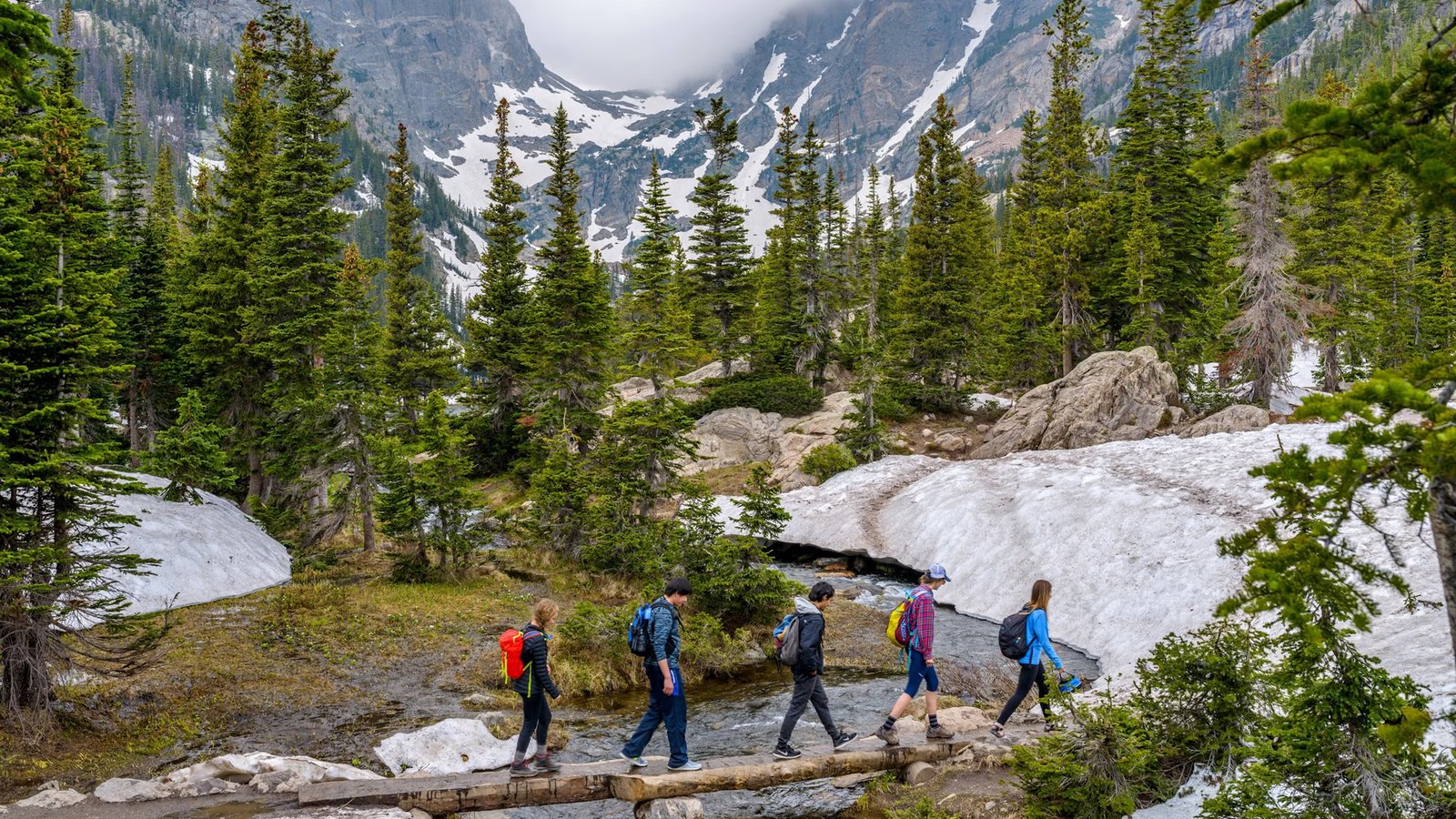
A study of hundreds of hikers and runners reveals a dangerous gap between how safe we feel and the gear we actually carry. Here is what you really need to survive a day in the mountains.
(Photo: SeanXu / Getty)
Published April 9, 2026 03:41AM
A few years ago, while running down a gnarly trail outside of Tucson, Arizona, I caught my toe on a rock and went flying. The landing was ugly and left me in very rough shape, alone in the mountains several miles from the trailhead, just after sunrise, with nothing in my pockets except my car key. It was very stupid—and a perfect example of the kind of inadequate wilderness preparedness highlighted in a new paper in the journal Wilderness and Environmental Medicine.
A team of researchers led by John Lambert of Boston University’s Center for Climate and Health studied trail runners and day hikers in Rocky Mountain National Park, a huge 415-square-mile swath of wilderness near Denver, Colorado, at elevations ranging from 7,600 to above 14,000 feet. They quizzed 586 day hikers and 68 trail runners on their way out of the park about their experiences that day and various elements of their preparedness. The results highlight key differences between the two groups, and flag some shortcomings in how many of us approach our single-day adventures.
What Does It Mean to Be Prepared?
You can define preparedness in various ways, and some of them—like knowledge, fitness, and familiarity with the terrain and climate—aren’t easy to measure in a quick survey. For this study, Lambert and his colleagues focused on the gear people were carrying with them, based on a list of 13 “essential” wilderness items: extra food, extra clothing, extra water, rain gear, light source, map, water treatment method, first aid kit, knife, compass, whistle, fire starter, emergency shelter.
Here’s a graph showing the proportion of trail runners (in gray) and day hikers (in black) carrying each of the items:
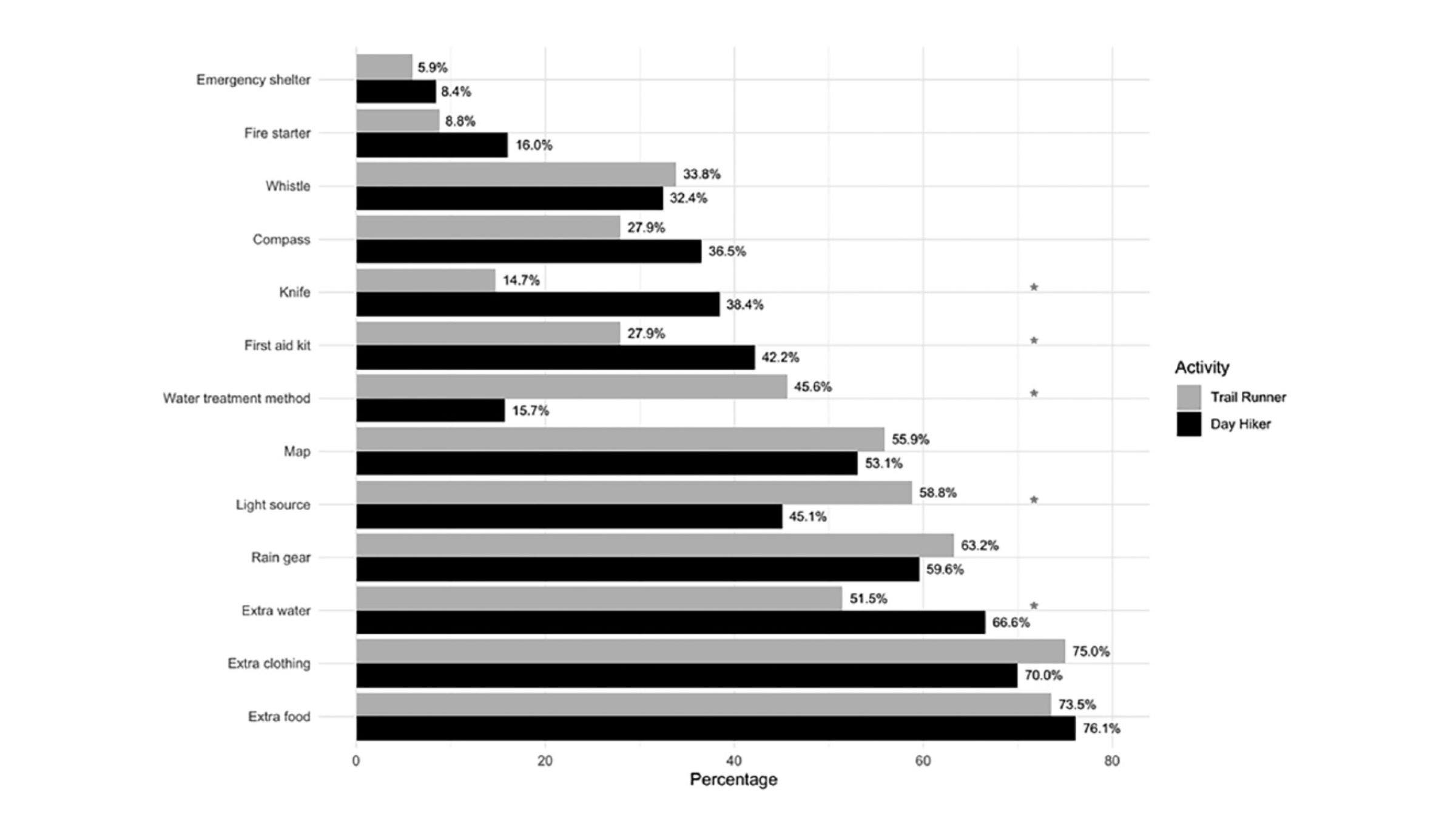
Overall, you can see that the two groups were equipped similarly. The day hikers were marginally more likely to be carrying extra water, a first-aid kit, and a knife; the trail runners were more likely to have a light source and (by far the biggest difference) a water treatment method.
The researchers also checked navigation tools, communication devices such as cell phones and satellite messengers, and first aid gear such as bandages, painkillers, tourniquets, and so on. Participants were considered “wilderness prepared” if they had at least seven items from the “essentials” list, a liter of water, a map or equivalent, and either two communication devices or 8 of the 15 recommended first-aid items. The bottom line: 25 percent of the trail hikers were considered adequately prepared, and 16 percent of the day hikers—not a great showing.
There are also some more subtle elements of preparedness. Altitude illness is a serious concern in the park, particularly for visitors coming from sea level. The researchers figured people were prepared for altitude if they ticked three of the following four boxes: having a way of determining their current elevation (either with an altimeter or with a topographic map and GPS); having a predetermined plan for how quickly they would ascend; being able to name at least two major symptoms of acute mountain sickness (e.g. headache and vomiting); and taking or considering drugs such as Diamox. Just under half of the people surveyed passed this test.
On the plus side, about three-quarters of the visitors had told someone where they were hiking or running and when they planned to be back. Most of them—80 percent of the hikers and 97 percent of the runners—rated their wilderness experience level as “some” or “experienced.”
What Could Possibly Go Wrong?
By definition, none of the survey respondents experienced any serious disasters on the day they were surveyed. Lambert spent 38 days over the summer of 2024 surveying people at various trailheads. On one of those days, he had to cut his data-gathering short to assist in a search-and-rescue operation—one of 229 per year in Rocky Mountain National Park, on average—for a day hiker who had suffered a serious fall and had to be hospitalized. He didn’t administer the survey to this hiker.
Still, there were some warning signs. More than a quarter of the trail runners reported wandering significantly off trail, presumably because they were moving too fast to navigate correctly. In comparison, just 3.3 percent of the day hikers went significantly off-trail. There were some injuries and illnesses: 4.5 percent of the runners and 2.9 percent of the hikers, with ankle injuries and acute mountain sickness leading the way. In addition, 13 percent of the runners and 6 percent of the hikers reported a close call: being stuck above tree line during a thunderstorm, falling, or nearly falling.
Perhaps the most significant stat is that, contrary to Lambert’s assessment, 88 percent of both the trail runners and day hikers rated themselves as “adequately prepared” for the wilderness. It’s the gap between self-perception and reality that is most dangerous. We can quibble about exactly which items of gear are really needed for a short run in the mountains—but trust me, you need more than your car keys.
For more Sweat Science, sign up for the email newsletter and check out my new book The Explorer’s Gene: Why We Seek Big Challenges, New Flavors, and the Blank Spots on the Map.
