

Published April 16, 2026 04:27PM
On April 10, my family and I sat around the kitchen table, eating tacos and watching a livestream of the four Artemis II astronauts return from their mission around the moon. When the capsule carrying them, which they’d named Integrity, splashed down off the San Diego coast, I felt tears form. And as NASA workers sent boats out to ensure everyone was safe and inflated the raft, “the front porch,” on which the Artemis II crew would sit when they exited, my husband, four-year-old son, one-year-old daughter, and I kept our eyes glued to my phone, propped up on a jar of salsa.
“Mom, should we go to the moon?” my son asked me.
We were only four of 27 million watching the historic event. Over the previous ten days, Christina Koch, Reid Wiseman, Victor Glover, and Jeremy Hansen broke the record for the farthest distance from Earth ever reached by humans—an astonishing 252,756 miles—as they orbited the moon, discovering and naming a new crater, testing new communication technology, and marking the first moon mission in more than 50 years. NASA livestreamed much of the adventure, which lasted 9 days, 1 hour, 31 minutes, and 35 seconds.
Unlike 50 years ago, news and discourse spread about the mission all over social media. The phrase “moon joy” started trending after Angela Garcia, a science officer at NASA, relayed to the crew that she “copied” their moon joy. Stunning photography of the Earth from space, photos of the four crewmates embracing, and poetic descriptions of the moon and planet by the crew went viral.
My favorite photo of the bunch depicted Koch looking down at Earth through a window on her way to the moon. She’s surrounded by darkness, and her face is illuminated by the glow of the blue marble sphere in front of her. A braid floats away from her head, and her caption on Instagram reads, “First braids to leave Earth orbit. (unconfirmed)”
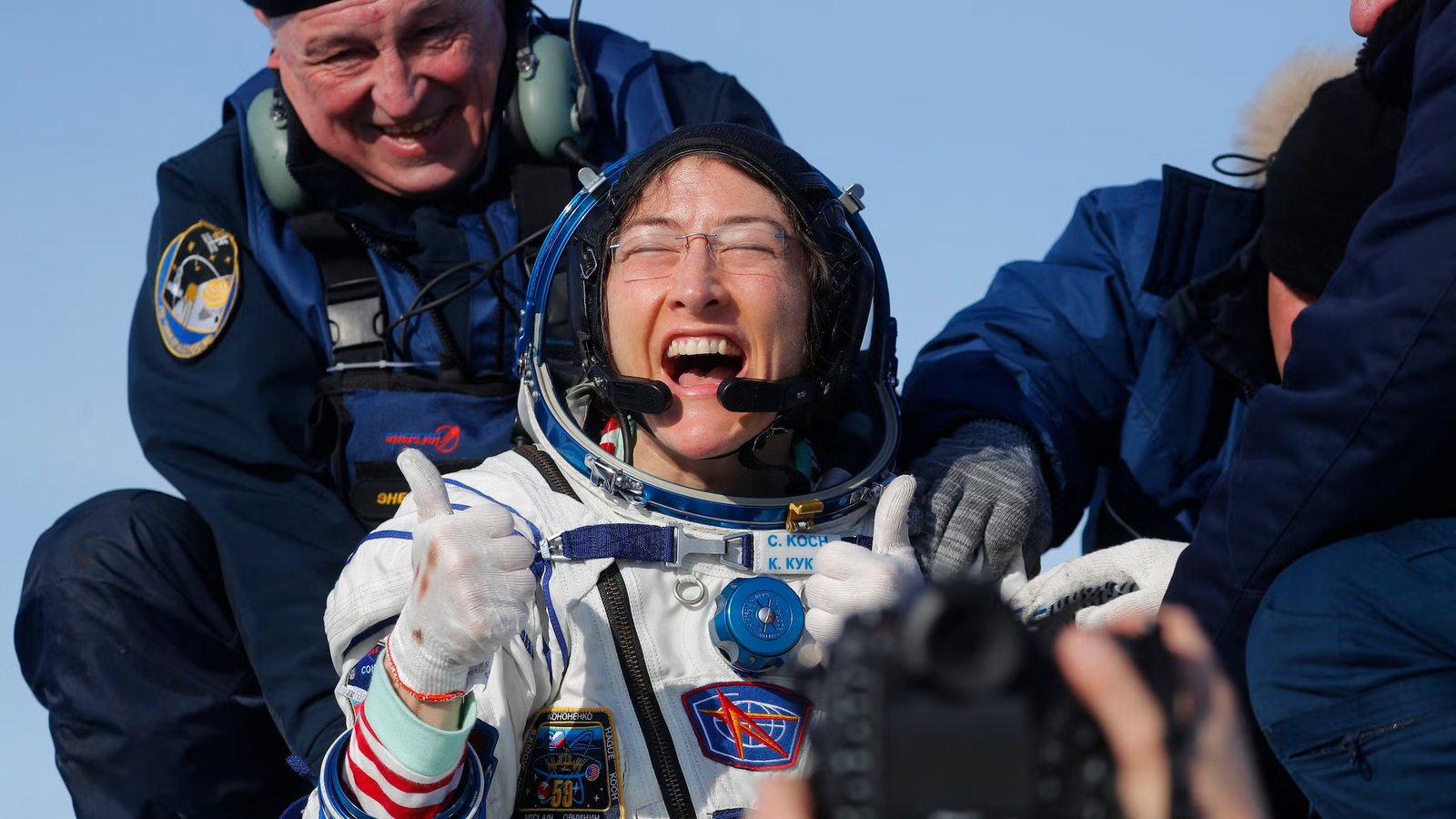
While the entire crew made history in the distance they traveled from the planet, Koch broke another record on the Artemis II mission: she became the first woman to orbit the moon. It’s not the only record she holds, either. Koch embarked on the first all-female spacewalk in history on October 18, 2019. And she holds the record for the longest spaceflight by a woman, which she set over the span of 328 days throughout 2019 and into 2020.
When she’s not exploring space, Koch likes to explore Earth. She’s a rock and ice climber, backpacker, and surfer. She competes in triathlons and practices yoga. She likes woodworking, photography, and travel.
I interviewed Koch after the Artemis II mission. I asked her about space exploration and how it compares to adventuring here on Earth, the Earth smell she missed most on her mission, and if space food is better than backpacking meals. Here’s what she had to say.
The First Woman to Orbit the Moon: An Interview with Christina Koch
How rock climbing prepared her for space: “It’s communication with a partner. It’s understanding the gear and the physics. It’s pushing yourself mentally and physically. And I think the most important aspect is that it helped me turn fear into focus. Doing trad climbing, when you’re not necessarily en route, and there’s no one up there to save you but yourself, can definitely make you find the zone and be able to push through, rely on your training, and recognize that the ultimate thing to focus on is just what you know and that you can do this.”
The greatest similarity between exploring Earth on foot and from up in space: “One-hundred percent, it is being willing to put in the work to see things you cannot see otherwise. Climbing Mount Whitney, climbing Mount Kenya, seeing these places that are absolutely spectacular, and you’ve chosen to do the hard thing because it’s worth it. That is the parallel that I want to highlight.”
Freeze-dried backpacking meals or freeze-dried space meals: “Definitely space food. The packaging is just a little bit more efficient. They’re both great, but some of the packaging of the backpacker food, there’s a lot there.”
What a space mission can teach about endurance: “I used to be a runner and did a lot of running races. And in comparison, they’re challenging in their own way, but they seem so simple compared to a triathlon. You don’t have to get your gear in every single transition ready. You have one thing to think about in the morning. Triathlons are all about task switching, making sure that every single thing you prepare for, and you’re ready to move from one to the other. And I think that endurance as well. One foot in front of the other. You will get to the end eventually, and you’re halfway through that bike, and you still have that run in front of you, but you’re not necessarily focused on that at the time.”
The most magical: space vs. Earth: “Earth is more magical to me. Earth has beautiful sounds. I fell asleep last night in my backyard. I just passed out for like two hours because we’re tired. We came back from space. Our bodies were adjusting. And when I woke up, it was to the sound of birds and a little tiny bit of sunlight still on my face. And it was the most magical thing to wake up to. I’m truly inspired by nature. I’m one of the most outdoors-motivated people that I know. I always want to eat every meal outside. I want to live my life in outdoor spaces. And it is because of that magic. But there’s one thing that’s true, which is that when we behold Earth from space, it is as beautiful as those alpine vistas. It’s as beautiful as the wildlife that we see. Something in us loves seeing planet Earth because there is something magical about looking back on your home from space.”
The one smell from Earth Koch missed most while in orbit: “Definitely the beach. Pretty much every outdoor smell is beautiful, but the beach was the one that I went to first when I got home. I do live at the beach. There’s something about that mixing of the water and the sand that is just, you can’t replicate that. Something about the way it carries in the wind that is truly beautiful.”
Iconic outdoor recreation places Koch spotted from space: “On my first mission, I looked at all of those things. I had almost a year. I had every single season. I had all of Earth in every season, and that was really cool. On this mission, when we were coming back in from 38,000 feet away, the highest part of our orbit when we hadn’t left Earth yet, and we were coming into perigee—the lowest point, only 100 miles above Earth, to then do our Translunar Injection burn—we came in the entire time over Australia. And I was the first one to recognize that it was Australia from really far away because of that huge bay that’s like a square cut out of the north, and I said, ‘I think that is the continent of Australia.’ As we got closer, it certainly was. I knew that there was a big surf championship happening there right now, and I just watched that whole coastline. I imagined what it was like to be there. I surfed there about a year ago, and it was phenomenal.”
How being totally disconnected from Earth for a 37-minute communication blackout made her feel: “Responsibility and fulfillment of that responsibility, because that was when we were doing the most science. It was when we had all of our targets. We had to observe; we had certain things that the science team had lined out for us that we had to understand. And just like you might observe geology when you’re in the backcountry—and is that a U-shaped valley from a glacier or a V-shaped valley from a river?—you’re thinking about what created all these things. What can we know about our universe and our solar system’s formation from these observations? So we were just so focused. I would say that Earthset and Earthrise, the two moments that punctuated that loss of communication, were poignant, but in between, we were just all business.”
On yoga in space: “I didn’t have as much space as on my first mission. And my first mission, I would do yoga, and I would just float for a long period of time in big modules and just allow myself to float all around. But I had a little bit of space. I would go up in the docking tunnel, and I could do bow, and I could do forward fold—just grabbing my heels—and it felt great. It was amazing to just get out of the standard hunched-over zero-gravity posture and just stretch and take in everything that yoga gives us, every gift that that practice gives us.”
One takeaway Koch hopes we remember from the Artemis II mission: “That we still choose Earth. That we don’t leave Earth because we don’t love it. We don’t leave Earth because we don’t accept the responsibility of taking care of it. That it’s our home. That it’s the one thing that keeps us all alive together. It represents our common needs. It represents our common cares. It represents our common love. And we choose Earth.”
