

Published April 18, 2026 03:06AM
I’m a distance runner who regularly struggles with watery eyes, a stuffy nose, and a low-grade headache during allergy season. Going on trail runs when pollen, the culprit behind most people’s allergies, is everywhere. I almost always regret leaving my house. I’m not alone; more than one in four Americans have seasonal allergies, according to the Centers for Disease Control and Prevention.
Rising atmospheric carbon dioxide (CO2) levels due to climate change have lengthened the allergy season by about three weeks between 1990 and 2018, according to a 2021 study. This is because many plants that trigger allergic reactions rely on CO2 to grow.
To cope with typical allergy symptoms like sneezing, rashes, hives, and itchy eyes, many people turn to meds. A 2025 YouGov survey about how Americans deal with their allergies found that 38 percent of adults rely on medication. Over-the-counter (OTC) allergy medicines are regulated by the Food and Drug Administration, whereas supplements are part of a largely unregulated industry in the U.S., making it hard to know what’s actually safe and what’s not. Still, some people turn to supplements if traditional allergy meds don’t work or cause uncomfortable side effects.
Because I feel so miserable for most of the springtime and have found that my allergy medicine doesn’t always bring much-needed relief, I gave allergy supplements a shot. As part of my personal experiment, I decided to put four popular allergy supplements to the test—and the results surprised even a skeptic like me. Here’s what I discovered, plus what toxicologists and allergists want you to know before trying them.
I Tested Four Allergy Supplements. Here’s How.
It’s important to note that I didn’t conduct rigorous, placebo-controlled clinical trials for these supplements. Instead, I served as a guinea pig, so other people may have different results. And because they’re unregulated and their efficacy is unproven, speak with your doctor before trying any new supplement.
I Tried a Different Supplement Each Week Over a One-Month Period
I tested each supplement for seven days to see how I felt. During each testing period, I took careful note of the allergy symptoms I experienced, the daily pollen count in my area, any side effects from the supplements, and the outdoor activities I engaged in that day. You can view the spreadsheet I used to track everything here.
Below are the supplements I tested:
- Week 1: Erha Herbal Rx for Allergies
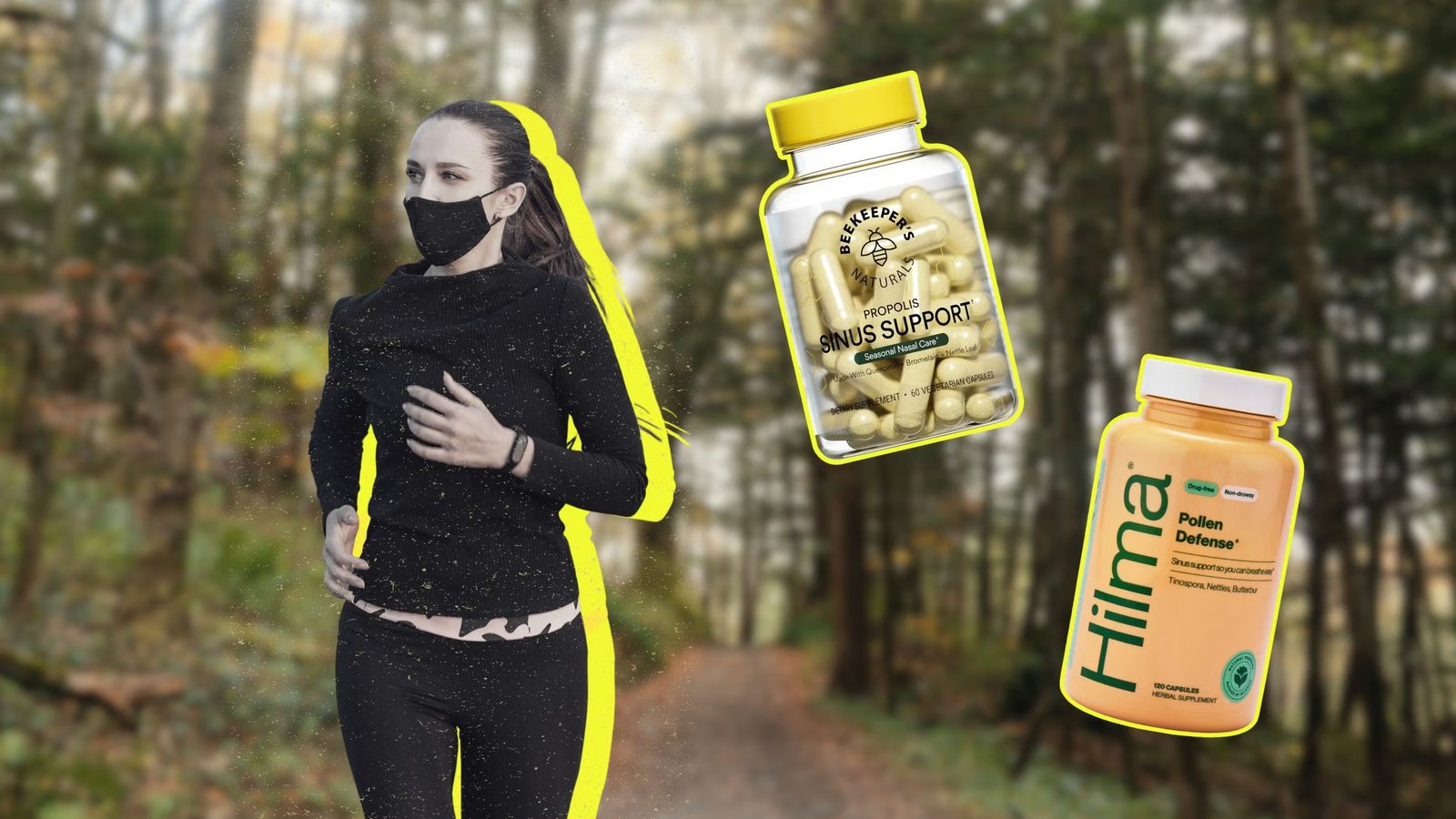
- Week 2: Hilma Pollen Defense
- Week 3: Beekeeper’s Naturals Sinus Support
- Week 4: Pure Encapsulations Aller-Essentials
I rated each supplement on a scale of one to four for effectiveness, with one being not very effective and four being very effective, meaning I had little or no symptoms. I continued to take my daily nasal allergy spray, Flonase, during testing.
1. Erha Herbal Rx for Allergies
Erha’s Herbal Rx for Allergies is a functional beverage that’s designed to support the body’s response to allergens. It contains acerola (a cherry-like fruit that’s high in vitamin C) and vitamin C for immune system support. It also includes quercetin, a flavonoid found in vegetables and fruits, which has anti-inflammatory and antioxidant properties. Erha also includes nettle, another antioxidant-rich plant.
According to its website, Erha recommends sipping this drink daily to “support immune health and provide comfort from mild congestion.”
The drink comes in a small 8.4-ounce can and can be consumed chilled or heated. I had mine chilled in the morning and found that it tasted like watered-down apple juice with a very subtle note of ginger. It’s not bad, just different. But it goes down easily.
The Verdict: I Had Mixed Results
Pollen counts in my area were very high on the first day of my testing week, and I still had my usual allergy symptoms. Over the next few days, I found that the drink seemed to be mostly effective at easing my allergy symptoms, although the watery eyes stuck around. When more high-pollen days hit, the effectiveness seemed to drop.
By the final day of testing, day seven, I had no allergy symptoms despite moderate pollen levels. Overall, I felt good or close to it for four out of seven days on this supplement.
2. Hilma Pollen Defense
Hilma bills its Pollen Defense supplement as “sinus support” to help you breathe easily. It relies on four ingredients: nettle, tinospora, and butterbur, two plants that are linked to allergy relief, and spirulina, a type of algae that’s rich in protein.
This supplement is taken as two pills a day. Those pills have a distinct hay-like scent and aren’t small, like an inch long, making them a poor fit for someone who has trouble swallowing pills or is sensitive to smells. The cap is not childproof, which, as a mom of four young kids, I didn’t love.
The Verdict: Symptom Relief Starts Slow But Lasts
Pollen counts in my area mostly hovered around the medium range during testing in the second week, and I didn’t notice a change in my symptoms on the first day of taking Hilma Pollen Defense. But by day four of taking these supplements, I had no symptoms—not even on a high-pollen day. That continued until I stopped taking them at the end of the week.
Overall, I felt great taking these pills for four out of seven days, with a clear trajectory of feeling better as more time went on.
3. Beekeeper’s Naturals Sinus Support
Beekeeper’s Naturals says its Sinus Support “supports healthy histamine levels, promotes reduced sinus irritation, and provides immune support.” These pills feature ingredients like propolis, an antioxidant-rich glue-like substance that bees make to protect their hives, quercetin, nettle, and bromelain (an enzyme found in pineapples that purportedly reduces congestion and coughing).
The Verdict: It Lessens Symptom Severity But Doesn’t Get Rid of Them
Like Hilma’s Pollen Defense, these are big pills, and you need to take two of them. Swallowing both felt like a challenge on some days, but I still managed to get them down. During testing, I had the same notes every day: a slightly stuffy nose and watery eyes. This was better than my baseline and remained consistent throughout the time I took the supplement. While I never felt symptom-free, I did find that I felt good seven out of seven days I took Sinus Support.
4. Pure Encapsulations Aller-Essentials
Pure Encapsulations Aller-Essentials supplement is designed to “support healthy immune response to environmental factors,” according to its website, and “promotes normal nasal function.” Aller-Essentials contains vitamin C, tinospora, dried yeast, quercetin, hesperidin methyl chalcone (a form of a flavonoid found in citrus fruits), and apple extract.
The Verdict: Effective and My Overall Favorite
This supplement comes in pill form, with users encouraged to take two capsules once or twice daily. Like the other capsule supplements, these pills are large. I noticed that I had reflux each day after taking the supplement, although it got better over time and seemed to go away by day four.
Despite that, I felt good on the allergy front all seven days that I took this supplement, rating the last six days as “very effective” for allergy symptom relief.
Do Allergy Supplements Actually Work?
This is an admittedly tricky question to answer. Even as someone who took these supplements, it’s hard to know for sure if it was the supplements, milder pollen days, or the placebo effects that eased my symptoms. However, I felt good while taking all of these supplements, which was an improvement over my usual state.
Allergists Are a Bit Skeptical of Their Efficacy
Allergists and toxicologists also have mixed thoughts on using supplements to relieve allergy symptoms. “In practice, I typically do not object to patients adding on a low-risk supplement onto standard care, provided the product is from a reputable manufacturer, is clearly labeled, and the patient understands that ‘natural’ is not synonymous with ‘proven,’” says Dr. Alan D. Workman, a sinus surgeon and assistant professor at Harvard Medical School.
Dr. Tiffany Owens, an allergist and immunologist at The Ohio State University Wexner Medical Center, also says she’s open to talking about supplements with her patients. “Unfortunately, ‘supplement’ is a general descriptor of many things and there may not be clear evidence on which to base decisions about supplements,” she says.
But data on many of the ingredients in these supplements isn’t strong, points out Jamie Alan, an associate professor of pharmacology and toxicology at Michigan State University. “There is no convincing clinical data for any of these supplements listed when used as an allergy supplement,” she says. “There is preclinical data on some of these. However, that is not enough for me to recommend these over conventional allergy treatments like antihistamines and corticosteroid nasal sprays.”
Workman agrees. “Butterbur and spirulina each have a small randomized trial that shows symptom relief, but these small trials are often not replicated,” he says.
Allergy Supplements Could React Poorly with OTC Allergy Meds
There’s also a potential risk of interactions with OTC and prescription medications you may be taking, says Dr. Kelly Johnson-Arbor, a toxicologist at MedStar Health, a not-for-profit healthcare system.
For instance, Workman says that quercetin and bromelain may interact with medications like blood thinners, so it’s important to speak with your doctor before taking a supplement.
I’m All for Taking a Supplement Ahead of Outdoor Runs
While I can’t avoid the pollen dusting the trails I run on, I’ve found that I can breathe a little easier when I’m taking an allergy supplement in addition to my nasal spray. I regularly came home less sniffly and with less watery eyes when I took a supplement compared to when I didn’t.
Want more Outside health stories? Sign up for the Bodywork newsletter.
