

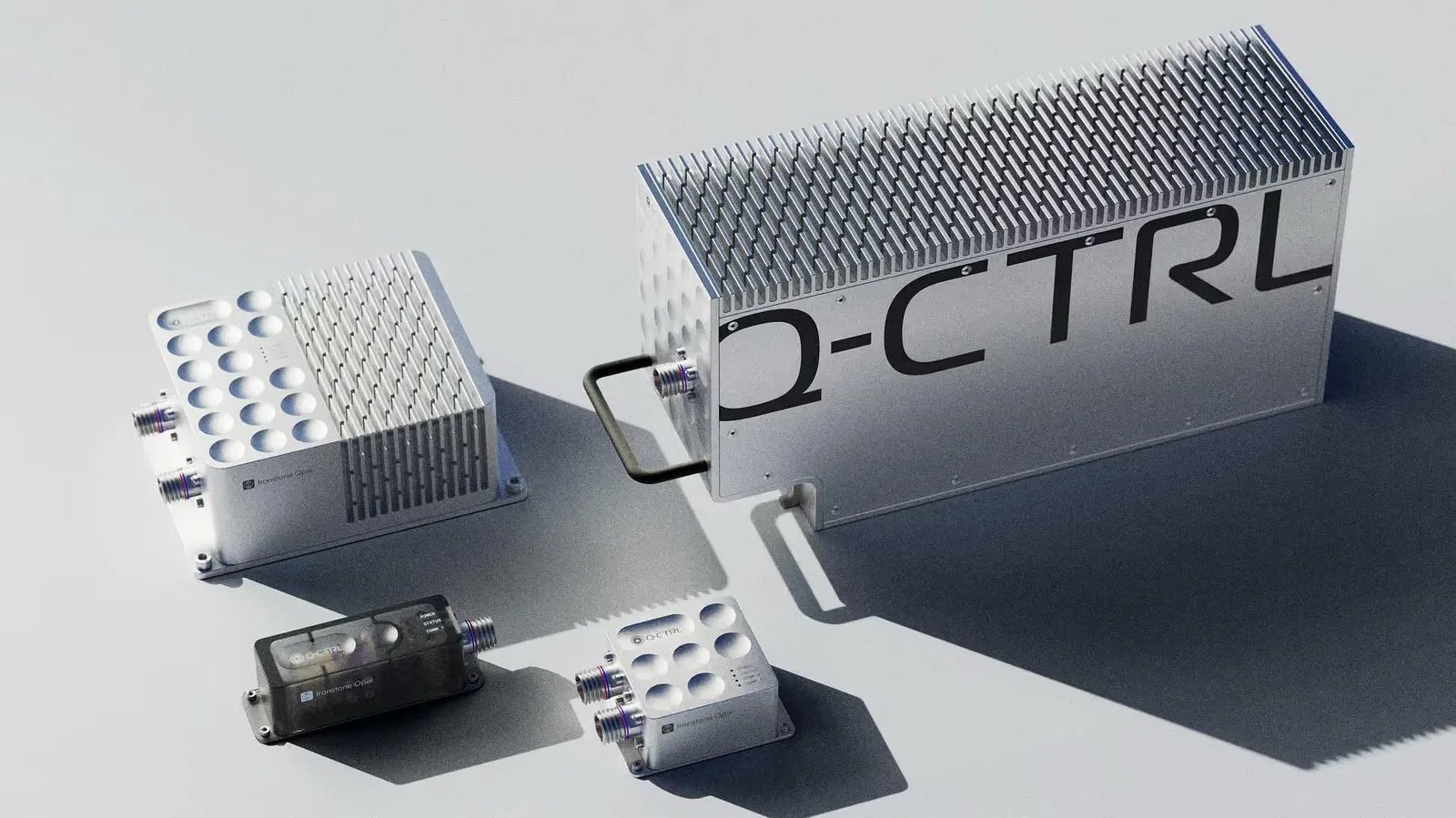
Quantum navigation is increasingly an important technology for airplanes, ships, and military applications.
Q-CTRL
$300 of hardware, a laptop running freely available open source software, and a little bit of know-how is all you need to hack GPS in a city or region. That’s why GPS is increasingly unreliable in conflict zones around the world, and why the world’s militaries, airlines, and shipping companies are looking for alternatives.
Enter quantum navigation.
Most of the time when we think of quantum, we think of movie silliness (descending to the “”quantum realm” with AntMan) or quantum computing, an unimaginably complex way of generating many answers from a single question.
But there’s also quantum navigation. Which, in a very short period of time has gone from science fiction to science fact.
“Roughly 14 months ago, none of this technology existed,” Michael Biercuk, founder and CEO of Q-CTRL, told me on the TechFirst podcast. “It had not been validated; it had not been tested yet.”
Today it’s shipping.
Q-CTRL is an Australian quantum startup that has just landed its first customers for quantum navigation systems about the size of a loaf of bread. The company hasn’t released the names of those customers, but AirBus is a public partner of the company, and national defense agencies have a vested interest in accurate navigation in conflict zones.
Competitors like SandboxAQ and SBQuantum are also busy. Recently the U.S. Defense Innovation Unit expanded its Transition of Quantum Sensing program to integrate SandboxAQ’s AQNav for autonomous U.S. military platforms. And SBQuantum’s diamond quantum magnetometer just launched into space on March 29 on a SpaceX rideshare to refresh the global magnetic map that everyone in this space relies on.
Quantum sensors can detect extremely minute variations in earth’s magnetic field as well as tiny gravitational variations that are common from region to region. Since you can map those variations — and resource companies have been for decades in their search for oil, minerals and precious metals — you can then navigate by our planet’s invisible physical features.
“The approach is to leverage quantum sensors as a new set of eyes to see otherwise invisible features of the Earth, and then use those to navigate, just like you navigate using your eyes and a map,” says Q-CTRL CEO Michael Biercuk. “If you go out in the woods and you’re playing orienteering, you can identify a hill, a valley, and a river and say, ‘Oh, here’s where I am on a map.’ We can do very similar things using quantum sensors and things that we cannot see with our eyes, and that allows us to navigate when GPS is not available.”
It’s called DBRN: database reference navigation. There’s no GPS required, no satellites that can be jammed, and no signal to spoof. In addition, unlike visual navigation systems that require stars or landmarks, quantum navigation via DBRN works over water, at night and when it’s cloudy.
Currently, one of the main GPS backups is inertial navigation systems. They’re precision accelerometers that track movement from a known starting point. The problem is drift: the longer you fly — or travel submerged in a submarine — the worse the error gets, and there’s no reset button.
In contrast, quantum navigation doesn’t drift. It continuously repositions against the magnetic map, so error don’t accumulate but stay bounded. In head-to-head real-world testing, Q-CTRL’s system performs 100 times better in positioning accuracy than inertial navigation, the company says, and it meets aviation’s required navigation performance standard of 0.3 nautical miles.
The big problem in quantum systems has long been separating noise from signal, which is why quantum computers have historically been placed very carefully on vibration-free foundations, as the slightest outside interference can disrupt quantum states.
Q-CTRL solves that hardware problem via software.
“Software can be the enabler,” says Biercuk. “As a scientist, a lot of the things you’ll do involve hardware countermeasures. You build a big box around your experiment to exclude acoustic noise or electromagnetic interference—again, great for science, but very heavy, very expensive. You’re certainly not going to put that on a tiny little drone.”
Instead, Q-CTRL’s AI-enabled software helps stabilize their quantum navigation sensors, plus process the data they generate to strip out the noise and isolate the signal.
“It’s that combination of things that has made our systems work extremely well in real-world environments and in very, very small form factors,” Biercuk says.
This is a multi-billion dollar market, he adds.
Analysts project that there will be perhaps two million Class 2 and Class 3 drones manufactured per year by 2030, he told me. These are bigger than your hobbyist drone: big enough that a loaf-sized payload for navigation is possible: Class 2 drones are roughly 25 to 55 pounds, while Class 3 drones are up to 1,320 pounds. And Biercuk hints that much smaller, even more portable systems are coming soon. Plus, Q-CTRL partner Airbus has built 28,000 of the world’s aircraft, and it’s just one of many commercial carriers.
