

Open almost any newspaper, scroll through LinkedIn, or listen to the latest business podcast, and you will encounter a familiar theme: the return of the strong leader. From “wartime CEOs” to hard-charging founders and authoritarian coaching styles in elite sports, and the virtues of “hands on” leaders, there is a growing narrative that command-and-control leadership is not only back, but necessary. The appeal is intuitive. When the world feels volatile and uncertain, decisiveness offers comfort, and centralized authority promises clarity.
But, is this resurgence real, or are we simply observing a handful of highly visible cases amplified by media and investor attention? More importantly, what does the evidence actually tell us about the effectiveness of top-down leadership compared with more participative approaches?
To answer these questions, it is useful to distinguish between perception and reality.
{“blockType”:”mv-promo-block”,”data”:{“imageDesktopUrl”:”https:\/\/images.fastcompany.com\/image\/upload\/f_webp,q_auto,c_fit\/wp-cms-2\/2025\/10\/tcp-photo-syndey-16X9.jpg”,”imageMobileUrl”:”https:\/\/images.fastcompany.com\/image\/upload\/f_webp,q_auto,c_fit\/wp-cms-2\/2025\/10\/tcp-photo-syndey-1×1-2.jpg”,”eyebrow”:””,”headline”:”Get more insights from Tomas Chamorro-Premuzic”,”dek”:”Dr. Tomas Chamorro-Premuzic is the Chief Science Officer at Russell Reynolds, a professor of organizational psychology at UCL and Columbia University, and the co-founder of DeeperSignals. He has authored 15 books and over 250 scientific articles on the psychology of talent, leadership, AI, and entrepreneurship. “,”subhed”:””,”description”:””,”ctaText”:”Learn More”,”ctaUrl”:”https:\/\/drtomas.com\/intro\/”,”theme”:{“bg”:”#2b2d30″,”text”:”#ffffff”,”eyebrow”:”#9aa2aa”,”subhed”:”#ffffff”,”buttonBg”:”#3b3f46″,”buttonHoverBg”:”#3b3f46″,”buttonText”:”#ffffff”},”imageDesktopId”:91424798,”imageMobileId”:91424800,”shareable”:false,”slug”:””,”wpCssClasses”:””}}
Ever present
First, we find that command-and-control leadership never really disappeared. In fact, it has always been present in certain contexts, particularly those characterized by time pressure, high risk, and tightly coupled systems. As former White House Chief of Staff Rahm Emanuel famously put it, one should “never let a good crisis go to waste,” a reminder that disruption often expands both the appetite and the tolerance for more directive leadership. In such environments, centralized authority can offer clear advantages. Why? Because it enables faster decision-making, reduces ambiguity, and clarifies accountability. In crises, when coordination matters more than deliberation, these qualities can be valuable.
There is also a psychological explanation for its appeal. Freud famously argued that groups have a natural tendency to idealize strong leaders, projecting onto them a sense of certainty, protection, and authority that reduces individual anxiety. In line, humans in groups regress psychologically and transfer their ego ideal onto a leader, whom they then idealize and obey. The key mechanism is identification with the leader and a reduced tolerance for ambiguity, which helps explain the attraction to strong, authoritative figures. The result is a recurring attraction to “alpha” leadership, not necessarily because it is more effective, but because it feels more reassuring.
Although most of Freud’s observations were the product of his own clinical intuition and creative imagination, they were often backed up by subsequent empirical science. Indeed, decades of behavioral research show that uncertainty increases our preference for, well, certainty. In other words, the more ambivalent or ambiguous things are, the more we crave clarity and closure. This is where romanticizing about strong leaders makes sense; they will (appear to) fill in that certainty gap by providing confident, simple, clear-cut, compelling explanations or interpretations of reality (brushing aside uncomfortable ambiguities) also matching them with a proneness to action and bold decision making. In this sense, command-and-control leadership often provides not just direction, but emotional reassurance. And in a complex and ambiguous world in which it is even difficult to judge leadership performance or the contribution individual leaders actually make to success, we are often prone to over-attribute success to these charismatic individuals and under-appreciate the collective systems that underpin performance.
However, stories are not the same as evidence. And when we move beyond anecdotes to large-scale empirical research, a different picture emerges.
Seeking diverse perspectives
Indeed, recent meta-analyses evidence suggests that authoritarian leadership tends to erode work climate, suppress initiative and innovation, and increase employees’ intention to leave, with any performance gains largely confined to specific, short-term, high-pressure situations. As one of us (Amy) has. extensively documented, cultures that discourage dissent and concentrate decision-making power tend to suppress information, limit experimentation, and increase the risk of strategic error. By contrast, environments characterized by psychological safety, leader humility, and distributed input are more likely to foster innovation, adaptability, and sustained performance.
One important nuance is often overlooked in these debates: the difference between who makes the decision and who contributes to it. Effective leaders do not necessarily decentralize authority, but they do decentralize input. They retain responsibility for final decisions while actively seeking diverse perspectives, data, and dissenting views. This distinction is critical. It allows organizations to benefit from both clarity and inclusiveness, avoiding the false trade-off between speed and participation.
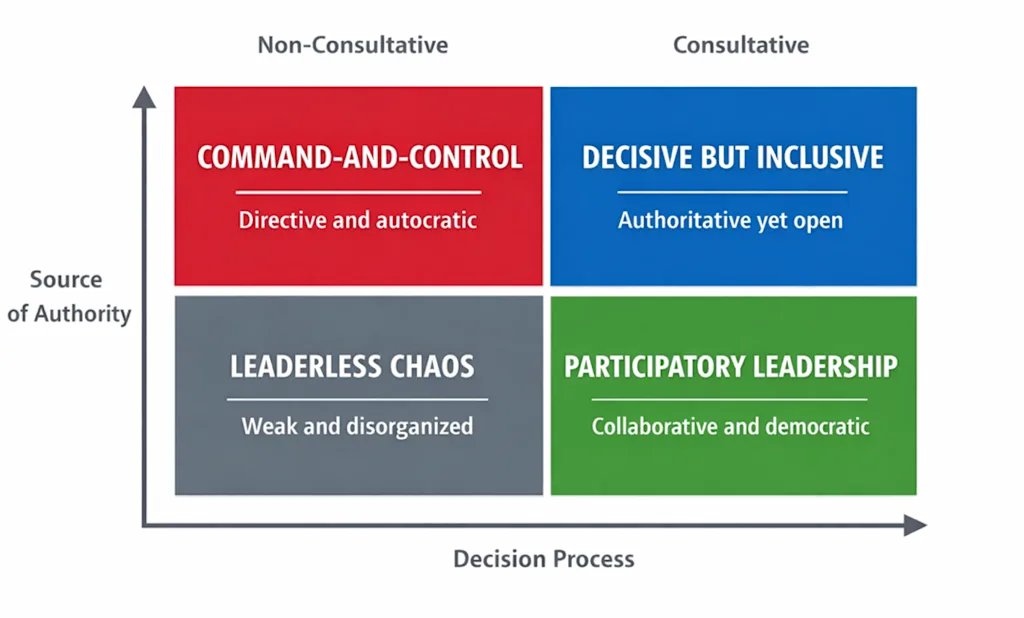
To make sense of the debate around command-and-control leadership, it is helpful to distinguish between two key dimensions: the decision process and ownership (ranging from non-consultative to consultative) and the source of authority and input (ranging from centralized to distributed). As the above 2 x 2 figure illustrates, these dimensions generate four distinct leadership modes:
In the top-left quadrant, where authority is centralized and the decision process is non-consultative, we find command-and-control leadership. This style is directive and autocratic, relying on unilateral decision-making with minimal input from others. It can deliver speed and clarity, particularly in crises, but it also risks suppressing dissent, overlooking critical information, and amplifying leader bias. The result, in the face of uncertainty and complexity, is too often failure.
In the top-right quadrant, where authority remains centralized but the decision process is consultative, we see decisive but inclusive leadership. This approach is authoritative yet open. Leaders retain control over final decisions while actively seeking input, expertise, and dissenting views. This model tends to produce higher-quality decisions in complex environments, as it combines accountability with access to broader intelligence. Although it may appear to be time-consuming, in reality it can be carried out efficiently and effectively.
In the bottom-left quadrant, where authority is distributed but the decision process remains non-consultative, we encounter leaderless chaos. This mode is weak and disorganized, characterized by unclear accountability and insufficient coordination. Decision-making is fragmented, and the absence of both strong leadership and meaningful consultation often leads to inconsistency and poor outcomes.
Finally, in the bottom-right quadrant, where authority is distributed and the decision process is consultative, we find participatory leadership. This style is collaborative and democratic, with shared decision-making and broad involvement. It can be highly effective in knowledge-intensive settings with skilled teams, though it may slow decisions and create coordination challenges if not carefully managed.
Balance is key
The key insight is that leadership effectiveness does not hinge on choosing one quadrant over another, but on understanding when each mode is appropriate (though, admittedly, this rarely applies to leaderless chaos, a state which by definition trends towards its own extinction). In practice, the most effective leaders gravitate toward being decisive and inclusive, combining clear authority with openness to input, while avoiding the pitfalls of both rigid command-and-control and unstructured participation.
In short, the limitations of command-and-control leadership become especially pronounced in complex, knowledge-intensive environments. No individual, regardless of experience or intelligence, possesses all the expertise or information required to navigate today’s challenges. Overconfidence at the top can therefore become a liability, leading to simplified thinking, blind spots, and costly mistakes. Concentrated power may deliver short-term alignment, but it often undermines long-term resilience.
The evidence instead points to a more balanced model of leadership. The most effective leaders combine direction with openness, authority with accountability, and decisiveness with learning. They create systems that encourage input without sacrificing clarity, and they recognize that their role is not to have all the answers, but to ensure that the right questions are asked.
As we have argued, this is particularly relevant in an era increasingly shaped by AI and data. As information becomes more abundant and accessible, leadership advantage shifts away from issuing directives toward designing systems that harness collective intelligence. The challenge is no longer to control information flows, but to integrate them effectively.
In that sense, the enduring lesson from decades of research is not that command-and-control leadership is obsolete, but that it is highly contextual and often overvalued. It may work in narrowly specific situations, especially in the short term, but it is rarely a reliable foundation for sustained performance. More broadly, leadership trends tend to oscillate. After years of emphasizing servant, humble, and coaching-oriented leadership, it is perhaps unsurprising that the pendulum swings back toward more directive styles. The real skill, however, is not to move from one extreme to another, but to remain versatile and flexibly moderate, which ought to include the ability to not “just be themselves”, calibrating one’s approach to the context. Effective leaders, in that sense, do not default to a single style; they adapt, drawing selectively from different modes to balance control and inclusion as circumstances require.
Whatever style or model leaders employ, though, it will always be easier for them to get things done and have a positive long-lasting impact if they are capable of bringing people along, motivating them to change their beliefs, and inspire rather than force them to action. As the brilliant political scientist Richard Neustadt observed, effective leadership in complex systems relies less on formal authority and more on influence. It requires persuasion rather than command, curiosity rather than certainty, and a disciplined focus on long-term consequences rather than short-term control. The real question, then, is not whether command-and-control leadership is back, but why we are so often tempted to believe that it works better than it does.
{“blockType”:”mv-promo-block”,”data”:{“imageDesktopUrl”:”https:\/\/images.fastcompany.com\/image\/upload\/f_webp,q_auto,c_fit\/wp-cms-2\/2025\/10\/tcp-photo-syndey-16X9.jpg”,”imageMobileUrl”:”https:\/\/images.fastcompany.com\/image\/upload\/f_webp,q_auto,c_fit\/wp-cms-2\/2025\/10\/tcp-photo-syndey-1×1-2.jpg”,”eyebrow”:””,”headline”:”Get more insights from Tomas Chamorro-Premuzic”,”dek”:”Dr. Tomas Chamorro-Premuzic is the Chief Science Officer at Russell Reynolds, a professor of organizational psychology at UCL and Columbia University, and the co-founder of DeeperSignals. He has authored 15 books and over 250 scientific articles on the psychology of talent, leadership, AI, and entrepreneurship. “,”subhed”:””,”description”:””,”ctaText”:”Learn More”,”ctaUrl”:”https:\/\/drtomas.com\/intro\/”,”theme”:{“bg”:”#2b2d30″,”text”:”#ffffff”,”eyebrow”:”#9aa2aa”,”subhed”:”#ffffff”,”buttonBg”:”#3b3f46″,”buttonHoverBg”:”#3b3f46″,”buttonText”:”#ffffff”},”imageDesktopId”:91424798,”imageMobileId”:91424800,”shareable”:false,”slug”:””,”wpCssClasses”:””}}
Source link
