

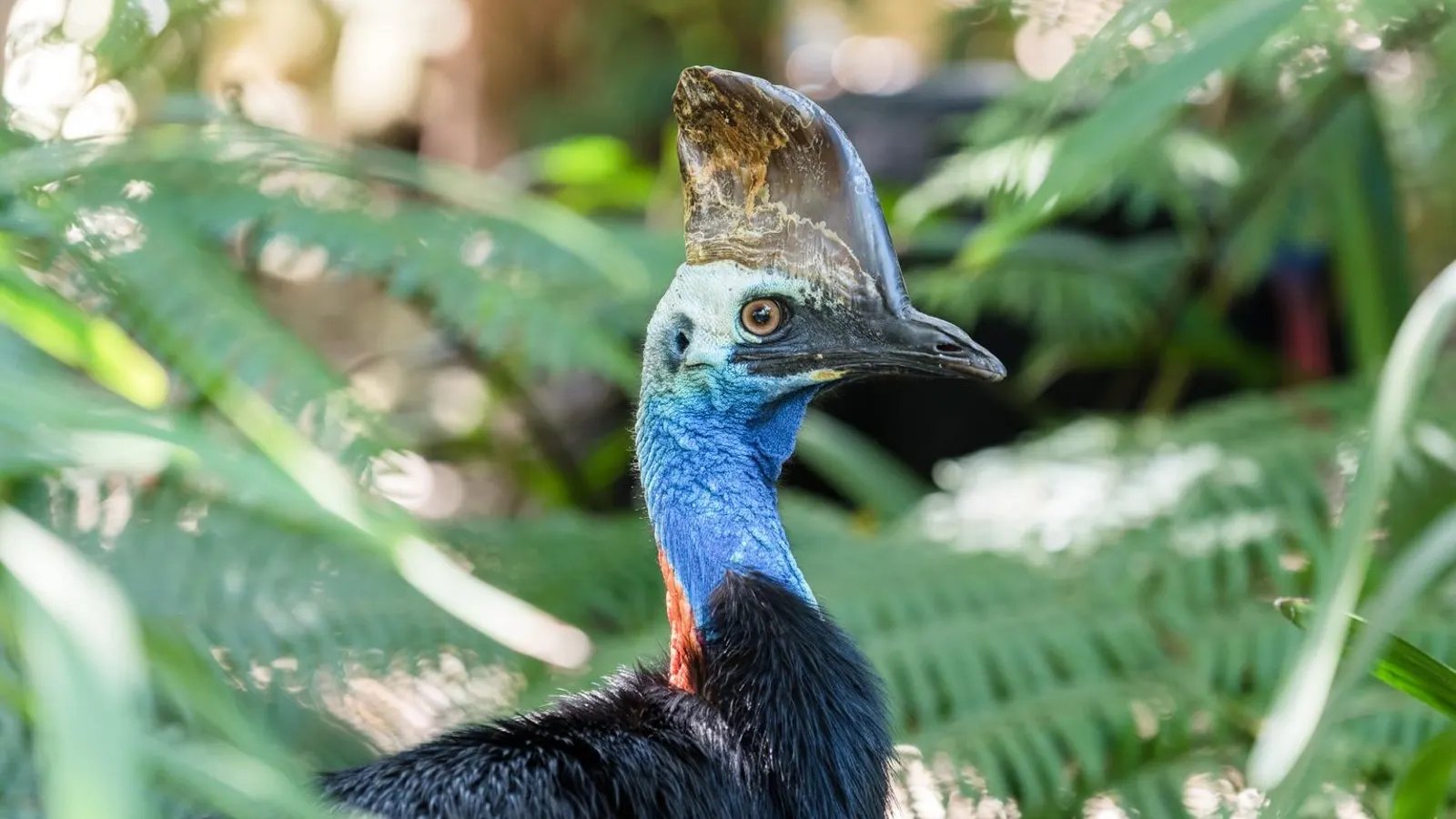
With dagger-like claws and explosive kicks, the cassowary has earned a reputation as the world’s most dangerous bird. But is it deserved?
getty
Most birds inspire either affection or indifference. We scatter seed for them in our gardens, admire them through binoculars or, occasionally, curse at them for stealing our lunch at the beach. Very few birds inspire the kind of caution that’s typically reserved for large predators. But the cassowary does.
Native to the tropical rainforests of New Guinea and northeastern Australia, the southern cassowary (Casuarius casuarius) holds the title of world’s most dangerous bird. It sounds comical considering that, after all, it’s only a flightless bird that spends most of its day wandering through dense forests in search of fallen figs and other ripe fruits.
But it stops sounding comical as soon as you notice its toes that end in daggers — known to cause deep puncture wounds and extensive lacerations. In New Guinea, there are documented accounts of cassowaries disemboweling New Guinea singing dogs. In Australia, a cassowary was responsible for the first known human death caused by a wild bird in modern times, and has since led to more.
Yet despite its reputation, this isn’t a bloodthirsty murder-bird that lurks in the rainforests waiting for its next victim. Its extraordinary anatomy and behavior only evolved in response to the unique challenges of life on the forest floor.
The Cassowary Is Built Like A Feathered Dinosaur
Standing up to 6 feet tall (1.8 meters) and weighing more than 165 pounds (75 kilograms), the southern cassowary is among the heaviest birds on Earth. Its body is supported by exceptionally powerful legs, which serve as both its primary means for movement and defense.
One of its most distinctive features is the casque: a tall, helmet-like structure that sits atop its head, composed of keratin covering a foam-like core. Scientists have proposed several functions for this unusual structure, including helping cassowaries navigate dense vegetation, serving as a visual signal to other cassowaries or even amplifying low-frequency sounds. Whatever its precise purpose, the casque contributes to the bird’s unmistakably prehistoric appearance.
Its most famous anatomical feature, however, is found much lower down. In a 2014 study published in the Journal of Veterinary Anatomy, researchers described the unique anatomy of the cassowary’s foot. Each carries three toes, the innermost of which bears a dagger-like claw that can exceed 10 centimeters (4 inches) in length. Combined with powerful legs capable of delivering explosive kicks, that claw has earned the cassowary a fearsome reputation.
The cassowaries are ratites in the genus Casuarius and are native to the tropical forests of New Guinea, Nearby Islands, Northeastern Australia and Papua Indonesia. Cassowaries are very shy, but when provoked they are capable of inflicting injuries to dogs and people, although fatalities are extremely rare.
getty
When threatened, cassowaries are known to leap upward and forward, striking with both feet. The force generated by such a large, muscular bird moving at speed is what transforms those claws into formidable weapons. A well-placed kick can puncture vital organs, sever blood vessels or inflict devastating wounds to the neck, chest or abdomen.
It’s difficult to look at a cassowary’s feet and not be reminded that birds are, in fact, the living descendants of dinosaurs.
Why Did Evolution Make The Cassowary So Aggressive?
The answer begins with a simple ecological fact: cassowaries cannot fly. For most birds, flight provides an elegant solution to danger. If threatened, they can simply take to the air. Cassowaries abandoned that option millions of years ago. So instead, they became giants.
Seminal research published in Biotropica highlighted the crucial ecological role cassowaries play within rainforest ecosystems. They are among the world’s most important seed dispersers, consuming large fruits and transporting seeds across vast distances through dense tropical forests. Some plant species rely heavily on cassowaries to move their seeds far enough from parent trees to successfully establish new populations.
This lifestyle places cassowaries in a unique position. They spend their lives on the forest floor doing the ecological groundwork that helps to maintain the structure and diversity of rainforest communities. But unlike smaller birds, they can’t quickly escape predators or competitors by flying away. For this reason, natural selection had to favor a different strategy: become difficult to attack.
Large body size, powerful legs and formidable claws all provide advantages in a rainforest environment where encounters with predators, rivals and territorial disputes can have serious consequences. These traits may also be particularly important for the bird to protect its offspring. Male cassowaries incubate the eggs and raise the chicks alone, while the female leaves to find another mate and start the process over again. Males must invest months of effort into parental care.
From an evolutionary perspective, a parent capable of aggressively defending its young has a significant advantage.
Is The Cassowary Really As Dangerous As People Think?
The bird’s reputation has been shaped by a mixture of genuine incidents and a tendency for humans to underestimate large wild animals.
Perhaps the most famous cassowary attack occurred in 1926 in Queensland, Australia. Sixteen-year-old Phillip McClean and his brother were reportedly attempting to kill a cassowary when the encounter turned deadly. As McClean fell to the ground, the bird kicked him in the neck. The wound severed a major blood vessel, and he later died from his injuries.
This was the first ever documented human fatality directly attributed to a bird, earning it the Guinness World Record for the world’s deadliest bird. But it was not the last: the most recent case, as GWR notes, was in April of 2019, when a man in Florida fell in his cassowary enclosure and was kicked. He also later died from his injuries.
Stories from New Guinea have also contributed to the bird’s fearsome image. Local observers have reported cassowaries disemboweling New Guinea singing dogs during confrontations. Given the bird’s anatomy, such injuries are entirely plausible.
However, the best available scientific evidence suggests that cassowaries actually aren’t naturally inclined to attack people. A comprehensive 2001 study published in the Journal of Zoology analyzed 221 reported cassowary attacks. Of these, 150 involved humans. Remarkably, approximately 75% of those incidents involved cassowaries that people had previously fed.
As such, the researchers hypothesized that most attacks occurred because birds were expecting food, attempting to obtain food or defending food resources. Chasing and charging were the most common behaviors, which accounted for 71% of incidents. Kicking occurred in only 15%.
The study also challenged several common myths. Jogging, for example, did not appear to provoke attacks, despite the popularity of this notion throughout Australia. Instead, the strongest predictor of aggression was habituation to humans through feeding. Once cassowaries learn to associate people with food, they tend to become bolder and more demanding.
Seven attacks resulted in serious injuries, including puncture wounds, lacerations and broken bones. The sole fatality examined in the study (i.e., the case of Phillip McClean) occurred during an attempt to kill the bird. And most notably, several of the most seriously injured victims were already crouching or lying on the ground when they were attacked, within striking range of the bird’s feet — which was also the case for the Florida man in 2019.
But broadly speaking, although cassowaries are capable of causing severe injuries, they’re not roaming the rainforest actively searching for humans to kick and kill. In fact, the threat runs overwhelmingly in the opposite direction.
Road collisions are among the leading causes of cassowary deaths in Australia. Habitat fragmentation, vehicle strikes, dog attacks and human development continue to place significant pressure on cassowary populations. Every year, far more cassowaries are killed by humans than humans are harmed by cassowaries.
That reality makes the bird’s fearsome reputation feel somewhat ironic. The world’s most dangerous bird is, in many ways, far more vulnerable to us than we are to it. Its dinosaurian silhouette is largely a facade: this bird is an ancient rainforest gardener, not a villain. It’s equipped with an extraordinary defense system, and it has every reason to use it when cornered.
The cassowary is only one of nature’s many avian oddities. Discover how much you really know with my fun Bird IQ Test and see how you compare to others.
